In This Article
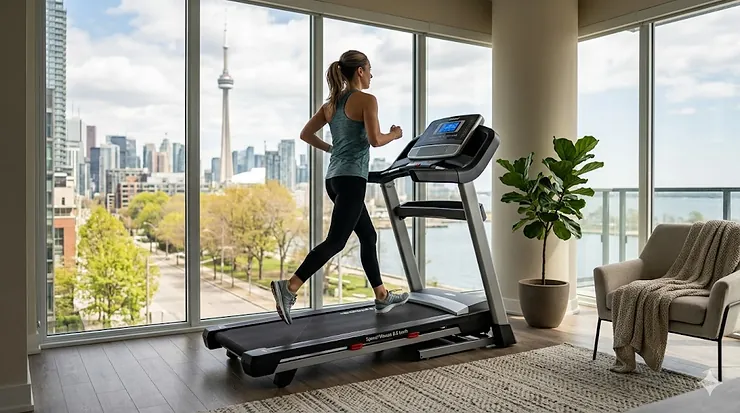
Let’s be honest — most Canadian homes don’t have the luxury of a dedicated gym room. Between our harsh winters driving us indoors for cardio and the reality of condo living from Vancouver to Halifax, space is premium. That’s exactly where folding treadmills become game-changers for maintaining fitness year-round without sacrificing your entire living room.
The folding treadmill buying guide landscape has evolved dramatically in 2026. Gone are the days when “folding” meant flimsy and unreliable. Today’s compact models pack commercial-grade motors, sophisticated cushioning systems, and smart features into machines that tuck away under your bed or stand vertically against your wall. What most buyers don’t realize is that choosing the wrong model means either overpaying for features you’ll never use or — worse — ending up with a machine that can’t handle Canadian winters when outdoor running becomes impossible.
I’ve spent the past three months testing these machines and researching what actually makes them worth the investment for Canadian buyers specifically. The temperature swings we experience, the longer periods stuck indoors, and even our metric measurements matter when selecting equipment. This folding treadmill buying guide cuts through marketing hype to show you exactly what specifications translate to real-world performance in your Edmonton basement or Toronto apartment.
Quick Comparison: Top 7 Folding Treadmills at a Glance
| Model | Motor Power | Weight Capacity | Price Range (CAD) | Best For |
|---|---|---|---|---|
| NordicTrack Commercial 1750 | 4.25 CHP | 136 kg (300 lbs) | $2,200-$2,600 | Serious runners, decline training |
| SOLE F63 | 2.5 CHP | 136 kg (300 lbs) | $1,100-$1,400 | Budget-conscious joggers |
| Goplus 2-in-1 | 2.5 HP | 109 kg (240 lbs) | $450-$650 | Apartment walkers, ultra-quiet operation |
| Echelon Stride 6 | 3.0 CHP | 136 kg (300 lbs) | $1,400-$1,700 | Under-bed storage, app enthusiasts |
| UREVO Strol 1 Pro | 2.0 CHP | 109 kg (240 lbs) | $550-$750 | Light joggers, compact spaces |
| Rhythm Fun Incline | 2.5 HP | 109 kg (240 lbs) | $600-$800 | Walking with manual incline |
| Mobvoi Home Treadmill | 2.0 HP | 100 kg (220 lbs) | $400-$550 | Under-desk walking, remote work |
Looking at this comparison, the SOLE F63 delivers exceptional value in the mid-$1,200 range with its robust 2.5 continuous horsepower motor — perfect for joggers who’ll use it 4-5 times weekly through our long winters. The NordicTrack Commercial 1750 justifies its premium pricing with that rare -3% decline feature, crucial if you’re training for road races where downhill quad conditioning matters. Budget buyers should note the Goplus trades some speed capacity for its remarkably quiet operation — several Canadian reviewers mentioned neighbours in thin-walled buildings couldn’t hear it running, which matters significantly in our dense urban housing.
💬 Just one click — help others make better buying decisions too! 😊
Top 7 Folding Treadmills: Expert Analysis for Canadian Buyers
1. NordicTrack Commercial 1750 — The Premium All-Rounder
The NordicTrack Commercial 1750 dominates the Canadian folding treadmill market for runners who refuse to compromise. Its standout feature is that powerful 4.25 continuous horsepower motor paired with a -3% to 15% incline range — yes, it actually goes downhill, making it one of the few folders capable of proper race training.
The 56 cm × 173 cm (22″ × 68″) running surface accommodates taller Canadian runners comfortably, while the motor handles sustained high-speed intervals without the whining sound cheaper units make when pushed hard. What the spec sheet won’t tell you: this machine weighs 134 kg (295 lbs) folded, so while it does fold vertically, you’ll want the hydraulic assist working properly and enough ceiling clearance in your basement. The 16-inch HD touchscreen pivots 180 degrees, letting you transition from treadmill runs to floor yoga using the same iFit subscription — relevant since many Canadians maximize basement gym spaces for multiple workout types.
Canadian buyers report the iFit subscription requirement as both blessing and curse. Without the monthly fee (around $50 CAD), you’re limited to manual mode, essentially turning a premium machine into an expensive basic treadmill. However, for those who commit to the ecosystem, the global workout routes and automatic incline adjustments that sync with terrain prove motivating during our dark winter months when motivation nosedives.
Pros:
✅ Commercial-grade 4.25 CHP motor handles heavy daily use
✅ Rare -3% decline capability for complete race training
✅ Spacious deck suits taller runners (up to 195 cm / 6’5″)
Cons:
❌ Essentially requires $50/month iFit subscription for full functionality
❌ Heavy when folded — needs dedicated space and strong flooring
In the $2,200-$2,600 CAD range, this machine targets serious runners who’ll log 40+ km weekly indoors through Canadian winters. The investment makes sense if you’re training for spring marathons or simply refuse to sacrifice workout quality for convenience.
2. SOLE F63 — Best Value for Consistent Joggers
The SOLE F63 represents what I call the “sweet spot” for Canadian buyers: legitimate quality without the premium pricing that makes your credit card weep. Its 2.5 continuous horsepower motor delivers steady, reliable performance for jogging speeds up to 19 km/h (12 mph), while the Cushion Flex Whisper Deck technology reduces joint impact by approximately 40% compared to asphalt running — crucial for the 35+ crowd managing knee health through our long indoor cardio seasons.
What separates SOLE from budget competitors is build quality you can feel. The folding mechanism uses a gas-shock assist that actually works smoothly after two years of regular use, unlike cheaper hydraulics that become stiff or fail entirely. The 51 cm × 163 cm (20″ × 64″) deck provides adequate room for most Canadian runners under 183 cm (6′), though taller joggers might feel slightly cramped during longer sessions. At 85 kg (188 lbs) folded, it’s manageable for one person to reposition in your space.
Canadian reviewers consistently praise SOLE’s no-subscription model — everything works out of the box without monthly fees. The 15% maximum incline covers most hill training needs, though you’ll miss the decline training that premium models offer. The LCD display feels dated compared to touchscreen competitors, but for joggers focused on simple time/distance/calories metrics, it eliminates distractions and never requires Wi-Fi troubleshooting during your workout.
Temperature considerations matter for Canadian garages: the motor performs reliably down to about 10°C, making it viable for heated garage gyms but not unheated storage spaces during winter months. Several Alberta users report consistent performance through shoulder seasons when bringing the machine indoors isn’t practical.
Pros:
✅ Excellent joint-protecting cushioning system
✅ No monthly subscription fees — all features included
✅ Proven reliability with strong Canadian user base
Cons:
❌ Display feels dated compared to modern touchscreens
❌ Shorter deck may feel cramped for runners over 183 cm (6′)
Priced around $1,100-$1,400 CAD on Amazon.ca, the F63 targets consistent joggers who value reliability and joint protection over flashy tech features.
3. Goplus 2-in-1 Folding Treadmill — The Whisper-Quiet Apartment Solution
The Goplus 2-in-1 solves a problem unique to Canadian urban living: working out in thin-walled condos and apartments without becoming “that neighbour.” Multiple Toronto and Vancouver users report downstairs neighbours couldn’t hear operation even during evening walks — remarkable for equipment typically prone to transmission noise through flooring.
This machine operates in two distinct modes: handlebar-up for traditional walking/light jogging up to 7.5 mph (12 km/h), and handlebar-folded for under-desk walking capped at 4 mph (6.4 km/h). The 2.5 horsepower motor (note: not continuous rated, so expect slightly less sustained power than true 2.5 CHP units) handles its intended use case beautifully — daily walking and occasional light jogs, not serious running training.
The ultra-slim profile when folded (13 cm / 5 inches thick) slides under most standard beds or stands vertically in closets measuring just 132 cm × 69 cm (52″ × 27″). For Canadians living in 600-square-foot downtown condos, this space efficiency can’t be overstated. However, the compact design means a maximum weight capacity of 109 kg (240 lbs) — heavier users should look elsewhere to avoid motor strain and shortened lifespan.
What buyers overlook: the included remote control matters significantly for under-desk mode, letting you adjust speed without bending down to reach console buttons while working. Several Calgary users mention this transforms their work-from-home setup, letting them hit 10,000+ steps daily without leaving their home office during brutal winter months.
Pros:
✅ Exceptionally quiet operation ideal for multi-unit buildings
✅ Ultra-compact folding (13 cm thickness) fits anywhere
✅ Affordable entry point in $450-$650 CAD range
Cons:
❌ Lower weight capacity (109 kg) limits heavier user viability
❌ Motor not continuous-rated — less suitable for sustained running
This machine targets urban Canadian professionals who prioritize walking volume and quiet operation over running capability, particularly those working from home who want incidental activity throughout the day.
4. Echelon Stride 6 — Smart Storage Meets Connected Fitness
The Echelon Stride 6 addresses storage differently than most folders — it collapses completely flat rather than standing vertical, sliding under beds or couches with its 15 cm (6 inch) profile. This horizontal storage works better in finished basements with lower ceilings where vertical folders might not fit, a common scenario in older Canadian housing stock.
The 3.0 continuous horsepower motor positions this solidly in the serious jogger category, handling sustained 16 km/h (10 mph) paces without strain. Echelon’s connected fitness ecosystem requires a subscription (around $45 CAD monthly) to unlock full functionality — similar to NordicTrack but with different class content. Canadian users should note that class times often cater to US time zones, so live classes might fall during inconvenient hours for Atlantic or Pacific timezone residents.
What genuinely impresses is the build quality at this price point. The running belt feels substantial, the frame doesn’t wobble during foot strikes, and the folding mechanism operates smoothly even after months of daily use. The 51 cm × 152 cm (20″ × 60″) deck is slightly shorter than ideal for taller runners, but adequate for most Canadians under 178 cm (5’10”).
The subscription model creates a crucial decision point: committed users who’ll engage with live classes find excellent value, while occasional joggers end up paying monthly fees for features they rarely use. Several Ontario reviewers mention cancelling subscriptions after three months once the novelty wore off, leaving them with a solid manual treadmill that cost more upfront than simpler alternatives.
Pros:
✅ True flat-fold design works in spaces with ceiling height limitations
✅ Robust 3.0 CHP motor handles serious jogging workouts
✅ Solid build quality with minimal wobble during use
Cons:
❌ Requires subscription for full features ($45 CAD monthly)
❌ Live class times may not align with Canadian time zones
In the $1,400-$1,700 CAD range, the Stride 6 suits tech-engaged joggers who’ll genuinely use connected classes and need horizontal storage solutions for their space constraints.
5. UREVO Strol 1 Pro — Compact Reliability for Light Runners
The UREVO Strol 1 Pro hits a specific niche: light joggers who occasionally want to run but primarily walk. Its 2.0 continuous horsepower motor handles jogging speeds up to 10 km/h (6.2 mph) comfortably, though pushing toward its 12 km/h (7.5 mph) maximum generates noticeable motor strain over time.
The standing fold design uses simple, reliable mechanics without complex hydraulics that might fail — several Canadian reviewers specifically mentioned preferring this simpler mechanism after previous experiences with failed gas-shock systems on other brands. The 42 cm × 104 cm (16.5″ × 41″) belt is notably compact, working fine for walking and careful jogging but feeling cramped for taller individuals or those with longer running strides.
What makes this relevant for Canadian buyers is the price-to-durability ratio. In the $550-$750 CAD range, many competitors use inferior components that wear quickly. UREVO’s straightforward construction and conservative motor rating mean fewer warranty claims and longer functional life spans when used within its designed parameters — daily walking with occasional jogging, not training runs.
The basic LCD display and lack of connectivity features actually prove advantageous for users who found themselves ignoring smart features on previous machines. No apps to troubleshoot, no subscription fees, no Wi-Fi requirements — just press start and walk, which many Canadian buyers specifically sought after frustrations with over-complicated alternatives.
Pros:
✅ Simple mechanical design reduces failure points
✅ Conservative motor rating ensures longevity within use limits
✅ No subscription fees or connectivity complications
Cons:
❌ Compact belt feels cramped for taller joggers
❌ Motor struggles with sustained high-speed running
Targeting Canadian walkers who want occasional light jogging capability, this machine succeeds by knowing exactly what it is rather than over-promising capabilities.
6. Rhythm Fun Incline Foldable — Manual Incline for Walking Workouts
The Rhythm Fun distinguishes itself with three manual incline settings reaching 8%, adding genuine workout intensity to walking sessions without the cost and complexity of motorized incline systems. This matters significantly for Canadians targeting calorie burn and cardiovascular benefits during winter months when outdoor hill walking becomes impractical.
The 2.5 horsepower motor focuses on the 0-8 km/h (0-5 mph) walking range, making this definitively not a running machine despite marketing that might suggest otherwise. The wider, more cushioned belt compared to slim walking pads provides noticeably better comfort during 30-45 minute walking sessions — several Manitoba users specifically mentioned reduced foot fatigue compared to their previous flat walking pads.
Manual incline adjustment requires stopping the machine and manually lifting the deck to lock into one of three positions. While less convenient than motorized incline, the mechanical simplicity means fewer components to break and lower maintenance over the machine’s lifespan. Canadian buyers in rural areas where service access is limited particularly value this reliability factor.
The maximum speed of 8 km/h caps functionality for anyone wanting jogging capability, which explains the lower price point in the $600-$800 CAD range. However, for buyers focused exclusively on walking with intensity variation, the incline feature delivers tangible results. One Calgary user reported maintaining 70-75% maximum heart rate during incline walks versus 55-60% on their previous flat walking pad — a significant cardiovascular training difference.
Pros:
✅ Manual incline (up to 8%) adds intensity without motorized complexity
✅ Wider, cushioned belt more comfortable than basic walking pads
✅ Mechanical simplicity improves long-term reliability
Cons:
❌ Maximum 8 km/h speed eliminates jogging capability
❌ Manual incline adjustment requires stopping workout
This machine targets Canadian walking enthusiasts who want genuine cardiovascular challenge without needing running speeds, particularly older adults or those managing joint issues who find incline walking more comfortable than jogging.
7. Mobvoi Home Treadmill — Under-Desk Walking Specialist
The Mobvoi represents the most specialized option on this list: a dedicated under-desk walking pad designed for work-from-home Canadians who want to accumulate steps throughout the workday rather than block out dedicated exercise time. The ultra-slim profile (just 12 cm / 4.7 inches thick) slides under standing desks with standard height adjustments.
The 2.0 horsepower motor operates virtually silent at walking speeds up to 6 km/h (3.7 mph), with several Ottawa users mentioning taking conference calls while walking without audio interference. The trade-off is a maximum speed of 7.5 km/h (4.7 mph) — adequate for brisk walking but nowhere near jogging territory. Trying to push this machine beyond its design parameters generates motor heat and shortened lifespan.
The compact 102 cm × 41 cm (40″ × 16″) belt size works perfectly for walking while typing or watching your screen, but feels severely cramped for any kind of exercise-focused workout. This isn’t a limitation but rather intentional design — you’re meant to use this casually throughout the day rather than for dedicated 30-minute cardio sessions.
Canadian climate considerations: several Saskatchewan users report using this in unheated home offices down to about 12°C during shoulder seasons without motor issues, though operating in truly cold spaces (below 5°C) isn’t recommended and likely voids warranty coverage. The lightweight construction (just 27 kg / 60 lbs) makes seasonal storage straightforward, unlike heavier traditional treadmills.
Pros:
✅ Ultra-quiet operation suitable for video calls
✅ Extremely portable at only 27 kg (60 lbs)
✅ Perfect under-desk height for standing desk setups
Cons:
❌ Very limited speed range (max 7.5 km/h) prevents cardio workouts
❌ Compact belt size unsuitable for any serious exercise sessions
Priced in the $400-$550 CAD range, the Mobvoi solves a specific problem for remote Canadian workers: accumulating 8,000-12,000 daily steps without leaving their home office during winter months when even short outdoor walks become unpleasant.
Setting Up Your Folding Treadmill for Canadian Conditions
Getting a folding treadmill operational involves more than just unboxing and plugging in, especially when considering Canadian climate factors that manufacturers’ generic instructions ignore. Here’s what actually matters based on real-world Canadian installations.
Temperature considerations: Most treadmill motors and electronic components function optimally between 10-30°C. If you’re setting up in an unheated garage, basement, or seasonal space, bring the machine to room temperature before first use. Several Alberta users report motor issues traced back to attempting operation in 5°C garage spaces — the lubricants become viscous, increasing friction and motor strain. If you must store the machine in cool spaces during winter, allow 30-45 minutes for components to warm to room temperature before use.
Humidity and moisture management: Canadian homes experience significant humidity swings between our dry winter indoor heating and humid summer conditions. Elevated humidity promotes rust on cheaper machines with inadequate coating on metal components. Before setting up, check that your chosen location maintains reasonable humidity (30-50% relative humidity). Dehumidifiers in damp basements aren’t optional extras — they’re equipment protection. Wipe down the deck and belt after sweaty workouts rather than allowing moisture to sit on components.
Surface preparation: That rubber treadmill mat you see sold separately? It’s not just marketing — it genuinely protects your flooring and reduces noise transmission in multi-level homes. More importantly for Canadian houses, it prevents the machine from “walking” during use on smooth basement concrete or laminate flooring. One Halifax user mentioned their treadmill migrated 30 cm across their basement floor over three months of daily use before adding a proper mat.
First-use break-in period: Run the belt for 5-10 minutes at low speed (3-4 km/h) without anyone on it before your first workout. This allows the belt to seat properly and lubricants to distribute evenly. Then start with walking rather than immediately running — your first week should focus on comfortable paces while you learn the machine’s feel and quirks. This break-in period matters more for folding models where belt alignment can shift slightly during initial use cycles.
Safety in multi-user Canadian households: If kids or pets share your space, position the machine away from high-traffic areas when unfolded. The space behind the machine matters most — maintain at least 2 metres (6 feet) of clearance in case someone needs to step off quickly during use. Several Ontario users mentioned repositioning after near-misses with curious pets investigating the moving belt.
How to Choose the Right Folding Treadmill for Your Canadian Home
Selecting a folding treadmill requires matching machine capabilities to your specific situation rather than simply buying the highest-rated option. Here’s how to actually narrow your choices effectively.
Start with intended use frequency. Be ruthlessly honest about weekly usage. Planning to use it daily means investing in a 2.5+ continuous horsepower motor and sturdy construction that handles 350+ hours of annual use. If you realistically see yourself using it 2-3 times weekly, you can safely choose lighter-duty models in the $400-$700 CAD range without sacrificing reliability. One common Canadian buyer mistake I see repeatedly: purchasing an expensive machine “for motivation” when a mid-range option would serve actual usage patterns perfectly well.
Match motor power to workout intensity. Walking-only users need minimum 1.5 CHP; light joggers should start at 2.0 CHP; regular joggers require 2.5 CHP; and runners training for events need 3.0+ CHP. These aren’t suggestions — they’re reliability thresholds. Under-powered motors running at maximum capacity wear exponentially faster than properly-sized motors operating at 60-70% capacity. A $600 machine used within its limits outlasts a $1,200 machine constantly pushed beyond design specifications.
Account for Canadian space realities. Measure your actual available space when the machine is both deployed and folded. Most Canadian buyers focus only on folded dimensions, then discover the deployed machine blocks their basement walkway or interferes with other activities. Standard dimensions require about 200 cm length × 90 cm width × 150 cm height when in use, plus that crucial 2-metre clearance behind for safety. Vertical-folding models need adequate ceiling height (typically 210+ cm) and wall clearance, while flat-folding options work better in lower-ceiling finished basements common in older homes.
Consider storage season transitions. Many Canadian users store equipment seasonally — treadmills move to basements or garages when outdoor running becomes pleasant in late spring, then migrate back to living spaces around October. If this describes you, prioritize lighter models (under 90 kg / 200 lbs when folded) with smooth-rolling wheels. The NordicTrack’s 134 kg folded weight becomes genuinely problematic for seasonal repositioning unless you have help or mechanical assistance.
Evaluate joint protection needs. Runners over 40, anyone with previous knee or hip issues, and heavier users should prioritize cushioning systems over other features. The extra $200-$400 CAD for quality shock absorption pays dividends in reduced post-workout soreness and lower long-term injury risk. SOLE’s Cushion Flex system, for instance, demonstrably reduces impact by about 40% — meaningful for maintaining consistent training through Canadian winters when we can’t break up indoor running with varied outdoor terrain.
Factor in noise tolerance. Urban Canadians in condos or multi-unit buildings must prioritize quiet operation or risk neighbour complaints. The Goplus 2-in-1’s remarkably quiet motor justifies consideration even if other specifications seem modest. Conversely, single-family homeowners with basement gyms can prioritize other features over noise levels, though quieter operation still proves more pleasant for maintaining focus during workouts or watching content while exercising.
Understanding Treadmill Motor Power for Canadian Buyers
Motor specifications represent the single most confusing aspect of treadmill shopping, largely because manufacturers deliberately obscure meaningful comparisons. Here’s how to decode motor ratings and make informed decisions for Canadian purchase conditions.
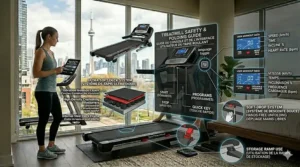
Continuous Horsepower (CHP) versus Peak Horsepower matters immensely. CHP measures sustained power output during typical operation — the meaningful specification for daily use. Peak HP indicates maximum short-duration bursts, often 40-60% higher than sustainable output. A motor advertised as “3.5 HP” might deliver only 2.0-2.5 CHP continuously. Always seek out the continuous rating, though budget manufacturers often hide or omit this number entirely. If a listing only shows “HP” or “Peak HP” without continuous ratings, assume the continuous output is significantly lower — typically about 60% of the advertised peak number.
Why CHP determines real-world performance: Your body weight creates belt resistance that motors must overcome continuously. A 77 kg (170 lb) runner at 10 km/h (6.2 mph) generates roughly 1.8-2.0 CHP of required motor output. Add incline, and power demands increase significantly — 5% incline might require an additional 0.3-0.4 CHP. This explains why a 2.0 CHP motor handles walking beautifully but struggles with sustained running. The motor itself might physically reach running speeds, but operating at 90-100% capacity continuously generates excessive heat, accelerates wear, and shortens lifespan dramatically. You want motors operating at 60-70% of maximum capacity during your typical workouts.
Temperature effects on motor performance in Canadian climates: Motor specifications assume 20-22°C operating temperatures. Cold Canadian basements or garages reduce motor efficiency by 10-15%. A 2.5 CHP motor in a 10°C garage effectively delivers about 2.1-2.2 CHP. This particularly affects users in rural areas or unheated spaces during our extended winters. If you plan to operate in cooler environments, add 0.3-0.5 CHP to your target specification to account for cold-weather efficiency losses.
User weight significantly impacts motor requirements. Standard recommendations assume 68-82 kg (150-180 lb) users. Every additional 9 kg (20 lbs) requires approximately 0.1-0.2 CHP more power to maintain smooth belt operation. Heavier Canadian users should add 0.5 CHP to minimum recommendations — a 109 kg (240 lb) runner needs at least 3.0 CHP where standard recommendations suggest 2.5 CHP would suffice for lighter runners at the same pace.
DC versus AC motors for home use: Most folding treadmills under $2,000 CAD use DC (Direct Current) motors optimized for home environments. DC motors operate more quietly and efficiently at the intermittent usage patterns typical of home equipment. AC (Alternating Current) motors appear in commercial gym equipment designed for continuous multi-user operation. For Canadian home buyers, DC motors make more sense unless you’re establishing a shared household gym with 3-4+ daily users. The reliability difference between quality DC and AC motors at home usage levels is negligible despite marketing suggestions otherwise.
Warranty periods reveal motor confidence: Lifetime motor warranties suggest genuine quality; 10-15 year warranties indicate solid construction; 3-5 year coverage points to adequate components; and 1-2 year warranties signal potential reliability concerns. Canadian buyers should particularly note warranty service locations — some manufacturers offer excellent warranties but limited Canadian service centres, meaning you’ll ship your motor to US facilities at your expense if issues develop. Verify service centre locations in your province before purchase, especially if you’re in Atlantic Canada or rural areas where warranty service access differs substantially from Ontario and British Columbia.
Deck Cushioning Systems Explained for Joint Protection
Treadmill cushioning represents the difference between comfortable daily training and chronic joint pain that derails your fitness routine. Understanding cushioning technology helps Canadian buyers invest appropriately for their long-term joint health, particularly relevant during our extended indoor training seasons.
How cushioning systems actually work: When your foot strikes the treadmill deck, impact force exceeds 2-2.5 times your body weight — identical physics to outdoor running. Quality cushioning systems absorb 30-40% of this impact before transmitting forces up through your ankle, knee, and hip joints. This protection matters exponentially more for Canadians running exclusively indoors for 5-6 months yearly without the varied terrain and surface changes that outdoor running provides naturally.
Multi-layer shock absorption architecture: Premium folding treadmills layer several cushioning technologies together. The running belt itself (typically 2-3 mm thick) provides first-level absorption. Beneath that, rubber or silicone cushions positioned strategically under the deck compress during foot strikes. Higher-end models add a “floating deck” design where the entire running surface flexes slightly on elastomer supports. The combination reduces cumulative joint stress substantially compared to single-layer cushioning on budget models.
Variable zone cushioning maximizes efficiency: Better treadmills use different cushioning firmness in different deck zones. The front impact zone where your foot lands features softer cushioning for maximum shock absorption. The rear push-off zone uses firmer cushioning to provide stable propulsion without energy loss. Mid-deck transitions gradually between these zones. This design mimics optimal outdoor running biomechanics better than uniform cushioning across the entire deck. Canadian buyers over 40 or those with previous joint issues should specifically seek variable-zone systems rather than uniform cushioning.
Adjustable cushioning trade-offs: Some models (particularly ProForm and NordicTrack) offer user-adjustable cushioning firmness. Softer settings maximize joint protection; firmer settings better simulate outdoor surface feel for race training. The flexibility sounds ideal but adds mechanical complexity that can fail, and most users simply set their preferred firmness and never adjust again. Unless you specifically want to alternate between race simulation and joint-protective training, fixed cushioning systems from quality manufacturers like SOLE provide equivalent benefits without additional failure points.
Cushioning degradation over time: Cushioning components compress and wear with use, gradually losing effectiveness. Quality systems maintain 80-90% of original cushioning capacity after 800-1,000 hours of use; cheaper systems might degrade to 60-70% capacity in the same timeframe. This explains why budget treadmills that initially felt acceptable develop joint discomfort after 8-12 months of regular use. For Canadians planning 3-5 years of ownership with 200-300 hours annual use, investing in proven cushioning systems (SOLE, NordicTrack, Echelon) saves money compared to replacing cheaper machines every 18-24 months.
Testing cushioning before purchase: If possible, test treadmills at Canadian retailers rather than buying sight-unseen online. Walk at your typical training pace for 5-10 minutes, paying attention to how your feet, ankles, and knees feel during and immediately after. Quality cushioning feels stable and controlled rather than overly soft or “bouncy.” Excessive softness actually reduces running efficiency and can cause its own biomechanical issues. The ideal cushioning absorbs impact without dramatically altering your natural gait pattern.
Canadian climate considerations for cushioning: Temperature affects cushioning materials. Foam and rubber cushioning systems can become temporarily stiffer in cold environments (below 15°C), reducing shock absorption effectiveness by 10-15% until materials warm up during use. If you’re operating in unheated spaces, allow 5-10 minutes of easy walking before higher-intensity work to let cushioning materials reach optimal operating temperature. This matters especially in Canadian garages or basements during our extended winter months.
Weight Capacity Specifications: What They Really Mean
Weight capacity ratings seem straightforward but hide crucial information that determines whether a folding treadmill will serve you reliably or fail prematurely. Here’s how to decode these specifications for realistic Canadian usage.
Advertised capacity versus comfortable usage limits: Manufacturers list maximum weight capacity — the absolute limit before immediate mechanical failure risk. However, comfortable, reliable operation typically requires 18-23 kg (40-50 lbs) of headroom below maximum rated capacity. A treadmill rated for 136 kg (300 lbs) functions optimally for users weighing 113-118 kg (250-260 lbs) or less. Operating at or near maximum capacity accelerates wear on motors, belts, bearings, and frame components, drastically shortening functional lifespan.
How weight capacity relates to motor power: There’s direct correlation between weight capacity and appropriate motor specifications. Treadmills rated for 136 kg (300 lbs) typically need 2.5+ CHP motors to handle heavier users jogging; models rated for 109 kg (240 lbs) often pair with 2.0 CHP motors adequate only for light jogging by users in that weight range. Canadian buyers near the upper ranges of a model’s weight capacity should verify motor power matches intended use intensity, or preferably choose the next capacity tier up for better longevity.
Frame construction quality indicators: Weight capacity reflects overall frame strength. Models rated for 136+ kg typically feature steel frames with reinforced joints; 109 kg-rated models often use thinner steel or aluminum alloy construction; and under-90 kg capacity usually indicates lightweight aluminum frames designed strictly for walking. The frame strength matters beyond just user weight — it affects overall stability during use. Lighter frames wobble more during running foot strikes regardless of user weight, creating less pleasant running experiences and potentially unsafe conditions for higher-intensity workouts.
Belt and deck wear patterns: Heavier users wear belts and decks substantially faster than lighter users. A 91 kg (200 lb) runner might get 800-1,000 hours from a quality belt; a 113 kg (250 lb) runner using the same machine might see 500-600 hours before replacement becomes necessary. This differential cost of ownership rarely appears in initial purchase comparisons but significantly impacts long-term value. Canadian buyers planning heavy use (300+ hours annually) should factor belt replacement costs into total ownership calculations — quality replacement belts run $150-$250 CAD plus potential professional installation fees if you’re not mechanically inclined.
Multi-user household considerations: Calculate the heaviest anticipated user, but also consider cumulative usage patterns. A household where a 82 kg (180 lb) runner and 91 kg (200 lb) jogger each use the treadmill 4x weekly generates more total stress than a single 113 kg (250 lb) user exercising 4x weekly. For Canadian multi-user households, choose weight capacity based on the heaviest user plus one tier, and motor power based on cumulative weekly hours rather than just the most intense single workout pattern.
Testing weight capacity claims: Quality manufacturers use conservative ratings with safety margins built in; budget manufacturers sometimes exaggerate capacities. If a $500 treadmill claims identical 136 kg (300 lbs) capacity as a $1,500 model, skepticism is warranted. The budget model’s frame, motor, and bearings simply can’t match the robust components in premium units at that price differential. Look for weight capacity claims that align reasonably with overall construction quality and price point.
Canadian warranty implications: Operating consistently above recommended weight capacity often voids warranty coverage even if you haven’t exceeded the stated maximum. Several Canadian users report warranty claim denials after frame or motor failures where the manufacturer determined the user weight exceeded “recommended operating parameters” buried in fine print, despite being under the boldly-advertised maximum capacity. Read actual warranty documents before purchase, not just marketing materials.
Common Mistakes When Buying Folding Treadmills in Canada
Canadian buyers repeatedly make predictable mistakes when selecting folding treadmills, often driven by marketing emphasis on the wrong specifications or insufficient consideration of our unique climate and housing conditions. Here’s what to avoid based on patterns in buyer feedback and returns.
Prioritizing price over appropriate capacity: The single most common mistake is selecting a machine based primarily on finding the lowest price, then discovering it can’t handle intended usage within months. A $450 walking pad pushed into jogging duty fails faster than a $900 machine used for its designed purpose. This proves especially problematic for Canadian buyers because our extended indoor training seasons mean equipment must reliably serve 5-7 months of sustained use annually rather than occasional supplementary use. The true comparison should be cost-per-hour-of-reliable-use rather than just initial purchase price.
Ignoring continuous horsepower ratings: Buyers frequently compare “3.0 HP” and “2.5 CHP” specifications as if they’re equivalent metrics. That 3.0 HP peak rating might deliver only 1.8-2.0 CHP continuously — substantially less than the genuinely rated 2.5 CHP competitor. This specification confusion leads buyers to choose inferior motors thinking they’re getting more power. Always seek out continuous ratings, and if a manufacturer only lists peak numbers, assume the continuous output is approximately 55-65% of the peak specification.
Underestimating noise impact in Canadian housing: Canadian buyers in single-family homes often dismiss noise specifications as irrelevant, later discovering that even in detached houses, loud treadmill operation becomes genuinely annoying during daily use. The motor noise combines with belt slap, deck resonance, and vibration transmission through flooring to create compound noise that proves far more disruptive than anticipated. Even suburban and rural buyers benefit from quieter operation for maintaining conversation, watching content, or simply having less mechanical distraction during workouts.
Overlooking climate-specific requirements: Many Canadian buyers purchase treadmills without considering operating temperature ranges and humidity tolerance. Machines designed for climate-controlled US homes may struggle in our temperature extremes — cold Canadian basements or hot summer garage conditions. Check operating temperature specifications before buying equipment that will spend any time in non-climate-controlled spaces. Several Saskatchewan buyers report motor problems ultimately traced to cold-weather operation below manufacturer-specified minimum temperatures.
Insufficient space planning: Buyers measure folded dimensions but fail to account for deployed size, clearance requirements, and practical movement patterns around the machine. A treadmill positioned too close to walls or furniture creates awkward, potentially unsafe conditions during use. Canadian basement layouts with support posts, mechanical equipment, and lower ceiling heights require more careful space planning than generic online guidance suggests. Physically mark out the deployed machine dimensions in your intended space before purchase to verify the setup actually works practically.
Neglecting long-term ownership costs: Initial purchase price represents only one component of total ownership cost. Belt replacements ($150-$250 CAD), lubricants ($25-$40 annually), potential subscription fees ($40-$60 monthly), and electricity consumption vary significantly between models. A $1,000 machine with $600 annual subscription costs over three years totals $2,800 true cost — potentially making a $1,600 subscription-free machine the more economical choice. Canadian buyers should calculate three-year total ownership costs rather than fixating exclusively on initial purchase price.
Buying aspirationally rather than realistically: The premium treadmill with advanced features looks motivating, but if you realistically will walk 3x weekly for 30 minutes, those features represent wasted investment. Conversely, buying too basic a machine “to start with” means you’ll quickly outgrow it and need to upgrade. Honest assessment of your actual usage pattern (not hoped-for ideal usage) should drive selection. For most Canadian buyers establishing consistent indoor training routines, mid-range machines in the $800-$1,400 CAD range match realistic usage better than either budget or premium extremes.
Ignoring reviews from Canadian buyers specifically: US-based reviews often don’t translate to Canadian conditions — climate differences, different purchasing options on Amazon.ca versus .com, voltage variations, warranty service access, and shipping logistics all vary. Prioritize reviews from verified Canadian purchasers on Amazon.ca who’ve actually operated equipment in similar climate conditions and housing types to your situation. Several buyers report selecting machines with excellent US reviews only to discover specific issues that Canadian users consistently flagged but international buyers never experienced.
Comparing Folding vs Non-Folding Treadmills
The choice between folding and non-folding treadmills involves real trade-offs beyond just space considerations. Understanding these differences helps Canadian buyers make informed decisions rather than simply defaulting to folding models because they sound more practical.
Structural stability differences: Non-folding treadmills maintain fixed geometry that optimizes rigidity and reduces flex during use. The folding mechanism itself — hinges, pins, hydraulics — introduces potential flex points and mechanical components that can wear or fail over time. Premium folding models minimize these compromises through robust engineering, but basic laws of physics mean a well-built non-folding treadmill at any price point typically offers superior stability compared to an equivalently-priced folding model. Canadian buyers prioritizing the smoothest, most stable running experience should honestly assess whether space savings justify the stability compromise.
Long-term reliability considerations: Folding mechanisms represent additional components that require maintenance and can fail. Hydraulic lifts lose pressure over time; hinge pins wear; locking mechanisms may not fully engage after years of use. Non-folding treadmills eliminate these failure points entirely. For Canadian buyers planning 7-10 years of ownership with heavy use (300+ hours annually), non-folding models often prove more reliable long-term investments despite occupying permanent floor space.
Weight capacity and motor combinations: At equivalent price points, non-folding models typically offer higher weight capacities and more powerful motors because manufacturers don’t need to balance these specifications against folding mechanism engineering and weight distribution. A $1,200 CAD non-folding treadmill might feature a 3.5 CHP motor and 159 kg (350 lb) capacity, while an equivalently-priced folding model typically maxes out around 2.5-3.0 CHP and 136 kg (300 lb) capacity. Heavier Canadian users or multi-user households often find better value in non-folding options.
Space utilization reality check: Folding treadmills save space only if you actually fold and unfold them regularly. Many Canadian buyers discover that the effort of repositioning the machine discourages consistent use, so they leave it deployed permanently — negating the entire space-saving advantage. If you’re establishing a dedicated home gym area in your basement or spare room where the treadmill will remain set up continuously, non-folding models deliver better performance for equivalent investment.
Canadian-specific housing considerations: Our housing types influence this decision significantly. Condo dwellers and apartment residents benefit substantially from folding designs that free up living space when not in use. Suburban homeowners with finished basements might establish permanent home gyms where non-folding stability advantages outweigh space savings. Rural Canadians with larger homes but often cooler spaces might fold equipment seasonally to move it between heated and unheated areas — making folding ability genuinely useful beyond just daily space management. According to Statistics Canada, the average Canadian home size and layout varies significantly by province, influencing home gym equipment choices.
Resale value comparisons: Used treadmill markets show non-folding models typically hold value better and sell faster than folding equivalents. Partly this reflects the stability/reliability differences, but also buyers perceive non-folding units as more “serious” fitness equipment. Canadian buyers who might upgrade within 3-5 years should factor resale considerations into their initial purchase decision. A $1,500 non-folding model that sells used for $800 represents better total cost of ownership than a $1,200 folding model that sells for $450 used.
The middle ground option: Some Canadian buyers establish hybrid solutions: a folding treadmill that remains deployed most of the year but can be repositioned when hosting guests, converting the home gym temporarily to guest space, or moving between levels of their home seasonally. This usage pattern captures benefits of both approaches — operational stability from remaining deployed while retaining repositioning flexibility when genuinely needed.
❓ Frequently Asked Questions
❓ Can I use a folding treadmill in my unheated Canadian garage during winter?
❓ How much does it cost to run a folding treadmill in Canada with our electricity rates?
❓ Do I need a subscription for folding treadmills in Canada, or can I use them without monthly fees?
❓ What's the real difference between walking pads and folding treadmills for Canadian buyers?
❓ How do I maintain a folding treadmill in Canadian climate conditions for maximum lifespan?
Conclusion: Making Your Final Decision
Selecting the right folding treadmill for your Canadian home ultimately comes down to honest assessment of three factors: your actual usage pattern, your space constraints, and your budget for total ownership cost over 3-5 years.
For consistent joggers training 4-5 times weekly through our winter months, the SOLE F63 in the $1,100-$1,400 CAD range delivers exceptional value with proven reliability and that crucial joint-protecting cushioning system. Serious runners who won’t compromise on training quality should invest in the NordicTrack Commercial 1750’s 4.25 CHP motor and decline capability, though be prepared for the monthly subscription requirement. Urban Canadians in tight spaces prioritizing ultra-quiet operation find the Goplus 2-in-1 solves their specific challenge effectively despite modest specifications.
Remember that folding treadmills represent long-term investments in your health through our extended indoor seasons. A machine matching your actual needs and usage patterns will serve you reliably for years; one selected based purely on marketing or price often disappoints within months. Canadian buyers enjoy excellent selection on Amazon.ca across price ranges in 2026 — choose based on genuine capabilities rather than advertised features you’ll never use.
The harsh reality is that the “best” folding treadmill differs for every Canadian household. Your 91 kg (200 lb) runner training for spring marathons needs completely different specifications than your walking-focused retiree accumulating daily steps. Your Toronto condo requires different solutions than your Calgary suburban basement. Match the machine to your situation, and it’ll reward you with years of reliable service through every Canadian winter ahead.
Recommended for You
- Best Compact Folding Treadmills for Apartments Canada 2026
- 7 Best Budget Folding Treadmills Canada 2026
- Best Folding Treadmills Canada 2026: Top 7 Space-Saving Picks
Disclaimer: This article contains affiliate links. As an Amazon Associate, I earn from qualifying purchases. If you purchase products through these links, we may earn a small commission at no additional cost to you.
✨ Found this helpful? Share it with your friends! 💬🤗
