In This Article
Let me be straight with you: if you’ve ever unfolded a treadmill mid-workout to find it wobbling like a shopping cart on a cracked parking lot, you already understand why non-folding treadmills exist. When the temperature outside is –20°C in Winnipeg and your motivation for a January run fades the moment you spot the frost on the window, a permanent treadmill for home gym use is the piece of equipment that actually gets used — day after day, season after season.
Non-folding treadmills, sometimes called stationary treadmills, are purpose-built machines with rigid, non-hinged decks that sit flat and stable on your gym floor permanently. What this means in practice is a heavier, sturdier frame, a more powerful motor, a longer deck, and a far more confident underfoot feel than anything that hinges in half. There’s no hydraulic mechanism to eventually fail, no locking latch to check before every run, and no compromised deck rigidity from years of folding stress.
In Canada, where harsh winters force millions of us indoors for four to six months of the year, the case for a durable non-folding treadmill comparison goes beyond convenience — it’s genuinely a health decision. According to Statistics Canada, only about one-third of Canadian adults currently meet the national guideline of 150 minutes of moderate-to-vigorous physical activity per week recommended by the Canadian Society for Exercise Physiology. A dedicated workout space anchored by a solid stationary treadmill removes every friction point between you and that goal.
In this guide, I’ve done a thorough durable non-folding treadmill comparison across seven models available to Canadian shoppers in 2026, covering everything from budget-friendly options in the $1,500–$2,000 CAD range all the way to premium professional-grade stability machines that cost considerably more. I’ll tell you who each one is actually for — because buying the wrong machine for your situation is an expensive mistake in any currency.
Quick Comparison: Top 7 Non-Folding Treadmills in Canada (2026)
| Model | Motor | Belt Size | Max Speed | Incline | Price Range (CAD) | Best For |
|---|---|---|---|---|---|---|
| Sole TT8 | 4.0 CHP | 22″ × 60″ | 19.3 km/h | 15 levels / –6% decline | $3,200–$3,800 | Serious runners, heavy daily use |
| Peloton Tread | 3.5 CHP | 51 cm × 150 cm | 19.3 km/h | 12.5% | $3,500–$4,200 | Connected fitness enthusiasts |
| NordicTrack X32i | 4.0 CHP | 56 cm × 152 cm | 19.3 km/h | 40% incline / –6% decline | $5,500–$6,500 | Incline training specialists |
| Horizon 7.8 AT | 3.5 CHP | 22″ × 60″ | 19.3 km/h | 15% | $2,200–$2,700 | Value-focused home gym builders |
| Sole ST90 | 2.0 HP AC | 22″ × 60″ | 19.3 km/h | 15 levels | $4,200–$5,000 | Commercial-grade home use |
| Life Fitness T5 | 3.0 HP | 20″ × 56″ | 19.3 km/h | 15 levels | $4,500–$5,500 | Rehab, walking & light running |
| NordicTrack X22i | 4.0 CHP | 56 cm × 152 cm | 19.3 km/h | 40% incline / –6% decline | $4,500–$5,200 | Tech-forward Canadian runners |
What the table actually tells us: The Horizon 7.8 AT stands out as the clearest value play under $3,000 CAD, while the NordicTrack X32i is essentially the benchmark for anyone who wants incline-focused training. What’s worth noting is that models with AC motors — like the Sole ST90 — will cost you more upfront but are fundamentally built for gym-floor durability, not living-room use. If longevity over a 10-year horizon is your priority, that premium makes sense in CAD terms.
💬 Just one click — help others make better buying decisions too! 😊
✨ Don’t Miss These Exclusive Deals!
🔍 Take your fitness to the next level with these carefully selected non-folding treadmills. Click on any highlighted item to check current pricing and availability on Amazon.ca. These machines will help you build the dedicated workout space your goals deserve!
Top 7 Non-Folding Treadmills in Canada: Expert Analysis
1. Sole TT8 Treadmill — Best Overall Stationary Treadmill for Canadian Home Gyms
The Sole TT8 is the machine that makes a strong argument for itself the moment you step on it: there’s a planted, zero-flex quality underfoot that folding treadmills simply can’t replicate. The 4.0 CHP DC motor is continuous-duty-rated, meaning it sustains that output throughout your workout — not just at peak — which matters enormously for interval training at higher speeds. The 22″ × 60″ (56 cm × 152 cm) belt is genuinely wide enough that heel-strikers and overpronators won’t feel cramped, and the ±6% decline capability is rare at this price tier, giving you hill training without a gym membership.
What most Canadian buyers overlook about the TT8 is the AC motor-adjacent build quality: it’s a DC motor, but it’s the heftiest consumer-grade DC unit Sole makes, and the steel frame feels closer to what you’d find in a hotel gym than a home unit. In terms of professional-grade stability, the TT8’s 138 kg (305 lbs) unit weight is doing a lot of work — heavier machines simply don’t travel during use the way lighter ones do.
Canadian reviewers consistently praise its cushioned deck for joint comfort during those multi-hour winter running sessions, and the 15.6″ touchscreen with Netflix and YouTube pre-loaded means you’re not paying a subscription just to watch your queue. For a dedicated home gym runner training for a spring marathon — or someone putting in serious kilometres during months when outdoor running in Ottawa or Edmonton is genuinely hazardous — the TT8 delivers long-term investment value.
✅ Pros:
- Dual motors (front + rear) for genuine decline training
- No mandatory subscription — apps pre-loaded
- Best-in-class cushioning for high-mileage joint health
❌ Cons:
- Very heavy; position it before delivery (you won’t move it alone)
- 15.6″ screen feels smaller once you’ve seen the NordicTrack X32i
Price range: $3,200–$3,800 CAD — strong value given commercial-adjacent build.
2. Peloton Tread — Best Non-Folding Treadmill for Connected Fitness in Canada
The Peloton Tread is, candidly, an ecosystem purchase more than a pure treadmill purchase — and that’s not a criticism if you’re already invested in the Peloton world. The 21.5″ Full HD touchscreen with 360° of pivot movement is genuinely elegant; you can swivel it off-belt for floor workouts, yoga, or strength sessions after your run, which makes the machine a fitness hub rather than a single-purpose device. The non-folding carbon steel frame weighs about 130 kg (287 lbs) and shows no deck flex even at maximum speed.
The spec sheet won’t tell you this, but the Peloton Tread’s slat belt — a segmented belt made of individual rubber slats rather than a continuous loop — delivers a noticeably different underfoot feel compared to traditional belts. It’s bouncier and more forgiving on knees, which several Canadian physiotherapists have noted in online forums as a meaningful consideration for runners dealing with cold-weather stiffness.
The Peloton All-Access Membership (required for full class access) adds a monthly cost in CAD — factor this into your total cost of ownership calculation. Peloton Canada ships directly and includes white-glove delivery to most major cities, though remote communities in northern Ontario, Manitoba, or the territories may face extended lead times or additional fees. If you’re a Torontonian who does spin classes, yoga, and treadmill work and wants all of it under one app, this is the permanent treadmill for home gym use that makes the most sense.
✅ Pros:
- Best-in-class instructor-led content library
- Swivel screen makes it a full fitness centre, not just a treadmill
- Slat belt is noticeably joint-friendly
❌ Cons:
- Monthly membership cost is a real ongoing expense in CAD
- Weight limit of 136 kg (300 lbs) is lower than similarly priced competitors
Price range: $3,500–$4,200 CAD — premium for the ecosystem, justifiable if you’ll use the content.
3. NordicTrack X32i Incline Trainer — Best for Incline Training and Professional-Grade Stability
If you are the type of Canadian who hikes the Rockies in summer and needs to maintain trail fitness during a five-month Calgary winter, the NordicTrack X32i is a category-defining machine. A 40% incline capability doesn’t sound dramatic until you’re on it: at 40%, you’re essentially climbing a staircase while walking, and the calorie burn is closer to running than any flat treadmill can produce. Combined with –6% decline, the range of training scenarios this machine enables is genuinely remarkable.
The 56 cm × 152 cm belt, 4.0 CHP motor, and the 32″ HD touchscreen make the X32i the premium option in any stationary treadmill reviews roundup. iFIT integration means your screen can automatically adjust the machine’s incline and speed to match real-world routes filmed around the world — useful for keeping Canadian winter training sessions mentally engaging. The X32i is large and heavy; measure your space carefully and confirm door clearances before delivery.
Canadian iFIT subscribers note the content library is fully accessible in Canada (unlike some US-only fitness platforms), and Canadian bilingual customer support is available. At its price point in CAD, this is a machine you buy once and keep for a decade.
✅ Pros:
- 40% incline is unmatched for calorie burn and leg strength
- 32″ screen is the largest in this category
- iFIT auto-adjusts machine to match on-screen terrain
❌ Cons:
- Requires iFIT subscription for best experience
- Physically very large; not suitable for smaller rooms
Price range: $5,500–$6,500 CAD — premium investment that pays off for serious trainers.
4. Horizon 7.8 AT Treadmill — Best Value Durable Non-Folding Treadmill in Canada
The Horizon 7.8 AT makes the strongest case that excellent doesn’t have to mean expensive, at least in the stationary treadmill reviews space. It’s a non-folding machine with a 3.5 CHP motor, a full 22″ × 60″ belt, and 15% incline — all the fundamentals covered. The Sprint 8 HIIT program is pre-loaded and trainer-designed, delivering structured interval sessions without any subscription requirement whatsoever. For Canadians who want structured, varied workouts but don’t want to commit to a monthly coaching platform fee in CAD, this is a meaningful advantage.
The 7.8 AT’s three-zone variable response cushioning is genuinely thoughtful engineering — firmer at the front for toe-off stability, softer in the heel-strike zone — and it makes the machine feel more expensive than it is. At around 113 kg (250 lbs), it’s also more manageable during delivery than the heaviest options on this list. Horizon’s lifetime warranty on frame and motor transfers to secondary owners in Canada, which adds resale value.
What most buyers don’t consider: the 7.8 AT’s relative simplicity is a maintenance advantage. Fewer electronics and connectivity components mean fewer potential failure points over a five-to-ten-year ownership period — particularly relevant in Canadian homes where seasonal humidity swings between extreme dry (forced air heating in January) and humid (July in Southern Ontario) can stress electronic components over time.
✅ Pros:
- Sprint 8 HIIT program built in, no subscription required
- Excellent three-zone cushioning system
- Lifetime frame and motor warranty
❌ Cons:
- Smaller screen than competitors at this price point
- Less connectivity and app integration than NordicTrack or Peloton
Price range: $2,200–$2,700 CAD — the best non-folding option under $3,000 in Canada.
5. Sole ST90 Treadmill — Best Commercial-Grade Stationary Treadmill for Heavy Canadian Home Use
The Sole ST90 occupies a category of its own: it is the only model on this list with a 2.0 HP AC motor, which is the type of motor found in commercial gym settings, not living rooms. The difference between AC and DC motors matters over long time horizons — AC motors handle heat better, suffer less efficiency degradation under sustained load, and are rated for far higher annual usage hours. If you run two hours daily, have a family of multiple daily users, or are converting a garage into a genuine training facility, the ST90’s motor will outlast any DC-motor alternative.
The 22″ × 60″ belt, 15-level incline, and the 15.6″ touchscreen with pre-loaded streaming apps cover the experience side adequately. Where the ST90 earns its price premium in CAD terms is durability — the frame is rated to 160 kg (353 lbs) user capacity, the welds are heavier-gauge, and the roller diameter at 3.0″ means less belt wear per kilometre than the 2.75″ rollers on most competitors. This is a long-term investment treadmill in the most literal sense.
Canadian gym equipment technicians consistently report Sole machines as among the easiest to service domestically, with parts available through Canadian distributors. This matters: cross-border warranty claims can be complicated for US-brand fitness equipment, and having accessible Canadian service support is a genuine purchasing advantage.
✅ Pros:
- AC motor rated for commercial usage volumes
- Heaviest-duty frame and rollers on this list
- Canadian parts availability makes servicing straightforward
❌ Cons:
- Significant price premium over DC-motor alternatives
- Less sophisticated connected-fitness ecosystem than Peloton or NordicTrack
Price range: $4,200–$5,000 CAD — correct choice only for high-volume users; otherwise overpaying.
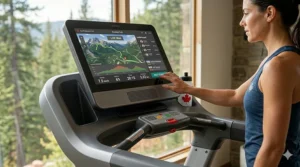
6. Life Fitness T5 Treadmill — Best Non-Folding Treadmill for Rehabilitation and Gentle Training
Life Fitness equipment is what you find in hospital physiotherapy departments and premium hotel fitness centres, and the T5 is the company’s residential-grade expression of that philosophy. The FlexDeck cushioning system reduces impact by up to 30% compared to an outdoor road surface — a claim backed by independent testing — and the result is a treadmill that is genuinely kinder to arthritic knees, recovering injuries, and older joints than any other machine in this price range.
The 3.0 HP motor and 20″ × 56″ belt are slightly narrower than some competitors, which reflects the T5’s prioritisation of walking and light jogging over sprint training. The console is deliberately simple: clear, large buttons, an easy-to-read display, and no overwhelming touchscreen to navigate. For Canadians in their 50s or 60s rebuilding fitness after a health event, or for any household where multiple generations will use the machine, the T5’s approachability is itself a feature.
Life Fitness has Canadian-based customer support and an authorised service network across most provinces. While availability on Amazon.ca may vary seasonally, the T5 is widely available through Canadian fitness equipment retailers. Price in CAD runs higher than its specs alone would suggest — you are paying for Life Fitness’s engineering reputation and service network, which is a legitimate value proposition for anyone who plans to keep the machine for 10+ years.
✅ Pros:
- FlexDeck cushioning is best-in-category for joint health
- Trusted in clinical and rehabilitation settings
- Reliable Canadian service network
❌ Cons:
- Belt width narrower than competitors at similar CAD price
- Less tech and entertainment integration
Price range: $4,500–$5,500 CAD — best suited to rehabilitation users and longevity-focused buyers.
7. NordicTrack X22i Incline Trainer — Best Tech-Forward Non-Folding Treadmill for Canadian Runners on a Budget
Think of the X22i as the X32i’s younger sibling that spent less on the screen and passed the savings on to you in CAD. The core hardware is essentially identical: 4.0 CHP motor, 56 cm × 152 cm belt, 40% incline, –6% decline, and full iFIT compatibility with automatic terrain adjustment. The difference is a 22″ touchscreen instead of 32″ — meaningful visually, but not functionally limiting for someone who prioritises training performance over cinema-quality viewing.
For Canadian buyers who want the incline-training capability of the X32i but find the higher-tier price point difficult to justify, the X22i is the obvious answer. It delivers genuine professional-grade stability — the frame weight is similar, the motor is identical, and the workout capability is equivalent. Where you’ll feel the trade-off is purely aesthetic: the smaller screen and slightly less premium console finish.
iFIT content is fully accessible to Canadian subscribers (no geo-restrictions), and the iFIT global routes library includes Canadian locations such as the Cabot Trail in Nova Scotia and trails in Banff — a small but genuinely motivating detail when you’re logging kilometres on a treadmill in February. Year-round Amazon.ca availability makes this one of the more consistently accessible options for Canadian shoppers.
✅ Pros:
- Near-identical hardware to X32i at a lower CAD price
- 40% incline and –6% decline for complete terrain simulation
- iFIT Canadian content included
❌ Cons:
- 22″ screen shows its size limitation during side-by-side comparison with X32i
- iFIT subscription required for the most compelling content
Price range: $4,500–$5,200 CAD — excellent value relative to the X32i; small-screen trade-off only.
How to Choose a Non-Folding Treadmill in Canada: A Step-by-Step Framework
Buying a stationary treadmill in Canada involves a different set of considerations than buying one in the United States. Here’s how I’d walk a friend through the decision in 2026:
1. Confirm your space — with a tape measure, not an estimate. Non-folding treadmills don’t compromise on size. Most models on this list require a footprint of roughly 90 cm × 190 cm (35″ × 75″), plus the 2-metre safety clearance behind the belt recommended by Canadian safety standards. Measure your room, mark out the space with tape, and live with it for a week before purchasing.
2. Match the motor to your training volume. If you’re walking 30 minutes daily, a 3.0 CHP DC motor is sufficient. Running 45+ minutes at 12+ km/h multiple times per week? You need 3.5–4.0 CHP at minimum. If two or more people will use the machine daily, consider the Sole ST90’s AC motor. The spec sheet says “3.5 CHP” but continuous output is the number that matters — always look for “continuous duty” rated motors, not peak ratings.
3. Calculate total cost of ownership in CAD, not just sticker price. A Peloton Tread or NordicTrack with iFIT at $4,000 CAD plus $600/year in subscription fees is a different budget conversation than a Horizon 7.8 AT at $2,500 with no recurring costs. Over five years, the subscription model can add $3,000+ CAD to total cost. Neither is wrong — but know what you’re signing up for.
4. Think about the Canadian winter maintenance reality. Indoor gym floors — especially in garages or basement setups with significant temperature fluctuation — can affect lubrication, belt tension, and electronics. Look for models with sealed electronics (most premium units) and budget for annual belt lubrication (roughly $25–$40 CAD for a quality silicone lubricant kit).
5. Verify warranty coverage for Canada. Some US brands have different warranty terms for Canadian customers, and cross-border warranty claims can involve shipping costs in the hundreds of dollars CAD. Sole, Life Fitness, and Horizon all have Canadian warranty service infrastructure. Confirm before purchasing.
6. Check Amazon.ca Prime eligibility. For most non-folding treadmills listed on Amazon.ca, Prime members receive free delivery, which is meaningful when you’re shipping a 130 kg machine. Non-Prime orders typically require a $35 CAD minimum for free shipping on smaller items, but large fitness equipment usually includes scheduled delivery regardless.
7. Assess the Canadian bilingual labelling reality. Under Canada’s Consumer Packaging and Labelling Act, products sold in Canada require bilingual French/English labelling. Most major fitness brands comply. This rarely affects the product itself but occasionally affects the quality of Canadian-market instruction manuals and online support resources.
Real Canadian User Profiles: Which Treadmill Actually Fits Your Life
One of the most common mistakes in stationary treadmill reviews is treating every buyer as the same person. Here are three profiles that reflect the actual Canadian buying landscape in 2026:
Profile 1 — The Toronto Condo Runner, “Mariam” Mariam is 34, lives in a 750 sq ft condo in North York, and runs 5K three times per week. She converted a storage room into a dedicated workout space. Her priority is a compact-footprint non-folding treadmill that won’t dominate the room. She doesn’t need a subscription service because she already pays for Apple Fitness+. Budget: $2,500–$3,500 CAD.
Best match: Horizon 7.8 AT. It delivers excellent training capability, a compact-relative non-folding footprint, no subscription requirement, and built-in Sprint 8 for the days she wants structure. Her existing Apple Fitness+ streams fine on her phone mounted on the tablet rack.
Profile 2 — The Kelowna Multi-Sport Household, “The Brennans” The Brennans are a family of four in Kelowna, BC — two adults who both run and two teenagers who are on school track teams. The treadmill sees five to seven uses per week, often back-to-back, across a wide range of users from 60 kg to 100 kg. They have a dedicated basement gym room. Budget: $4,000–$5,500 CAD.
Best match: Sole ST90. The AC motor is built for exactly this volume. The 160 kg (353 lbs) user capacity comfortably covers every family member, and the durability of the commercial-grade frame means it won’t need replacement before the teenagers finish university. The long-term investment calculus firmly favours the premium upfront cost.
Profile 3 — The Retired Physician in Victoria, “Dr. Larochelle” Dr. Larochelle is 68, just recovered from a partial knee replacement, and wants to resume walking and light jogging under her physiotherapist’s guidance. She prioritises joint cushioning, ease of use, and the reassurance of a brand with a reputable service network. Budget: $4,500–$6,000 CAD.
Best match: Life Fitness T5. The FlexDeck cushioning system was literally designed with clinical applications in mind. The simple console reduces the cognitive load of just getting on and walking. Life Fitness’s Canadian service network means if something goes wrong two years from now, a technician comes to her home in Victoria — not a call centre in another country.
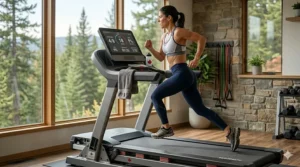
Common Mistakes When Buying a Non-Folding Treadmill in Canada
If I had a dollar for every online review that said “I wish I had known this before buying,” I’d have a very well-equipped home gym. Here are the mistakes worth avoiding:
Mistake 1: Ignoring delivery logistics for a 130 kg machine. A non-folding treadmill is not a cardboard box on your doorstep. Most weigh between 100–160 kg (220–350 lbs) and require at least two people to position. Some Amazon.ca listings offer threshold delivery only (to the door, not inside). If white-glove delivery and setup isn’t included, budget for it separately — movers who handle fitness equipment typically charge $150–$300 CAD in most Canadian cities.
Mistake 2: Buying a US-warranty product for Canadian use. Some fitness equipment sold through third-party Amazon.ca sellers is US-market stock with no Canadian warranty support. Always confirm the seller is an authorised Canadian dealer and that the warranty is honoured domestically. Sole, Life Fitness, and NordicTrack Canada all have official Canadian warranty programs.
Mistake 3: Underestimating space for the safety zone. Canadian building codes don’t specify minimum clearance behind treadmills in residential settings, but the Canadian Centre for Occupational Health and Safety and most equipment manufacturers recommend at minimum 2 metres (6.5 ft) of clear space behind the running deck. This is the space you’ll use if you fall backward — which does happen, and which is why the safety clip matters.
Mistake 4: Ignoring winter temperature effects in garages. Running a treadmill in an unheated Canadian garage in January is harder on the machine than running it indoors. Lubricants thicken, belt tension changes, and electronics can fail. If your home gym is in an attached garage, ensure it’s insulated and heated to at least 10°C before use. Most manufacturers void warranties for equipment operated below 10°C ambient temperature.
Mistake 5: Overlooking cumulative subscription costs in CAD. iFIT costs roughly $39 USD per month on a monthly plan, or about $396 USD annually — which converts to roughly $540–$560 CAD at current exchange rates. Over three years, that’s potentially $1,600+ CAD. This isn’t an argument against iFIT — the content is genuinely excellent — but it should be a line item in your purchasing decision, not an afterthought.
Non-Folding Treadmill vs. Folding Treadmill: The Honest Comparison Every Canadian Buyer Needs
I’ll be direct about something the marketing materials won’t tell you: folding treadmills are not inferior products. They’re a different solution. Here’s the honest breakdown:
| Factor | Non-Folding (Stationary) | Folding |
|---|---|---|
| Frame rigidity | Superior — no hinge stress | Slightly reduced over time |
| Motor capability | Typically 3.5–4.0 CHP | Typically 2.5–3.5 CHP |
| Belt size | Usually 22″ × 60″+ | Often 20″ × 55″ |
| Long-term durability | Stronger — fewer mechanical components | Hinge mechanism adds failure point |
| Space efficiency | Permanent footprint | Frees up floor space when folded |
| Price (CAD) | Higher — $2,000 to $6,000+ | Lower — $800 to $2,500 |
| Best for | Dedicated gym rooms, heavy users | Shared living spaces, occasional use |
The honest take: If you have a dedicated workout room or basement gym and you exercise four or more times per week, a non-folding machine is the correct choice in every meaningful way. The frame doesn’t flex during hard efforts, the motor can be larger because weight isn’t a design constraint, and there’s simply nothing to fail mechanically over time. Folding treadmills make more sense for apartments or occasional users — not because they’re worse machines, but because the space trade-off is genuine.
Long-Term Cost & Maintenance of Non-Folding Treadmills in Canada
Let’s talk about the numbers that don’t appear on the Amazon.ca product listing.
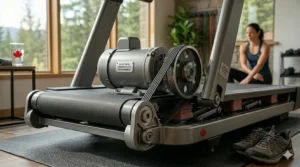
Lubrication: Non-folding treadmill belts require silicone lubrication every three months under regular use (roughly every 150 hours of running). A quality Canadian-market silicone lubricant kit costs $25–$40 CAD. Skipping this accelerates belt and deck wear, potentially adding $300–$600 CAD in parts costs over five years.
Belt replacement: A worn belt on a commercial-quality machine costs $150–$350 CAD installed, depending on the model. Most quality non-folding treadmill belts last 5–8 years under normal residential use.
Deck replacement: Decks eventually need replacement too — typically after 8–12 years in home settings. Cost: $200–$500 CAD. Brands with strong Canadian parts availability (Sole, Life Fitness, Horizon) make this significantly easier than niche imports.
Annual true cost of ownership (CAD estimate, mid-range model):
- Lubrication: ~$40/year
- Pro service call every 2 years: ~$150/year amortised
- Belt amortised over 6 years: ~$60/year
- Subscription (if applicable): $540–$600/year
On a $3,000 CAD treadmill without subscription, your annual total cost of ownership runs about $250 CAD — roughly the cost of two months of a gym membership in most Canadian cities. On a long-term investment basis, the math is compelling.
FAQ: Non-Folding Treadmills in Canada
❓ Are non-folding treadmills worth it for a Canadian home gym?
❓ Can I use a non-folding treadmill in a cold Canadian basement or garage?
❓ Do non-folding treadmills on Amazon.ca come with Canadian warranty support?
❓ What is the best non-folding treadmill in Canada under $3,000 CAD?
❓ How do Canadian treadmill prices compare to US prices?
Conclusion: Your Permanent Treadmill for Home Gym Life in Canada
Choosing among non-folding treadmills in Canada in 2026 is genuinely a matter of aligning the right machine with the right life. If you’re a serious runner who needs a long-term investment in professional-grade stability and training capability — whether that’s to survive a Manitoba winter or to train for a spring race while the snow is still deep — the machines reviewed here represent the best the category has to offer at Amazon.ca.
My overall recommendation: start with the Horizon 7.8 AT if your budget is under $3,000 CAD, the Sole TT8 if you want the best all-round stationary treadmill under $4,000 CAD, and the NordicTrack X22i or X32i if incline training is central to your goals. Rehab-focused buyers should look seriously at the Life Fitness T5, and households with multiple heavy daily users should consider the Sole ST90’s AC motor seriously.
Whatever you choose, remember that Statistics Canada data shows most Canadians still aren’t meeting the 150-minute weekly activity guideline. The best treadmill isn’t the one with the biggest screen or the most features — it’s the one you actually use, in the space you’ve made for it, during the months when going outside feels impossible.
✨ Don’t Miss These Exclusive Deals!
🔍 Ready to commit to your home gym? Click on any highlighted model above to check current pricing and availability on Amazon.ca. Free Prime shipping on eligible orders means your permanent treadmill could be at your door within days!
Recommended for You
- Best Ultra Compact Treadmill in Canada 2026: 7 Top Picks
- Best Quiet Treadmill for Apartment in Canada 2026 (Top 7 Picks)
- Best Easy Folding Treadmill for Seniors in Canada 2026
Disclaimer: This article contains affiliate links. As an Amazon Associate, I earn from qualifying purchases. If you purchase products through these links, we may earn a small commission at no additional cost to you.
✨ Found this helpful? Share it with your friends! 💬🤗
