In This Article
A treadmill for long-distance running is a machine built to carry sustained mileage: a motor rated for continuous duty (3.0 CHP or higher), a belt about 22 x 60 inches (56 x 152 cm), a cushioned deck, and a frame that stays steady after an hour of pounding. Everything else is decoration.
Canada does not make this easy. In January the sidewalks turn to ice. In July the humidity feels like running through soup. A treadmill for long-distance running turns the weather into a rumour. Your 25 km Sunday run stops depending on whether the plow came through.
Not every treadmill can do this. Plenty of machines look fine at 20 minutes and fall apart at 90. Belts creep, motors heat up, and decks that felt soft in the showroom feel like a patio at kilometre 18. That is why this guide looks at a durable treadmill for long runs the way a mechanic would: belt first, motor second, cushioning third, then the little things like where your water bottle goes.
I researched seven real machines from SOLE, NordicTrack and Horizon. I leaned on published editorial reviews and manufacturer specifications, and I could not verify aggregated customer ratings for every model on amazon.ca. Where that is the case, I say so. Pricing is shown as ranges in Canadian dollars, so check current price before buying.
Want background first? Wikipedia’s treadmill entry covers how the machine evolved from a punishment device into a training tool. Now for the shortlist.
Quick Comparison: The Best Treadmill for Long-Distance Running at a Glance
Here is the whole field in one table. Prices are estimated CAD ranges at the time of research and will move.
| Treadmill | Belt Size | Motor | Max Speed | Price Range (CAD) | Best For |
|---|---|---|---|---|---|
| SOLE F63 | 20″ x 56″ | 3.0 CHP | n/a | C$1,500-C$2,100 | Budget-conscious beginners |
| SOLE F80 | 22″ x 60″ | 3.5 CHP | 10 mph (16 km/h) | C$2,100-C$2,900 | Mid-range value runners |
| SOLE F85 | 22″ x 60″ | 4.0 CHP | 12 mph (19 km/h) | C$2,800-C$3,600 | Heavy mileage, heavier runners |
| SOLE TT8 | 22″ x 60″ | 4.0 CHP | 12 mph (19 km/h) | C$3,800-C$4,600 | Daily high-volume training |
| NordicTrack Commercial 1750 | 22″ x 60″ | 3.5-4.25 CHP* | n/a | C$2,500-C$3,200 | Hills, decline work, interactive coaching |
| NordicTrack Commercial 2450 | 22″ x 60″ | n/a | n/a | C$3,800-C$4,800 | Marathon plans with iFIT |
| Horizon 7.8 AT | 22″ x 60″ | 3.5 CHP | n/a | C$2,800-C$3,600 | HIIT plus long runs |
*Sources list different CHP figures for different model years, so confirm on the listing you buy.
The table shows a clear split. The SOLE F63 saves money but gives up belt length, and 56 inches (142 cm) is short for a long stride. The SOLE F85 and SOLE TT8 put the biggest motors in the group, which matters most when you are running for two hours. The NordicTrack Commercial 1750 trades some motor muscle for decline training and a better interactive ecosystem. Buyers who care most about distance should favour belt length and motor first, then cushioning, then screens.
💬 Just one click — help others make better buying decisions too!😊
Top 7 Treadmills for Long-Distance Running: Expert Analysis
1. SOLE F63 — best entry point on a tight budget
The SOLE F63 gets you onto a treadmill without taking out a second mortgage. It carries a 3.0 CHP motor and a folding frame. Its 20″ x 56″ (51 x 142 cm) belt is the compromise.
That belt length is the thing to watch. A 60-inch (152 cm) belt is the practical minimum cited by NordicTrack for marathon training, and the F63 sits four inches short. If you are under about 5’8″ with a compact stride, you will probably be fine for steady easy running. A taller runner pushing a faster pace may find the back edge getting close on every stride.
It works best as a treadmill for endurance runners who are still building their base. Its 300 lb (136 kg) weight capacity is also lower than the bigger SOLE models.
Editorial reviewers list it as a leading budget pick. I could not verify enough amazon.ca customer reviews to summarize sentiment, so treat that as a gap rather than a green light.
Pros:
- ✅ Lowest entry price in this lineup
- ✅ Folding frame saves floor space
- ✅ 3.0 CHP motor meets the running minimum
Cons:
- ❌ 56-inch belt is short for taller runners
- ❌ Lower weight capacity than SOLE’s bigger models
Price range: roughly C$1,500-C$2,100. It offers fair value for easy-pace runners, but it is not the machine for a serious 30 km week.
2. SOLE F80 — best middle ground between price and capability
The SOLE F80 fixes the F63’s biggest limitation. It steps up to a full 22″ x 60″ (56 x 152 cm) belt and a 3.5 CHP motor. That is a real upgrade for long sessions.
Its top speed is 10 mph (16 km/h), which means a 3:45 per kilometre pace is as fast as it goes. For most recreational long-run training, that is plenty. If you plan on tempo work faster than that, look higher up the list.
The weight capacity is 400 lb (181 kg), and the Cushion Flex Whisper Deck is built to reduce cumulative impact over thousands of strides. On paper, that is the kind of spec a long-run runner should want. What the spec sheet cannot tell you is how it feels at hour two, so check recent buyer reviews on amazon.ca for any complaints about deck wear.
I could not verify a large pool of customer reviews. Published editorial coverage generally positions it as a strong value pick.
Pros:
- ✅ Full 22″ x 60″ belt at a moderate price
- ✅ 3.5 CHP motor handles daily mileage
- ✅ 400 lb weight capacity
Cons:
- ❌ 10 mph top speed limits fast work
- ❌ Fewer premium features than higher models
Price range: around C$2,100-C$2,900. It suits runners who want a durable treadmill for long runs without paying flagship money.
3. SOLE F85 — best motor and warranty for high weekly mileage
The SOLE F85 is the workhorse of this group. It has a 4.0 CHP motor, a 22″ x 60″ belt, a 400 lb capacity, and a 0-12 mph (19 km/h) speed range. A published SOLE comparison describes the motor as delivering sustained output for long-distance runs without overheating or losing consistency. That is a manufacturer claim, but the 4.0 CHP rating supports it.
Compared with the NordicTrack Commercial 1750, one reviewer notes that the SOLE F85 has the stronger motor, higher weight capacity and longer warranty. The trade-off is that it offers incline only, with no decline, and a smaller screen.
SOLE says the Cushion Flex Whisper Deck reduces joint impact by up to 40% compared with road running. Treat that as a company claim, but the multi-layer deck does suggest real engineering for impact.
It also uses the free Sole+ app, so you are not paying a monthly subscription to access workouts.
Pros:
- ✅ 4.0 CHP motor for sustained effort
- ✅ Free Sole+ app avoids monthly fees
- ✅ Higher weight capacity than the NordicTrack 1750
Cons:
- ❌ Incline only, no decline training
- ❌ Smaller screen than interactive rivals
Price range: around C$2,800-C$3,600. For someone who just wants to put in kilometres, the SOLE F85 is the safest bet in the group.
4. SOLE TT8 — best for daily, high-volume training
The SOLE TT8 is built for runners who treat the machine like a gym membership. It combines a 4.0 CHP motor, a 22″ x 60″ belt, a speed range of 0-12 mph (19 km/h), and an incline range from -6% to 15%.
The standout detail is its 3.0-inch crowned rollers. Roller size is a durability spec few buyers check. Larger rollers reduce belt flex per revolution, which lowers motor load and helps extend belt and motor life as the mileage adds up. For a treadmill for endurance runners who log daily kilometres, that is a meaningful advantage on paper.
The decline capability, down to -6%, is also rare at this level. It lets you train for downhill-heavy marathons or simply vary your loading.
The 10.1-inch LCD display and SOLE+ Fitness app keep things simple. It is a long-run machine, not a media centre.
Editorial coverage describes it as light commercial construction. I could not verify a large body of customer reviews, so that is the limit of the evidence here.
Pros:
- ✅ 3.0-inch crowned rollers for durability
- ✅ -6% decline plus 15% incline
- ✅ 4.0 CHP motor for sustained use
Cons:
- ❌ Highest price among SOLE models
- ❌ Non-flashy display and interface
Price range: roughly C$3,800-C$4,600. It is the right pick if you plan to run every day for years.
5. NordicTrack Commercial 1750 — best for hills, decline and interactive coaching
The NordicTrack Commercial 1750 has been a reference machine for years. It offers incline and decline training, a wide 22″ x 60″ deck, and a cooling fan. Editorial reviewers also describe a run that feels similar to road running.
Motor specs vary by source. One reviewer lists 3.5 CHP, while another lists 4.25 CHP for newer versions. Confirm the figure on the exact listing before you buy.
The iFIT integration gives you interactive coaching, auto-adjusting speed and incline, and Google Maps-style routes. iFIT is a paid subscription, roughly US$39 per month in the sources I found. Factor that into the total cost.
Reviewers flag three downsides: a big footprint, a heavy frame, and a warranty that is voided if you use or store the machine in a garage. That last point matters in Canada. Many of us put gym equipment in an unheated garage, and cold temperatures are hard on electronics.
Pros:
- ✅ Incline and decline training
- ✅ Built-in cooling fan
- ✅ Road-like feel according to reviewers
Cons:
- ❌ Warranty voided in garage use
- ❌ Heavy and large footprint
Price range: around C$2,500-C$3,200. It rewards runners who want guided training and variety.
6. NordicTrack Commercial 2450 — best for marathon plans with guided coaching
The NordicTrack Commercial 2450 is NordicTrack’s pick for overall runners and a strong starting point for marathon training. It has a 22″ x 60″ running deck and sits near the top of the brand’s range.
NordicTrack is the official treadmill sponsor of the Boston Marathon, and its own guidance says a 60-inch surface is the practical minimum for marathon work. That aligns with what the other machines here offer. Of course, this is a manufacturer’s content, so read it as marketing with some substance.
Like the NordicTrack Commercial 1750, the NordicTrack Commercial 2450 leans on iFIT for programming. That subscription adds to the ongoing cost. If you prefer to run with your own playlist and a plain screen, the SOLE F85 may deliver more value.
I could not verify a full motor figure for this model from my sources, so check the listing.
Pros:
- ✅ Full 22″ x 60″ deck
- ✅ iFIT programming for structured plans
- ✅ Premium build and display
Cons:
- ❌ Highest price tier in this lineup
- ❌ Ongoing iFIT subscription cost
Price range: roughly C$3,800-C$4,800. It fits the runner who wants coaching built in, not just a belt.
7. Horizon 7.8 AT — best for mixing intervals with long runs
The Horizon 7.8 AT sits in the mid-to-premium range. One review lists a 3.5 CHP motor and a 22″ x 60″ deck. Another source highlights its quick-adjusting motor, roller dials and Sprint 8 programming for HIIT.
That makes it a flexible choice. If your training week includes tempo intervals and a long Sunday run, the Horizon 7.8 AT handles both. The quick response is useful when you change speed mid-interval.
A 3.5 CHP motor is not as strong as the 4.0 CHP found on the SOLE F85 and SOLE TT8, so it may run closer to its limit for heavier runners at long durations. For most recreational athletes, it should be fine.
Verified customer sentiment was limited in my research, so I would not claim more than the editorial positioning.
Pros:
- ✅ Quick-adjusting motor for intervals
- ✅ 22″ x 60″ deck
- ✅ Sprint 8 HIIT programming
Cons:
- ❌ 3.5 CHP is lower than the 4.0 CHP rivals
- ❌ Fewer long-run-specific features
Price range: around C$2,800-C$3,600. It is a good all-rounder for runners who do more than just distance.
Top 7 Comparison: Which Treadmill Wins Which Scenario?
| Scenario | Winner | Why |
|---|---|---|
| Tightest budget | SOLE F63 | Lowest price, but a shorter belt |
| Best value overall | SOLE F80 | Full belt, 3.5 CHP, moderate cost |
| Max motor and warranty | SOLE F85 | 4.0 CHP, high weight limit |
| Daily mileage, years of use | SOLE TT8 | 3.0″ rollers, decline option |
| Hills and coaching | NordicTrack Commercial 1750 | Decline plus iFIT |
| Marathon-plan guidance | NordicTrack Commercial 2450 | iFIT, 22″ x 60″ deck |
| Intervals plus distance | Horizon 7.8 AT | Quick-response motor |
The table points to a pattern. If raw durability is the goal, the SOLE TT8 and SOLE F85 lead on paper. If guided training matters more, the NordicTrack Commercial 1750 and NordicTrack Commercial 2450 earn their subscription fees. The Horizon 7.8 AT sits in the middle for runners who mix workouts. Whatever you pick, the 22″ x 60″ belt is the common thread.
🔥 Don’t Miss These Exclusive Deals!
🔍 Take your treadmill for long-distance running search to the next level with these carefully selected machines. Click on any highlighted item to check current pricing and availability. These picks will help you build the kind of base your next race deserves!
How to Choose a Treadmill for Long-Distance Running
Here is a short, snippet-friendly checklist. Work through it in order.
- Check the belt length first. Aim for at least 60 inches (152 cm). One review says 60 inches is the minimum for runners with a stride over 5.5 feet. Anything shorter risks a clipped stride.
- Check belt width. 20 to 22 inches (51 to 56 cm) is standard, and 22 inches gives more lateral room on long, tired runs.
- Look for 3.0 CHP at minimum. Heavier runners or those doing hills should look at 3.5 to 4.0 CHP. Continuous horsepower matters far more than peak horsepower.
- Inspect the cushioning. You want enough absorption to protect joints without feeling bouncy and unlike the road.
- Check the weight capacity. A good rule is to stay well below the stated limit, since you are also generating impact forces when running.
- Read the warranty carefully. Look at the frame, motor, and parts and labour terms, and whether garage use voids coverage.
- Confirm CSA or cUL certification. In Canada, look for the mark on the electrical components.
Think of this list like packing for a long trip. A missing item at the start is hard to fix at kilometre 30.
Long-Distance Treadmill Belt Size: What the Numbers Mean for Your Stride
Long-distance treadmill belt size gets less attention than it deserves. Most people compare screens and subscriptions while ignoring the thing their feet actually touch.
The standard range for running runs from 20″ x 60″ to 22″ x 60″. SOLE’s own guide recommends 22″ x 60″ for runners, and notes that taller people over six feet need longer belts to keep their stride natural. That advice matches what independent sources say.
What does it mean in practice? A belt that is too short forces you to shorten your stride or hover near the front. After 20 minutes you can compensate. After two hours, those small adjustments add up to fatigue and awkward mechanics.
Width matters too. Wider belts give a bit of margin when your form degrades late in a run. If you are splay-footed or bow-legged, 22 inches is the safer choice.
Some taller runners prefer 62 inches. One non-standard option in the sources is a curved, manual 62-inch belt, which encourages a mid- to forefoot strike but works very differently from a motorized deck.
For space planning, leave about 2 feet (60 cm) on each side and 6 feet (1.8 m) behind. A bigger belt needs a bigger room, so measure before you order. In a basement with a low ceiling, also check the overhead clearance when the deck is on full incline.
Deck Cushioning for Long Runs: Soft Is Not Always Better
Deck cushioning for long runs is a Goldilocks problem. Too hard and your shins and knees pay. Too soft and your stabilizer muscles work overtime and the run feels unlike the road.
One 2026 roundup suggests the sweet spot is the middle: enough absorption to protect joints during high mileage, but not so much bounce that the run feels foreign. I agree with that reasoning. A treadmill is training for the road, so your body should still feel familiar forces.
The SOLE F85, SOLE F80 and SOLE TT8 use the Cushion Flex Whisper Deck, with SOLE claiming up to 40% lower joint impact than road running. NordicTrack uses its own FlexCushioning, and the Horizon 7.8 AT has multi-zone cushioning per one source. All of these are manufacturer descriptions, so treat the percentages as marketing numbers.
A few practical notes. First, cushioning wears. A deck that feels perfect in month one may feel firmer in year three. Second, shoes matter. A well-cushioned trainer plus a firmer deck can feel better than a mushy deck with thin shoes. Third, change your surface occasionally. Mixing treadmill runs with road or trail runs trains your body to handle different loads.
Motor Cooling: The Quiet Reason Cheap Treadmills Die Young
Motor cooling is the boring topic that decides whether your treadmill lives five years or twelve. Heat is a major killer of treadmill electronics. One source notes that a 4.0 CHP motor running at 75% capacity stays much cooler than a 2.5 CHP motor pushed to 95%.
Here is the logic. Continuous horsepower tells you how much power the motor can sustain without overheating. Peak horsepower tells you very little about long sessions. One industry source gives an example of a treadmill rated at 5.0 HP peak dropping to about 2.2 CHP after only five minutes of incline running. That gap is exactly why marketing numbers are dangerous.
For a treadmill for long-distance running, the motor should have headroom. If you weigh more than about 200 lb (91 kg) or run hills, aim for 3.5 to 4.0 CHP. AC motors are generally described as less prone to overheating than DC motors, but check the specific design.
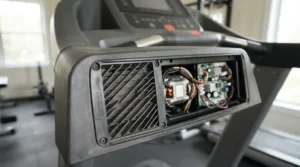
Practical cooling habits help too. Keep the motor cover clear of lint and dust. Leave space around the motor housing so air can move. Use the built-in fan on models like the NordicTrack Commercial 1750, and consider a separate floor fan for yourself. Running at 25°C ambient in a closed room will stress both you and the machine. And watch for warning signs like burning smells, odd sounds, or speed hesitation. If you notice any, stop and call support.
Durable Treadmill for Long Runs: What Actually Lasts
A durable treadmill for long runs is the sum of small, unglamorous parts. The frame, rollers, deck thickness, and motor duty cycle matter more than any touchscreen.
Roller size is the underrated one. Larger rollers reduce belt flex per revolution, which lowers motor load and can extend belt and motor life. The SOLE TT8 advertises 3.0-inch crowned rollers, which is a serious spec for daily mileage.
Deck construction matters too. A standard home treadmill often uses a one-inch medium-density fibreboard deck. Thicker, higher-quality decks tend to last longer and cushion more consistently.
Warranty is your signal. The NordicTrack Commercial 1750 lists a lifetime frame warranty and a 10-year motor warranty in one retailer’s specs, with shorter parts and labour coverage, though terms vary by country and seller. The SOLE F85 is described as having a longer warranty than the NordicTrack Commercial 1750. Always read the Canadian terms on the listing.
Finally, think about local service. A great treadmill that cannot be repaired in your province becomes a very expensive clothes rack. Check whether the brand has Canadian support before you buy.
Treadmill for Endurance Runners: Building a Weekly Plan Around the Machine
A treadmill for endurance runners should support a full training week, not just one type of session. Think of it as a toolkit.
Easy runs. These are the bulk of your mileage. Use a slight 1% incline to approximate outdoor effort, and focus on a relaxed cadence. A larger belt makes these runs feel less claustrophobic.
Long runs. Keep a cooling fan on you, set up your hydration, and vary the incline in small steps to spread load across muscles. The SOLE F85 and SOLE TT8 are built for this.
Tempo and intervals. Here the quick-response motor on the Horizon 7.8 AT matters. Speed changes should feel instant rather than laggy.
Hill and strength work. The NordicTrack Commercial 1750 and SOLE TT8 both offer decline options, useful for downhill-heavy courses.
For general health context, Canada’s guidelines recommend at least 150 minutes of moderate-to-vigorous activity per week for adults, according to Statistics Canada’s summary of the 24-hour movement guidelines. Endurance runners will blow past that number, which is exactly why durability matters.
Hydration Holder Placement: Small Detail, Big Difference
Hydration holder placement sounds trivial until you are 90 minutes in and need a drink. A badly placed bottle holder forces you to twist, lean, or break stride, and that is how people get hurt on treadmills.
What to look for:
- Within easy reach. The holder should sit near your hand’s natural position on the console rails, not behind your hip.
- Stable and deep. A bottle that wobbles at 12 km/h will fall off at the worst moment.
- Separate from your electronics. Water and a touchscreen are not friends, so keep spills away from the console.
Most treadmills include some kind of cup or bottle holder, but quality varies, and I could not verify the placement details for every model here. Check product photos and recent buyer comments for complaints about holders that are too small or too far away.
If the built-in holder is poor, a small stand or a table beside the treadmill works. Use a bottle with a sport cap so you can drink without removing a lid. Sip on a schedule, not when you feel thirsty, because a long run at a steady pace hides dehydration until it is too late.

Practical Usage Guide: Setting Up Your Treadmill for 2-Hour Runs
Here is a transformation guide you will not find on a product listing. Use it in your first 30 days.
Setup. Put the treadmill on a flat, hard floor. Add a rubber mat to reduce vibration and protect the surface underneath. Leave 6 feet (1.8 m) clear behind the machine. Plug into a dedicated circuit if you can, and check the manufacturer’s electrical requirements. One source suggests a dedicated 20-amp circuit for a high-quality treadmill, so confirm that with a licensed electrician.
First-use tips. Break in the belt by walking, then jogging, for a few sessions before any long run. Learn where the emergency stop key is and clip it to your clothing every time.
Maintenance schedule. Wipe the console and rails after every run. Vacuum around the motor housing monthly. Lubricate the belt according to the manual, because over-lubricating is as bad as under-lubricating. Check belt alignment weekly in the first month, since belts drift as they settle.
Common first-month mistakes. Running too fast too soon, ignoring belt tension, skipping the safety key, and placing the machine on thick carpet that traps heat around the motor.
Optimization tricks. Add a 1% incline for road-like effort. Use a fan and a towel. Plan fuel for runs over 75 minutes. Rotate your shoes, and track the age of your treadmill deck by logging total kilometres.
Real-World Scenarios: Which Treadmill Fits Which Runner?
Here are three user profiles with reasoning. These are illustrative scenarios, not real customer stories.
Scenario 1: The first-time marathoner in Winnipeg. Budget around C$2,500, runs four days a week, 50 km weekly at peak, basement setup. The SOLE F80 fits: full 22″ x 60″ belt, 3.5 CHP motor, no subscription. The 10 mph limit is not a problem for long, steady training.
Scenario 2: The experienced runner in Vancouver chasing a Boston qualifier. Budget around C$4,000, 80 km weekly, includes hill repeats and tempo work. The SOLE TT8 or NordicTrack Commercial 2450 fits. The TT8 favours raw durability and decline; the 2450 favours guided coaching.
Scenario 3: The heavier runner in Calgary on a mid budget. Weighs over 200 lb (91 kg), runs five days a week, wants a machine that won’t strain. The SOLE F85 fits, thanks to its 4.0 CHP motor and 400 lb capacity.
Common Mistakes When Buying a Treadmill for Long-Distance Running
Here is where most shoppers go wrong.
Trusting peak horsepower. A big peak number on a listing hides weak continuous power. Always look for CHP.
Buying the biggest screen. A bright touchscreen is nice, but it does nothing for your belt, motor or deck. Specs for sustained running beat entertainment features.
Ignoring belt length. A 56-inch belt feels fine in a short test and cramped on a long run.
Forgetting the subscription. iFIT adds a monthly cost. Over several years, that changes the total price noticeably.
Skipping the garage warning. Some warranties are voided if the treadmill is used or stored in a garage. For Canadian winters, that is a serious detail.
Not measuring the room. The treadmill, plus clearance, plus overhead height when inclined, adds up quickly.
Treadmill vs Outdoor Running: What Changes for Long Distance
A treadmill for long-distance running is not a replacement for the road, but it is a powerful partner.
Consistency. The treadmill gives you a controlled surface and climate, free of ice, traffic and wind. For a Canadian runner, that is a big win from November to March.
Pacing. The belt sets your pace. That is excellent for discipline, but it can mask pacing weaknesses you would notice outdoors.
Impact. A cushioned deck can be gentler than pavement. SOLE claims a large reduction in joint impact versus road running, though that is a manufacturer figure.
Mental load. Two hours on a belt can feel long. Music, podcasts, or guided programming help, which is where iFIT earns its fee for some people.
Specificity. Race day happens outside. Mix in outdoor long runs when conditions allow, so your body keeps adapting to wind, camber and uneven surfaces.
Long-Term Cost and Maintenance: The Real Price of Running Indoors
The sticker price is only the start. Here is how total cost of ownership shakes out.
Purchase price. Roughly C$1,500 to C$4,800 across this lineup, with the SOLE F63 at the bottom and the NordicTrack Commercial 2450 near the top.
Subscriptions. iFIT was listed at about US$39 per month in the sources I found, which adds up to a few hundred dollars per year. The SOLE F85 uses the free Sole+ app.
Maintenance. Belt lubrication, cleaning, and occasional belt replacement. Over several years, a treadmill with larger rollers and a stronger motor can reduce wear-related repairs.
Electricity. A treadmill adds modestly to your power bill. Check your province’s rates, but for most households it is a small line item.
Cost per kilometre. Divide the price by expected lifetime kilometres. A C$3,500 treadmill used for 50 km a week over eight years works out to a very low cost per run, far cheaper than most gym memberships.
Safety, Regulations and Certification in Canada
For a heavy electrical appliance, safety deserves real attention.
Electrical certification. Look for CSA or equivalent cUL marks on the machine and power supply. This shows the product was tested to Canadian standards.
Circuit capacity. Check the manufacturer’s electrical requirements, and consider a dedicated circuit. When in doubt, hire a licensed electrician.
Safe use. Always clip on the emergency stop key. Keep children and pets away from the belt. Hold the rails while stepping on and off.
Health context. Before ramping up mileage, talk to a doctor if you have a medical condition. For general guidance, see the Government of Canada’s Chief Public Health Officer report on physical activity, which explains how activity is measured against national guidelines.
News context. The CBC’s coverage of Canada’s exercise guidelines gives a plain-language summary of why more movement is better, though the guidelines have been revised since that article.
FAQ
❓ How much treadmill motor power do I need for long runs?
❓ Is a 20-inch or 22-inch belt better for distance running?
❓ Can I keep my treadmill in an unheated garage in Canada?
❓ Do I need an iFIT subscription to run on a NordicTrack?
❓ How often should I lubricate my treadmill belt?
Conclusion
A good treadmill for long-distance running comes down to a short list: a 60-inch belt, a motor with real continuous power, a deck that protects your joints without feeling like a trampoline, and a frame that survives years of use. Everything else is a bonus.
If you want the safest all-around pick, the SOLE F85 pairs a 4.0 CHP motor with a 22″ x 60″ belt and a free app. If you train every day, the SOLE TT8 and its 3.0-inch rollers are built for it. For coaching and hills, the NordicTrack Commercial 1750 and NordicTrack Commercial 2450 deliver. The SOLE F80 is the value play, the Horizon 7.8 AT suits mixed training, and the SOLE F63 is the budget entry with a shorter belt.
Whatever you choose, check current prices, confirm Canadian warranty terms, and measure your space. Then go build that base.
✨ Ready to run through the winter? Click on any highlighted treadmill to check current pricing and availability, and start your next long run indoors!
Recommended for You
- Treadmill For Half Marathon Training: 7 Essential Picks (2026)
- Treadmill For Marathon Training: 7 Top Picks In Canada 2026
- Treadmill For Serious Runners Vs Commercial Gym Treadmill: 7 Top 2026
Disclaimer: This article contains affiliate links. As an Amazon Associate, I earn from qualifying purchases. If you purchase products through these links, we may earn a small commission at no additional cost to you.
✨ Found this helpful? Share it with your friends! 💬🤗
