In This Article
A treadmill keeps moving whether you’re ready or not. For a marathoner, that’s motivation. For someone six weeks out from a knee replacement, or relearning a steady stride after a stroke, it’s a design problem. Choosing a treadmill for physical therapy is nothing like shopping for a running machine, and the specs that impress a 10K trainer (19 km/h top speed, 15% incline) tell you almost nothing about what you need.
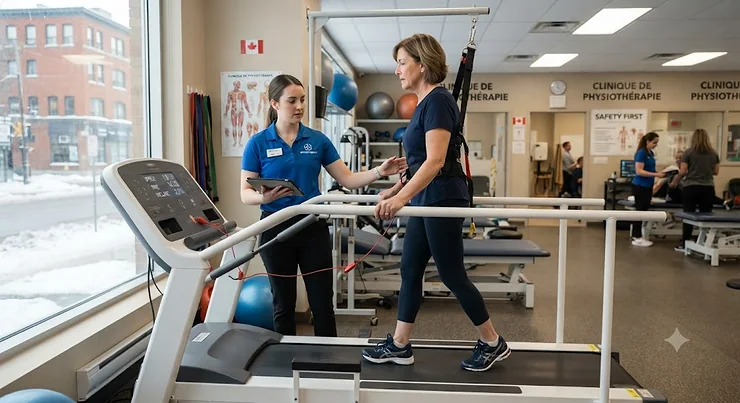
What you need sits at the opposite end of the dial. That means a belt that starts as a crawl, adjustable speed increments small enough to feel like a gentle nudge, a low step-up, and stability rails you can trust when your balance wobbles. Add a Canadian January, when sidewalks double as hockey rinks, and a home machine becomes one of the more sensible rehab tools you can own.
This guide compares seven real models across budget, mid-range and premium tiers, from rehab-first walkers to full-size machines with fine control. It draws on published specifications, retailer listings and the aggregated feedback found in published reviews. It is not based on hands-on testing by us, and we flag any data point we couldn’t verify, such as conflicting motor ratings between sources. Prices are approximate ranges in Canadian dollars only, so check current pricing on amazon.ca.
One note before we start: this is buying guidance, not medical advice. Your physiotherapist decides speed, duration and how much weight you can bear. The treadmill just carries out the plan, ideally without drama.
Quick Comparison: 7 Treadmills for Physical Therapy at a Glance
| Product | Best For | Slowest Start (approx.) | Support Rails | Approx. Price (CAD) |
|---|---|---|---|---|
| Exerpeutic 4003 | Post-surgery and balance-limited users | 0.2–0.3 mph (0.3–0.5 km/h) | Full-length, 49 in (124 cm) | C$500–C$900 |
| Sunny SF-T7857 | Budget rail-first walking | 0.6 mph (1 km/h) | Multi-grip, top/middle/sides | C$500–C$800 |
| Sunny SF-T722062 | Walking now, jogging later | Check listing | Extended safety rails | C$600–C$1,000 |
| Horizon 7.0 AT | Rehab-to-fitness progression | 0.5 mph (0.8 km/h) | Partial side rails | C$1,300–C$1,900 |
| SOLE F63 | Everyday all-rounder | 0.5 mph (0.8 km/h) | Standard side rails | C$1,500–C$2,200 |
| SOLE F80 | Heavier users, heavy use | About 0.5 mph (0.8 km/h) | Standard side rails | C$2,000–C$2,900 |
| NordicTrack Commercial 1750 | Decline training, guided workouts | Check listing | Standard side rails | C$2,400–C$3,400 |
Price ranges are estimates at the time of research and may vary. Check current price before buying.
The table splits into two camps. The Exerpeutic 4003 and both Sunny models are built around support and slow starts. The Horizon 7.0 AT, SOLE F63, SOLE F80 and NordicTrack Commercial 1750 are full-size machines that give you room to progress. If your physiotherapist expects you to stay at walking pace, the first camp saves you well over C$1,000. If the goal is a return to brisk walking, hills or jogging, the second camp is worth the money.
💬 Just one click — help others make better buying decisions too!😊
What Is a Treadmill for Physical Therapy?
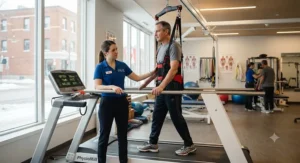
A treadmill for physical therapy is a motorized walking machine chosen for controlled, low-speed rehabilitation rather than running. It typically offers very slow starting speeds, small speed adjustments, a low step-up height, sturdy handrails and a cushioned deck. That lets people recovering from injury, surgery or neurological conditions practise walking safely and measure progress.
Clinic machines such as the PhysioMill, Landice L7 and Spirit 4.0T can start from a true zero, reverse the belt and offer step-up heights near 16 cm (6.25 in). They also cost more than most home budgets allow. Home models can’t match every clinical feature, but the best ones borrow the important ideas.
Physiotherapists in Canada build personalized exercise programs to improve strength, range of motion and function, as the Canadian Physiotherapy Association explains. A home treadmill is one tool that lets you repeat those programs between appointments. Consumer treadmills sit in two groups. Rehab-first walkers have long rails, low decks and limited top speeds. Full-size machines with fine speed control trade some hand-holding for durability and growth room. Neither group replaces professional assessment. Both can extend it.
Top 7 Treadmills for Physical Therapy: Expert Analysis
Here are the specs that matter for rehab, side by side. Values come from manufacturer pages and published reviews, and where sources disagree we say so below.
| Product | Deck Size | Max User Weight | Top Speed | Best For |
|---|---|---|---|---|
| Exerpeutic 4003 | 18×50 in (46×127 cm) | 300–400 lb (136–181 kg), confirm version | 5 mph (8 km/h) | Lowest step-up, frail or post-op users |
| Sunny SF-T7857 | 44×19.5 in (112×50 cm) | 295 lb (134 kg) | 5 mph (8 km/h) | Budget balance support |
| Sunny SF-T722062 | 18.9 in wide (48 cm) | Check listing | 8.5 mph (13.7 km/h) | Progressing beyond walking |
| Horizon 7.0 AT | 20×60 in (51×152 cm) | 325 lb (147 kg) | 12 mph (19 km/h) | Long strides, quick stops |
| SOLE F63 | 20×60 in (51×152 cm) | 325 lb (147 kg) | 12 mph (19 km/h) | Low step-up among full-size |
| SOLE F80 | 20–22×60 in (51–56×152 cm), by source | 350 lb (159 kg) | 12 mph (19 km/h) | Heavier or rail-leaning users |
| NordicTrack Commercial 1750 | About 22×60 in (56×152 cm) | Check current listing | 12 mph (19 km/h) | Decline work, guided sessions |
Read the table by asking what your rehab ends with. If it ends with a comfortable daily stroll, the smaller decks and 8 km/h ceilings of the first two rows cost you nothing. If it ends with hill walking or jogging, only the bottom four rows have the headroom.
1. Exerpeutic 4003 — lowest step-up in this lineup
The 12.7 cm (5 in) step-up makes getting on feel like stepping off a kerb rather than climbing a stair. According to the manufacturer, the belt starts as low as 0.2 mph (0.3 km/h) and adjusts in tenths of a mile per hour, which is exactly the kind of adjustable speed increments that keep a slow start from lurching. The 49 in (124 cm) foam-padded stability rails run alongside the full walking surface, so you can hold on from the moment you step on until you step off.
The catch is an 18 in (46 cm) belt that feels tight for wide-gait walkers and a top speed of 8 km/h that rules out jogging. Based on the spec comparison, this is a therapeutic walking treadmill for people whose goal is safe, repeatable walking, such as post-surgical recovery or balance concerns. Older listings cite a 300 lb (136 kg) limit while the newer model page cites 400 lb (181 kg), so confirm the version you’re buying. Review-site commentary consistently frames it as senior and recovery focused, praising stability and simplicity. We couldn’t verify individual amazon.ca review counts, so check current ratings.
Pros:
- ✅ Lowest step-up height in this group
- ✅ Full-length foam-padded stability rails
- ✅ Speed adjusts in tenths of a mph
Cons:
- ❌ Narrow 46 cm belt limits stride
- ❌ Manual incline and basic console only
Price range: roughly C$500–C$900. The Exerpeutic 4003 offers the most rehab-specific features per dollar here, provided you never need to progress past a brisk walk.
2. Sunny SF-T7857 — rails at three heights on a small budget
Multi-grip handrails along the top, middle and sides let you re-grip as your posture changes mid-session. The 2.5 peak horsepower motor covers 0.6–5 mph (1–8 km/h), and the 112×50 cm deck has shock absorption and a step-up of roughly 11.4 cm (4.5 in). Peak horsepower is a marketing figure, so ignore it. Smooth, quiet belt travel at walking speed is what counts here.
There’s no incline, and it doesn’t fold, so it claims floor space permanently. A 1 km/h floor is fine for most rehab walking, but it’s not for very slow neurological gait work. Reviewers highlight the simple console and easy step-on, while noting there are no quick-select speed buttons, so changes come gradually. That gradual response suits cautious users. It frustrates anyone who wants to jump straight to a prescribed number.
Pros:
- ✅ Multi-height stability rails for varied grips
- ✅ Wide 50 cm deck for its class
- ✅ Simple console, minimal learning curve
Cons:
- ❌ No incline and no folding
- ❌ Slowest speed is 1 km/h
Price range: around C$500–C$800. The Sunny SF-T7857 is a sensible starter for balance support, less so for anyone who expects to outgrow it.
3. Sunny SF-T722062 — extended rails with room to progress
Most rail-heavy treadmills top out at walking pace. The Sunny SF-T722062 pairs extended safety handrails with a top speed of 8.5 mph (13.7 km/h) and a wider 48 cm low deck. That matters if your physiotherapist plans a walk-to-jog progression, since you won’t have to buy twice. It also has a safety clip, a non-slip deck and Bluetooth connectivity to the SunnyFit app.
The listing doesn’t foreground its slowest start speed, so check that before buying if you need very gentle starts. Retailer reviews include a family member with disabilities who found the physical handrail buttons easier to use and one who wanted a bottle holder. Another reviewer reported a console that wouldn’t light up, so buy from a seller with a clear return policy. Treat that as one data point, not a verdict.
Pros:
- ✅ Physical buttons on the handrails
- ✅ Speed headroom beyond walking
- ✅ Wider 48 cm low deck
Cons:
- ❌ Slowest start speed not prominently listed
- ❌ Some console failures reported
Price range: about C$600–C$1,000. It’s good value for a walk-now, jog-later plan.
4. Horizon 7.0 AT — big cushioned deck, quick-stopping safety key
The 60 in (152 cm) deck gives long-stride walkers the room to relax their gait. The 3.0 HP motor covers 0.5–12 mph (0.8–19 km/h) with a 0–15% incline. Consumer Reports found that pulling the safety key stopped the belt from 6 mph in about 2.7 seconds, against a 5.7-second average for treadmills it tested. Fast stopping is worth more than any console feature when a foot catches. QuickDial controls on the handrails let you change speed without reaching for the console.
Rail coverage is partial, so it offers less hand-holding than the rehab-first models. Step-up to the foot rails is about 24 cm (9.5 in). This is a machine for someone whose balance is mostly restored and who wants a decade of progression ahead. Reviews report quiet operation and easy folding. Some owners complain that the cupholder and handrail accessories sit low for tall users.
Pros:
- ✅ Fast-stopping safety key per Consumer Reports
- ✅ 152 cm deck with three-zone cushioning
- ✅ Handrail dial controls, no console reach
Cons:
- ❌ Side rails only partial length
- ❌ 0.8 km/h slowest start
Price range: about C$1,300–C$1,900. Good long-term value for mid-recovery users.
5. SOLE F63 — low step-up, lifetime frame and motor coverage
At roughly 20 cm (8 in), the step-up is one of the lowest among full-size machines, which also helps in rooms with low ceilings. It has a 3.0 HP motor, a 51×152 cm Cushion Flex Whisper Deck, 0.5–12 mph (0.8–19 km/h) and 15 incline levels. One Canadian retailer lists 0.1 mph steps, which is about 0.16 km/h. Fourteen quick-touch buttons jump straight to set values, handy when your physio hands you numbers on a sheet of paper.
Canadian retailers list lifetime frame and motor warranties plus a 3-year deck warranty, so confirm current terms before purchase. Contact grips and an included chest strap can help pace effort during cardiac rehab, always under medical guidance. Reviewers describe it as stable and straightforward, with no subscription needed. A commonly noted quirk is a kick-release fold lever with a breakable plastic part, so fold it gently.
Pros:
- ✅ Low step-up for a full-size deck
- ✅ Fine speed steps and quick-touch buttons
- ✅ Lifetime frame and motor coverage listed
Cons:
- ❌ Rails are not full-length
- ❌ Kick-release fold needs gentle handling
Price range: around C$1,500–C$2,200. The SOLE F63 is the best-balanced pick for most home users.
6. SOLE F80 — heavy-duty frame for heavier or harder use
A capacity of 350 lb (159 kg) is generous, and reviewers describe the frame as commercial-feeling. Sources disagree on the motor, with reviewers citing 3.5 CHP and the current manufacturer page listing 3.25 HP, plus deck width of 20 versus 22 in. Confirm the current model-year spec. Motor steadiness matters at slow speeds. A senior-fitness guide notes that undersized motors can hesitate or surge below about 2 mph, and a stronger motor tends to smooth that out.
The SOLE F80 adds a 10.1 in touchscreen, a wireless charging pad and a larger stop switch with tether. It weighs about 126 kg (278 lb), so it’s not something you’ll casually shuffle between rooms. Reviewers praise durability and the absence of a subscription. OutdoorGearLab found assembly demanding enough to recommend professional setup, and another test flagged less dynamic programming than pricier rivals.
Pros:
- ✅ 159 kg capacity suits heavier users
- ✅ Steady, quiet motor at low speeds
- ✅ No subscription required
Cons:
- ❌ Heavy, with demanding assembly
- ❌ Rails not full-length
Price range: roughly C$2,000–C$2,900. The SOLE F80 justifies its price only if capacity and longevity are priorities.
7. NordicTrack Commercial 1750 — decline training and guided workouts
Decline down to −3% and incline up to 12% let you train the lowering phase of a step, which loads muscles differently from level walking. Use it only if your physiotherapist approves. Newer 2025-and-later models are reported to carry a 4.25 CHP motor, where earlier versions used 3.75, so check the model year. The 16 in pivoting screen runs iFIT, and a walking-focused review found belt movement smooth between 1.5 and 4.0 mph with sturdy rails.
Speed adjusts in half-mph steps on the console, per one review, which is coarser than the finer steps of the SOLE F63. A 10 in (25 cm) step-up is also the highest in this lineup. iFIT offers trainer-led workouts, not therapist-led rehab, so the machine complements your physiotherapy plan without replacing it. Reviewers praise the quiet motor and stability. The recurring reservation is that full features depend on an iFIT subscription.
Pros:
- ✅ Decline and incline for varied loading
- ✅ Quiet 4.25 CHP motor on recent models
- ✅ Large pivoting screen for guided sessions
Cons:
- ❌ Full features need an iFIT subscription
- ❌ Highest step-up and coarser speed steps
Price range: about C$2,400–C$3,400. The NordicTrack Commercial 1750 suits progression-minded users who want variety, not the most cautious start.
✨ Don’t Miss These Rehab-Friendly Picks!
🔍 Take your home rehab to the next level with these carefully selected machines. Click on any highlighted product to check current pricing and availability on amazon.ca. The right machine helps you build steady, confident steps you’ll keep using long after the last appointment.
Your First 30 Days: Setup, Safety and a Gentle Progression Plan
The first month decides whether a treadmill becomes a habit or a very expensive coat rack. Start with setup. Place the machine on a level, hard floor with at least 60 cm (2 ft) of clear space on each side and behind. Add a mat to control vibration. Lubricate the belt if the manual requires it, since some walkers like the Sunny SF-T7857 need lubrication before first use and periodically after that.
Wear proper shoes. HealthLink BC advises low-heeled shoes that fit well and support your feet, and that applies doubly on a moving belt. Clip the safety key to your clothing every time. Do a dry run before your first session: pull the key and confirm the belt stops, check that the stability rails don’t wobble, and practise stepping on and off with the belt stationary.
Here’s a simple structure to bring to your physiotherapist for approval:
- Week 1: Stand on the belt at the slowest speed, holding both rails. Focus on posture and a heel-to-toe pattern, using very short sessions.
- Week 2: Introduce small speed changes, one adjustable speed increment at a time. Notice when your stride shortens.
- Weeks 3–4: Reduce rail grip gradually, with a hand hovering rather than clamped.
Common first-month mistakes include leaning on rails constantly, skipping warm-ups, and raising speed before the gait feels smooth. Log speed, time and how you felt afterward. Your physiotherapist can use those notes far better than a vague report that it went fine.
Real-World Scenarios: Which Treadmill for Physical Therapy Fits Your Life?
The Canadian 24-Hour Movement Guidelines suggest adults 65 and older accumulate at least 150 minutes of moderate to vigorous activity weekly, including activities that challenge balance. They also note that people with a disability or medical condition should consider consulting a professional first. You can read the full 65+ guidelines for context. These profiles are illustrations, not prescriptions.
Scenario 1: post-hip-replacement, age 68, budget under C$1,000, daily short sessions indoors. The priority is low step-up, full-length support and slow starts. The Exerpeutic 4003 fits best. Its 5 in step-up and full-length stability rails match early recovery. The Sunny SF-T7857 is the fallback if you prefer wider grip options.
Scenario 2: ACL rehab, age 45, aiming to jog again, mid-range budget. A machine that only walks would be outgrown within months. The Horizon 7.0 AT offers a long deck and a fast-stopping safety key. The SOLE F63 trades some deck comfort for finer speed steps. Consider the Sunny SF-T722062 if budget is tighter.
Scenario 3: arthritis, age 60, heavier build, walking most days. Capacity, stability and a steady motor at low speeds dominate. The SOLE F80 stands out with a 159 kg rating. If you’d rather have more rail coverage than headroom, revisit the rehab-first models.
Problem → Solution: Fixing Common Treadmill Rehab Frustrations
Problem: the belt feels jerky at slow speeds. Motor size affects smoothness. A senior-fitness guide suggests that 2.5+ CHP motors avoid the hesitation many smaller motors show below about 2 mph. Among full-size options, the SOLE F80 and NordicTrack Commercial 1750 lean toward the sturdier end.
Problem: I keep gripping the rails. Clamping the rails tilts your body and hides your real gait. Ask your physiotherapist to help you wean off gradually. Handrail-mounted controls, like those on the Horizon 7.0 AT, encourage you to keep hands where they belong.
Problem: I can’t reach the controls. Console-only controls force you to lean forward. Physical handrail buttons, mentioned by reviewers of the Sunny SF-T722062, keep you upright.
Problem: my small apartment can’t spare the space. Folding models such as the SOLE F63 and Horizon 7.0 AT fold upright. The Sunny SF-T7857 doesn’t, so measure before buying.
Problem: winter shuts down my walking routine. A treadmill removes ice from the equation, which matters given that falls are a significant health concern for older Canadians.
How to Choose a Treadmill for Physical Therapy
Choosing a treadmill for physical therapy comes down to a few decisions in the right order. Here’s the sequence, with the reasoning for each.
- Confirm the plan with your physiotherapist. Ask for target speeds, durations and whether incline or decline is allowed. Everything else follows from this.
- Check the slowest start speed. Neurological and early post-op work often needs pace under 1 km/h. Machines starting at 0.8–1 km/h may be too fast at first.
- Look at adjustable speed increments. Steps of 0.1 mph (0.16 km/h) feel like a dial. Steps of 0.5 mph feel like a staircase.
- Judge the stability rails. Full-length rails protect balance at any point on the belt. Partial rails suit people who mainly need a safety net.
- Measure step-up height. A lower deck is safer to mount and dismount. Compare 5 in on the Exerpeutic 4003 with about 10 in on the NordicTrack Commercial 1750.
- Match capacity and motor to your body and use. Choose comfortable headroom on weight rating and motor steadiness at slow speeds.
- Plan for space, delivery and setup. Heavy machines like the SOLE F80 may benefit from professional assembly.
Why Adjustable Speed Increments Matter More Than Top Speed
In rehab, the interesting part of the speed range is the bottom inch of it. A machine that moves from 1.0 to 1.5 mph in one press is asking you to increase pace by 50% in one step. Adjustable speed increments of 0.1 mph (0.16 km/h) let you find the pace where your stride stays even, and they make progress measurable. Moving from 1.2 to 1.3 to 1.4 mph over three weeks is a story your physiotherapist can read.
The Exerpeutic 4003 adjusts in tenths, as does the SOLE F63 according to one Canadian retailer, while NordicTrack Commercial 1750 owners report half-mph steps on console buttons. Coarser steps aren’t a dealbreaker for a fit user, but they’re a real disadvantage for someone stepping up pace cautiously. Clinical guidance also points the same direction. One rehab-treadmill buying guide notes that a machine starting at 0.5 mph with only 0.5 mph adjustments is wrong for slow ambulation training.
Combine fine increments with smooth low-speed motor behaviour and quick-select buttons for prescribed values, and you have the key ingredients for controlled progression. Skip any one of the three and the machine will feel clumsy exactly where you need it to feel gentle.
Stability Rails: Support Without Dependence
Stability rails are the difference between a treadmill and a treadmill for physical therapy. Full-length rails, such as the 49 in (124 cm) foam-padded set on the Exerpeutic 4003, let you hold on from the first step to the last. Multi-height rails on the Sunny SF-T7857 let you re-grip as posture shifts. Partial rails on the Horizon 7.0 AT provide a safety net rather than a full handhold.
Rails are also the point where rehab goes wrong. Gripping too tightly shifts weight to your arms, shortens stride and hides the very asymmetries your physiotherapist wants to see. Think of rails as training wheels, not a handbrake. The ideal progression moves from two-hand support to one hand, then to fingertip contact, then to hovering.
Look at rail height, padding and stability. A rail that flexes when you lean on it defeats its purpose. Check that it’s bolted securely and doesn’t rattle. On budget models, reviewers occasionally mention assembly that leaves rails a little loose until every bolt is retightened after the first few sessions.
What Makes a Therapeutic Walking Treadmill Different?
A therapeutic walking treadmill is built around what happens at 1–4 km/h, not what happens at 19 km/h. That changes design priorities. The deck is lower, cushioning is generous, the belt and motor are tuned for smooth slow travel, and controls are readable at a glance.
Compare Sunny SF-T7857 with a running machine like the NordicTrack Commercial 1750. The Sunny caps out at 8 km/h and prizes rails, while the NordicTrack offers decline training, a huge screen and a 4.25 CHP motor. Neither is wrong. They’re solving different problems.
Clinic-grade machines take this further, with true zero starts, reversible belts and low step-up heights near 16 cm. Those specs exist because clinicians treat patients who can barely shift weight. Home buyers can’t replicate all of that, but the closest matches are the Exerpeutic 4003 on step-up and slow start, and the SOLE F63 among full-size options.
What the spec sheet won’t tell you, but reviews often hint at, is noise and vibration. A quiet motor means you can hear your own footfalls, and even footfalls are a useful gait cue.
Treadmill for Physiotherapy: Home Machine, Clinic Visits or Alternatives?
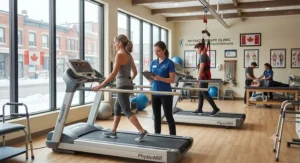
A treadmill for physiotherapy at home doesn’t replace clinic visits. It multiplies the practice you can do between them. Physiotherapy is a regulated profession in Canada, licensed through provincial and territorial colleges, and direct-access rules vary by province and by insurer. Your physiotherapist assesses, prescribes and adjusts. The machine repeats.
| Option | Joint Load | Control | Weather-Proof | Best For |
|---|---|---|---|---|
| Rehab-friendly home treadmill | Low to moderate, with cushioned deck | High (speed, incline) | Yes | Exerpeutic 4003, Sunny SF-T7857, SOLE F63 |
| Outdoor walking | Moderate | Low | No | Mild conditioning in good weather |
| Stationary bike | Low | High | Yes | Non-weight-bearing recovery phases |
| Clinic session | Prescribed | Highest | Yes | Assessment, hands-on guidance |
The table shows why a treadmill earns its place. It’s the only option that combines weight-bearing gait practice with controlled pace and weather independence. A bike suits phases when weight-bearing must stay light. Outdoor walking is free but unpredictable, especially on winter ice. Use the clinic for assessment and correction, and the home machine for the repetition that makes correction stick.
What Makes a Treadmill Recommended by Physiotherapists?
There is no official list of treadmills that physiotherapists endorse, and it would be misleading to invent one. What clinicians do describe in buying guidance is consistent. A treadmill recommended by physiotherapists typically has a low starting speed, fine speed control, sturdy rails, a low step-up, an accessible emergency stop and a motor that stays smooth at slow speeds.
One clinic-focused buyer’s guide treats 4.0 continuous horsepower as a minimum for clinical multi-patient use, but that standard doesn’t apply to a single home user. For home use, motors around 2.5–3.5 CHP are commonly considered adequate for walking, with steadiness at slow speeds mattering more than raw power.
Use these criteria to screen any machine, including ones not on this list. Then ask your own physiotherapist about the specific model. Some may favour rail coverage, others may favour headroom for progression, depending on your diagnosis and goals. If a listing claims doctor or physiotherapist approval without naming who, treat it as marketing rather than evidence.
Therapist-Guided Programs at Home: What’s Realistic?
None of the machines here ships with programs written by your physiotherapist, and that’s normal. Therapist-guided programs at home usually mean a written prescription you enter manually, such as speed, duration, incline and rest intervals. Manual mode on every model handles that easily.
Console programs and apps are a different beast. The NordicTrack Commercial 1750 runs iFIT, with trainer-led workouts and automatic speed, incline and decline changes. The SOLE F63 and SOLE F80 include app connectivity. The Sunny SF-T722062 connects to the SunnyFit app. These are fitness programs, not clinical ones, so they suit the later phases of recovery, once your physiotherapist confirms that automatic adjustments are appropriate. Auto-adjusting decline and speed can surprise anyone whose balance is still fragile.
A practical middle path is to have your physiotherapist write a simple sequence, for example warm-up pace, working pace and cool-down pace. Screenshot or photograph it, keep it near the console, and log each session. That’s a therapist-guided programme in every way that counts, and it costs nothing.
Long-Term Cost & Maintenance
Sticker price is only the first line of the ledger. Consider cost per use. A C$1,800 machine used five times a week for two years works out to roughly C$3.50 per session. That’s an illustration, not a promise, but it shows why durability and warranty matter as much as the initial price.
| Tier | Products | Approx. Price (CAD) | Value Logic |
|---|---|---|---|
| Budget | Exerpeutic 4003, Sunny SF-T7857, Sunny SF-T722062 | C$500–C$1,000 | Rehab-first features, limited progression |
| Mid-range | Horizon 7.0 AT, SOLE F63 | C$1,300–C$2,200 | Growth room, longer warranties listed |
| Premium | SOLE F80, NordicTrack Commercial 1750 | C$2,000–C$3,400 | Capacity, decline, guided content |
The tiers tell a simple story. Budget models cost less but can be outgrown, so they suit people with a defined, modest goal. Mid-range models carry you from rehab to general fitness. Premium models make sense if you’ll use them heavily, need the capacity or want decline training and guided content, while remembering that some features depend on subscriptions.
Maintenance is modest. Lubricate the belt as the manual instructs (one review of the Sunny SF-T7857 cites roughly every 188 miles, about 300 km), keep the belt clean, check bolts and test the safety key monthly. Belt centring on the SOLE F63 uses simple quarter-turn adjustments described in its manual.
Safety, Regulations and Compliance in Canada
Falls are a leading concern for older Canadians, and the Government of Canada notes that improving balance and strength through exercise is one of the key ways to prevent falls and injuries for older adults. A treadmill with stability rails is a tool in that effort, not a guarantee.
Start with the basics. Look for recognised electrical safety certification marks such as CSA or cUL on the listing or product label, and confirm the machine is intended for Canadian 120 V outlets. Test the safety key before every session, keep clutter and pets away, and never step on or off a moving belt.
Regulation is provincial for physiotherapists, who are licensed through provincial and territorial colleges. Consumer treadmills are generally sold as fitness equipment rather than licensed medical devices, so don’t expect clinical-grade claims from a listing. Extended health plans often cover physiotherapy visits but treat equipment purchases differently, so ask your insurer before assuming reimbursement.
FAQ
❓ How slow should a treadmill go for physical therapy?
❓ Can I use a regular treadmill for physical therapy at home?
❓ Will my extended health plan cover a rehab treadmill?
❓ Should I hold the stability rails the whole time?
❓ Is it safe to use a rehab treadmill on my own?
Conclusion
Picking a treadmill for physical therapy is about choosing the right kind of slow. The Exerpeutic 4003 leads on step-up and support. The Sunny SF-T7857 and Sunny SF-T722062 deliver budget-friendly rails, with the latter adding headroom. The Horizon 7.0 AT and SOLE F63 balance deck comfort, fine control and long-term value. The SOLE F80 brings capacity and durability, and the NordicTrack Commercial 1750 adds decline and guided content for confident progressors.
Every recommendation here rests on published specs and aggregated review themes, with conflicts flagged so you can verify them. Before you buy, confirm the slowest start speed, the size of the speed steps, the rail layout and the step-up height. Then run your shortlist past your physiotherapist. A treadmill that fits your plan will quietly turn thousands of small steps into real progress, whatever January throws at the sidewalk.
✨ Ready to walk your way back? 🔍
Compare the seven options above, click any highlighted product to check current pricing and availability on amazon.ca, and choose the machine that matches your recovery plan. Every steady step counts! 🚶♂️
Recommended for You
- Gentle Exercise Treadmill For Beginners: 7 Best Picks (2026)
- Low-Impact Treadmill For Joint Pain: 7 Best Knee-Saving Picks 2026
- Under-Desk Walking Treadmill: 7 Best Picks For Canada (2026)
Disclaimer: This article contains affiliate links. As an Amazon Associate, I earn from qualifying purchases. If you purchase products through these links, we may earn a small commission at no additional cost to you.
✨ Found this helpful? Share it with your friends! 💬🤗
