In This Article
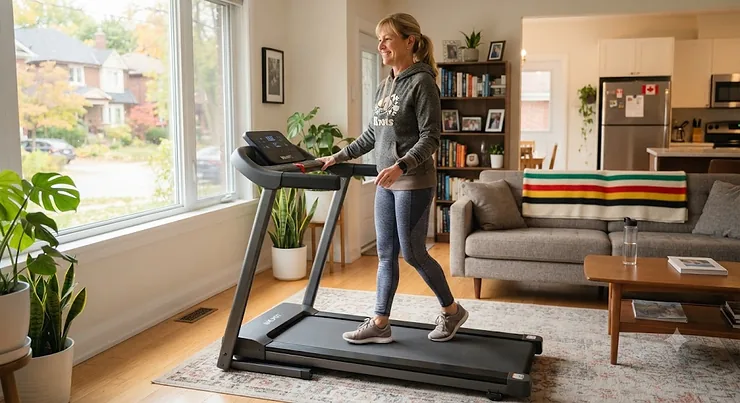
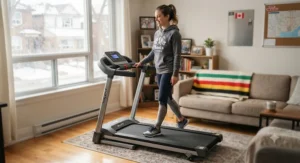
Picture a January morning in Winnipeg. It’s -28°C with the windchill, the sidewalks are glazed like a doughnut, and your brand-new resolution to “walk more” is already negotiating its own surrender. This is precisely the moment a gentle exercise treadmill for beginners earns its floor space.
What is a gentle exercise treadmill for beginners? It’s a motorized treadmill or walking pad built around slow, controllable speeds (usually starting at 0.8–1 km/h), a stable deck, easy-to-reach controls and safety features like handrails and emergency stop keys — designed so new or returning exercisers can build walking fitness without joint strain or intimidation.
Here’s the thing most buying guides skip: beginners don’t need a machine that hits 19 km/h. They need one that behaves beautifully at 3 km/h. That’s a different engineering brief entirely, and it’s why a C$2,000 runner’s treadmill can actually be a worse choice for your first year than a C$500 machine with a well-tuned low-speed range.
Canada’s own guidance backs the slow-and-steady approach. The Public Health Agency of Canada’s physical activity recommendations point adults toward 150 minutes of moderate-to-vigorous activity per week — and brisk walking gets you there without a single burpee. A gentle cardio treadmill simply removes the excuses: weather, darkness, icy sidewalks, the neighbour’s unleashed dog.
In this guide, I’ve dug through real spec sheets, independent lab-style reviews and aggregated owner feedback to shortlist seven machines available to Canadian shoppers — from a compact under-desk walking pad to a premium cushioned deck. You’ll also get a 30-day starter plan, walking pace programs explained in plain English, and a Canadian safety section covering the 2026 walking pad recalls you’ll want to know about before you click “buy.”
Quick Comparison Table: Top Picks at a Glance
| Product | Speed Range | Max User Weight | Handrail | Price Range (CAD) | Best For |
|---|---|---|---|---|---|
| WalkingPad C2 | 0.8–6 km/h | 100 kg (220 lb) | No | C$500–C$700 | Under-desk walkers in small condos |
| UREVO 2-in-1 Folding Treadmill | Walk mode to ~6 km/h; run to 12.2 km/h | 120 kg (265 lb) | Fold-up bar | C$250–C$400 | Budget buyers who want a handle |
| Sunny Health & Fitness SF-T7603 | 0.8–14.5 km/h | 100 kg (220 lb) | Yes | C$450–C$600 | First full treadmill on a tight budget |
| XTERRA Fitness TR150 | 0.8–16 km/h | 113 kg (250 lb) | Yes | C$450–C$600 | Program-lovers who like variety |
| Sunny Health & Fitness SF-T7718 Strider | 1–14.5 km/h | 120 kg (265 lb) | Yes | C$600–C$850 | Wobbly walkers who need a wide belt |
| Horizon Fitness T101 | 0.8–16 km/h | 136 kg (300 lb) | Yes | C$900–C$1,200 | Knees that want real cushioning |
| Sole F63 | 0.8–19.3 km/h | 147 kg (325 lb) | Yes | C$1,800–C$2,300 | Long-term buyers who’ll progress |
Looking at the table, the dividing line isn’t really price — it’s the handrail column. The WalkingPad C2 is brilliant for steady under-desk strolling, but anyone with balance concerns should start with a railed machine like the Sunny Health & Fitness SF-T7718 Strider or Horizon Fitness T101. Meanwhile, the Sole F63 only makes sense if you’re confident you’ll still be using it five years from now, when its 147 kg capacity and 3.0 HP motor start paying you back.
💬 Just one click — help others make better buying decisions too!😊
Top 7 Gentle Exercise Treadmill for Beginners Picks: Expert Analysis
1. WalkingPad C2 — best ultra-compact under-desk walker
The WalkingPad C2 is basically a treadmill that learned to fold in half and hide under your couch — its defining trick is how little space it demands.
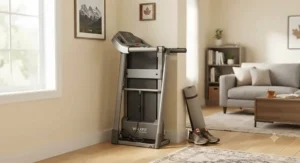
Speed runs from 0.8 to about 6 km/h, which covers everything from a hesitant shuffle to a purposeful power walk, and the brushless motor keeps things quiet enough for video calls. The belt measures roughly 120 × 40 cm, and it folds down to about 83 × 52 cm and only 14 cm tall, so a Toronto one-bedroom can swallow it without drama. The 100 kg weight limit is the key constraint: heavier beginners should look elsewhere.
My analytical take? This is a walking machine, full stop — perfect for remote workers who want to rack up steps during meetings, less ideal for anyone who needs something to grip. There’s no handrail, so it suits people with steady balance. Independent testers at Garage Gym Reviews also flagged that speeds above roughly 3 km/h in manual mode require the KS Fit app, which is a nuisance if you’re not tech-inclined.
Reviewers consistently praise its looks and footprint, while a common complaint in user reviews is the “automatic” speed mode, which tends to stop the belt rather than slow it when you drift backward.
Pros:
- ✅ Folds to a genuinely tiny, sofa-friendly footprint
- ✅ Quiet brushless motor suits shared spaces
- ✅ Arrives essentially assembled — plug in and walk
Cons:
- ❌ No handrail for balance support
- ❌ App needed to unlock higher manual speeds
Usually found in the C$500–C$700 range at the time of research (check current price) — worth it for small-space walkers, overpriced if you need stability.
2. UREVO 2-in-1 Folding Treadmill — best budget walk-to-jog hybrid
The UREVO 2-in-1 Folding Treadmill earns its “2-in-1” label by switching from a flat walking pad to a mini treadmill with a raised handle bar in seconds.
In walking mode it tops out around 6 km/h, controlled by remote; lift the bar and running mode opens up to roughly 12.2 km/h via handrail buttons. The 2.5 HP motor and 120 kg (265 lb) capacity beat the WalkingPad C2 on paper, and OutdoorGearLab measured noise at about 61 dB at moderate intensity — roughly a normal conversation. The belt, though, is short at about 108 × 42.5 cm.
Based on the spec comparison, this is the budget beginner’s gateway drug: walk under your desk this month, grab the bar for balance next month, try a gentle jog by spring. Just don’t expect a comfortable run — at roughly 6.5 mph (10.5 km/h) and above, testers found strides get cramped. It’s also free of apps and subscriptions, which some beginners will find refreshing.
Aggregated owner feedback highlights the easy nine-minute setup and portability; the most-cited annoyance is the infrared remote, which needs a clear line of sight.
Pros:
- ✅ Handle bar adds reassurance for nervous starters
- ✅ Lightweight at about 26 kg, easy to reposition
- ✅ No subscription or app required
Cons:
- ❌ Short deck limits comfortable jogging
- ❌ No incline adjustment at all
Typically C$250–C$400 at the time of research — the strongest value in this list if your budget is firm.
3. Sunny Health & Fitness SF-T7603 — best first “real” treadmill under C$600
The Sunny Health & Fitness SF-T7603 looks and feels like a proper gym treadmill — just shrunk to apartment size — with full handrails and speed buttons right where your hands rest.
Speed ranges from 0.8 to 14.5 km/h, powered by a 2.2 CHP motor, and there are three manual incline positions plus nine preset programs. The belt is about 124 × 41 cm, which suits average-height walkers but may feel short above 183 cm (6 ft). A soft-drop gas shock lowers the deck gently when unfolding — a small detail that protects toes, floors and curious pets.
Here’s what to weigh: that handrail-mounted speed control is gold for beginners, because you never need to let go to adjust pace. The trade-off is a 100 kg limit and a motor that’s slow to reach higher speeds — irrelevant for gentle walking, frustrating for runners. The manual incline also requires stepping off to change.
Reviewers consistently mention the small footprint, easy belt adjustment and friendly price; the most common complaints involve a finicky pulse sensor and questions about long-term durability.
Pros:
- ✅ Handrail speed buttons — no letting go required
- ✅ Soft-drop folding protects floors and feet
- ✅ Nine programs add variety without an app
Cons:
- ❌ 100 kg capacity is below category average
- ❌ Incline changes require stopping the belt
Look for it in the C$450–C$600 range (prices may vary) — excellent value for light, regular walkers.
4. XTERRA Fitness TR150 — best program variety for bored beginners
The XTERRA Fitness TR150 packs 12 preset programs into a budget frame, which matters more than you’d think when week three boredom arrives.
It runs 0.8–16 km/h on a 2.25 CHP motor, offers three manual incline levels and supports up to 113 kg (250 lb). The belt is roughly 127 × 41 cm — a touch longer than the Sunny Health & Fitness SF-T7603 — and XTERRA backs the frame with a lifetime warranty, unusual at this price.
What most buyers overlook about this model is the folding mechanism. Unlike the gas-assisted SF-T7603, reviewers report the TR150’s deck can drop hard when lowered, so households with small kids or pets should be deliberate here. For solo walkers who want built-in walking pace programs rather than an app, though, it’s a sensible, no-nonsense pick with handlebar pulse sensors for rough heart-rate checks.
Across its large pool of Amazon reviews, buyers praise the easy folding and value; the recurring complaints involve belts loosening with frequent use and the lack of a slow-drop fold.
Pros:
- ✅ Twelve built-in programs fight workout monotony
- ✅ Lifetime frame warranty at a budget price
- ✅ Slightly longer deck than similar-priced rivals
Cons:
- ❌ Deck can drop hard when unfolding
- ❌ Minimal cushioning for sensitive joints
Generally in the C$450–C$600 range at the time of research — a smart pick if variety keeps you motivated.
5. Sunny Health & Fitness SF-T7718 Strider — best wide belt for unsteady walkers
The Sunny Health & Fitness SF-T7718 Strider stands out for a 51 cm (20-inch) wide belt — the same width you’ll find on treadmills costing three times as much.
Speed runs from about 1 to 14.5 km/h via a 2.5 peak HP motor, with a fixed, low-profile deck, padded non-slip handlebars and nine programs. It supports 120 kg (265 lb), weighs about 53 kg, and folds flat to roughly 27 cm tall — slim enough to roll under many beds. Belt length is about 119 cm, so it’s built for walking rather than long running strides.
Why does width matter so much for beginners? Because a narrow belt forces you to “walk a tightrope,” and first-timers — especially older adults — naturally drift side to side. Those extra 10 cm over typical walking pads give your feet room for error. The low step-up height also helps anyone with stiff hips or knees.
Owner feedback generally highlights how stable and roomy it feels for walking; common gripes are the fixed incline and a deck that’s shorter than serious joggers would like.
Pros:
- ✅ Extra-wide belt reduces missteps and anxiety
- ✅ Low step-up height is kinder to stiff joints
- ✅ Folds flat for under-bed storage
Cons:
- ❌ No adjustable incline for later progression
- ❌ Heavier than walking pads to reposition
Expect the C$600–C$850 range (check current price) — worth the premium over budget models if balance is a concern.
6. Horizon Fitness T101 — best cushioning for sore knees
The Horizon Fitness T101 is the machine I’d point to first for beginners carrying joint pain, thanks to its 3-Zone Variable Response cushioning.
Specs: 0.8–16 km/h, powered incline to 10%, a 2.5 HP motor, a 140 × 51 cm belt and a generous 136 kg (300 lb) capacity. Horizon backs the frame and motor with a lifetime warranty (parts and labour for one year), and there’s Bluetooth audio for music.
On paper, this means three things for a beginner. First, cushioning that’s softer where you land and firmer where you push off. Second, powered incline — the easiest way to raise intensity without walking faster, which is ideal for a low-intensity treadmill workout that still builds fitness. Third, a longer, wider deck that won’t feel cramped as your stride lengthens.
Reviewers consistently praise its quiet operation and comfort; the recurring criticism is shakiness at running speeds — largely irrelevant for walkers.
Pros:
- ✅ Three-zone cushioning is gentle on knees
- ✅ Powered incline up to 10% for progression
- ✅ Generous 136 kg capacity and roomy deck
Cons:
- ❌ Basic display with only three readout windows
- ❌ Some wobble reported at higher running speeds
Usually C$900–C$1,200 at the time of research — the sweet spot between comfort and cost.
7. Sole F63 — best premium machine you won’t outgrow
The Sole F63 is the “buy once, cry once” option: a heavy-duty treadmill that feels just as happy at a 3 km/h stroll as it does at interval pace.
It covers 0.8–19.3 km/h with incline to 15% in 0.5% increments, a 3.0 HP motor, a 152 × 51 cm belt and 147 kg (325 lb) capacity. Sole’s Cushion Flex Whisper Deck is claimed to reduce impact by around 40% versus asphalt, and the warranty includes lifetime frame and motor coverage.
Here’s what to weigh: for a pure beginner, most of that capability is dormant headroom. But headroom is precisely the point — this machine won’t bottleneck you when your walking pace programs evolve into hill intervals. Those fine 0.5% incline steps are also underrated; they let you nudge intensity up so gradually your body barely notices.
Owner reviews commonly praise sturdiness and value relative to gym-grade machines; recurring complaints centre on its roughly 102 kg weight (moving it is a two-person job) and a basic LCD screen.
Pros:
- ✅ Fine-grained incline control for gradual progression
- ✅ Cushion Flex deck reduces joint impact
- ✅ Highest weight capacity in this roundup
Cons:
- ❌ Very heavy — relocating needs two people
- ❌ Expensive if you only ever walk slowly
Often in the C$1,800–C$2,300 range (prices may vary) — outstanding long-term value if you’re committed.
Top 7 Detailed Specs Comparison
| Product | Motor | Belt (cm) | Incline | Folding | Best For |
|---|---|---|---|---|---|
| WalkingPad C2 | Brushless | 120 × 40 | None | Folds in half | Desk walking |
| UREVO 2-in-1 Folding Treadmill | 2.5 HP | 108 × 42.5 | None | Flat fold | Tight budgets |
| Sunny Health & Fitness SF-T7603 | 2.2 CHP | 124 × 41 | 3 manual | Soft-drop | Railed budget walking |
| XTERRA Fitness TR150 | 2.25 CHP | 127 × 41 | 3 manual | Yes | Program variety |
| Sunny Health & Fitness SF-T7718 Strider | 2.5 peak HP | 119 × 51 | Fixed | Flat fold | Balance support |
| Horizon Fitness T101 | 2.5 HP | 140 × 51 | Power, 10% | Hydraulic | Joint comfort |
| Sole F63 | 3.0 HP | 152 × 51 | Power, 15% | Hydraulic | Long-term growth |
The spec table exposes a clear pattern: belt width jumps from about 41 cm to 51 cm once you pass the C$600 mark, and that single number influences beginner comfort more than motor horsepower does. Powered incline appears only on the Horizon Fitness T101 and Sole F63, which matters because incline — not speed — is the safest intensity lever for beginners.
Practical Usage Guide: Your First 30 Days on a Gentle Cardio Treadmill
Unboxing day is exciting. Day nine is where most treadmills become clothes racks. Here’s how to avoid that fate.
Setup Essentials
- Placement: Leave at least 2 m (about 6.5 ft) of clear space behind the deck and 50 cm on each side. Put a rubber mat underneath to protect hardwood and reduce noise for downstairs neighbours.
- Power: Plug directly into a grounded wall outlet — no power bars or extension cords, which can overheat under motor load.
- Belt check: Before your first session, walk at 2 km/h and watch whether the belt drifts. Most machines, including the Sunny Health & Fitness SF-T7603, adjust with a quarter-turn of the rear roller bolts.
Your 30-Day Low-Intensity Treadmill Workout Ladder
- Week 1: 10 minutes, 5 days, 2.5–3.5 km/h, flat. Hold the rail if you like.
- Week 2: 15 minutes, 5 days, 3–4 km/h. Practise walking with hands free for 1–2 minutes.
- Week 3: 20 minutes, 5 days, 3.5–4.5 km/h. Add a 1–2% incline for the middle five minutes.
- Week 4: 25–30 minutes, 5 days, finishing with a 3-minute cool-down at 2.5 km/h.
This low-intensity treadmill workout ladder gets you from zero to roughly 125–150 minutes a week in a month — right in line with national guidelines.
Maintenance Schedule
- Weekly: Wipe the rails and console; vacuum around the base.
- Monthly: Check belt tension and alignment.
- Every 3 months (or ~250 km): Lubricate with 100% silicone as your manual specifies — the UREVO 2-in-1 Folding Treadmill even has a side lubrication port for this.
Common First-Month Mistakes
Gripping the rails with locked elbows, looking down at your feet, and jumping speeds too quickly. Stand tall, eyes forward, and raise speed in 0.5 km/h steps.
Real-World Scenarios: Matching Beginner Profiles to the Right Machine
Specs are abstract. People aren’t. Here are three realistic profiles and the reasoning behind each match.
Profile 1: Priya, 34, Remote Worker in a Vancouver Condo
Budget: under C$700.
Space: 550 sq ft.
Frequency: daily, 45–90 minutes while working.
Priya’s problem isn’t fitness — it’s sitting. She needs a treadmill for light exercise that disappears when friends visit. The WalkingPad C2 is the natural fit: it folds small, runs quietly during Zoom calls and caps at a speed she’ll never exceed while typing. If her budget is tighter, the UREVO 2-in-1 Folding Treadmill does the same job for less and adds a handle for weekend brisk walks.
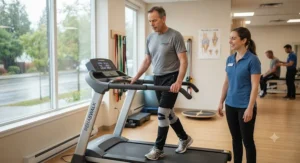
Profile 2: Gord, 67, Retired in Sudbury with a Replaced Knee
Budget: around C$1,000.
Space: finished basement.
Frequency: 5 days a week, 20–30 minutes.
Gord’s priorities are cushioning, handrails, and a gentle start. The Horizon Fitness T101 checks every box: three-zone cushioning for his knee, full rails, and powered incline so he can build intensity without walking faster. If his physiotherapist is especially focused on balance, the wider-belted Sunny Health & Fitness SF-T7718 Strider is a strong, cheaper alternative.
Profile 3: Marie-Claude, 45, Busy Parent in Quebec City
Budget: C$1,500–C$2,300.
Space: spare room.
Frequency: 4 days a week, 30 minutes, plus a teenager who jogs.
A shared household needs headroom. The Sole F63 handles Marie-Claude’s walking today, her incline intervals next year, and her teenager’s runs — all on one sturdy frame with a hydraulic fold that won’t slam onto little toes.
✨ Don’t Miss These Top-Rated Picks! 🔍
Take your walking routine to the next level with these carefully selected treadmills. Click on any highlighted product to check current pricing and availability on Amazon.ca — these machines will help you build steady, confident fitness your body will thank you for!
Problem → Solution Guide: Fixing Common Beginner Treadmill Frustrations
Problem 1: “I feel dizzy when I step off.”
That’s your brain recalibrating after the moving belt stops.
Solution: always cool down for 2–3 minutes at 2–2.5 km/h, then hold the rail for a few seconds before stepping off. Machines with handrails like the XTERRA Fitness TR150 make this far easier.
Problem 2: “My knees ache after 15 minutes.”
Often a sign of an overly firm deck or overstriding.
Solution: shorten your stride, land mid-foot, and consider a cushioned deck such as the Horizon Fitness T101 or Sole F63. Supportive shoes make a difference too.
Problem 3: “I keep drifting toward the back of the belt.”
Common with walking pads, and it triggers auto-stop on the WalkingPad C2.
Solution: lower the speed by 0.5 km/h, look straight ahead (not down at your phone), and position a small mirror or TV at eye level.
Problem 4: “The belt squeaks or hesitates.”
Usually low lubrication or poor tension.
Solution: lubricate per the manual and re-centre the belt. If it hesitates under load, check you’re under the weight limit — the Sunny Health & Fitness SF-T7603 tops out at 100 kg.
Problem 5: “I’m bored by week three.”
The quiet killer of home fitness.
Solution: rotate built-in programs (the XTERRA Fitness TR150 has 12), pair walking with a podcast only allowed on the treadmill, or introduce 1–2% incline intervals.
How to Choose a Gentle Exercise Treadmill for Beginners
Choosing well comes down to seven questions, in this order:
- Check the lowest speed first. Look for a start of 0.8–1 km/h. A smooth, slow start is more important than a high top speed for first-time users.
- Decide on handrails. If you have any balance concerns, joint issues or are over 60, treat full handrails as non-negotiable.
- Measure belt width. Around 41 cm works for confident walkers; 51 cm is noticeably more forgiving for beginners.
- Match weight capacity with a buffer. Choose a machine rated at least 20–25 kg above your body weight so the motor isn’t working at its limit.
- Prioritize cushioning if joints complain. A cushioned deck reduces stress on ankles, knees and hips.
- Measure your space — folded and unfolded. Include 2 m of clearance behind the deck.
- Consider how you’ll progress. Powered incline gives you a gentle path to higher intensity without jogging.
Following this list, most beginners land somewhere between the Sunny Health & Fitness SF-T7718 Strider and the Horizon Fitness T101 — machines that respect a slow start while leaving room to grow.
Why the Low-Speed Range Matters More Than Top Speed
Treadmill marketing loves big numbers: 16 km/h! 19 km/h! But for a gentle exercise treadmill for beginners, the magic happens at the bottom of the dial.
A well-engineered low-speed range does three things. First, it starts smoothly, without a lurch that can throw off an uncertain walker. Second, it moves in fine increments — 0.1 or 0.5 km/h — so progress feels gradual rather than jarring. Third, the motor stays consistent under load at slow speeds, which is surprisingly hard; cheaper motors can “pulse” or hesitate at 1–2 km/h when a heavier person steps down.
Here’s a useful reference point. Comfortable walking for most adults sits around 4–5 km/h, while a rehab or deconditioned pace may be 2–3 km/h. Every machine on this list covers that band, but the experience differs. The WalkingPad C2 is tuned almost entirely for it, whereas the Sole F63 treats it as a small slice of a much wider range — though its heavier motor tends to deliver smooth low-speed torque.
What the spec sheet won’t tell you, but reviewers note: handrail-mounted speed buttons (as on the Sunny Health & Fitness SF-T7603) let you tweak your pace in the low-speed range without breaking stride, which is far more reassuring than fumbling with a remote.
Bottom line: if a treadmill’s lowest speed is above 1.5 km/h, it isn’t built with true beginners in mind.
Walking Pace Programs Explained: Using Built-In Workouts the Smart Way
Built-in walking pace programs are pre-set sequences that automatically change speed (and sometimes incline) over a session. They’re useful for beginners because they remove decision-making — you just press start and walk.
Common Program Types
- Manual: You control everything. Best for your first two weeks.
- Hill or incline programs: Gradually raise and lower incline. Ideal on the Horizon Fitness T101 and Sole F63, where incline is powered.
- Interval programs: Alternate faster and slower segments. Great for building stamina once 20 minutes of steady walking feels easy.
- Fat-burn or target programs: Keep you in a moderate zone for a set time.
How to Use Them Well
Start by running a program at a lower “level” than you think you need — levels often jump more aggressively than beginners expect. Treat the program’s maximum speed as a ceiling, not a target, and don’t hesitate to press the speed-down button mid-session.
According to the Canadian 24-Hour Movement Guidelines for adults, several hours of light activity, including standing, add to your health benefits, alongside at least 150 minutes of moderate-to-vigorous activity weekly. That makes a mixed approach smart: use programs for three or four “workout” sessions a week, and add unstructured slow walking on other days.
If your machine has no programs, like the UREVO 2-in-1 Folding Treadmill, simply create your own: 5 minutes easy, 2 minutes brisk, repeat four times, then cool down. Simple, effective, and free.
Gentle Cardio Treadmill vs Outdoor Walking and Other Alternatives
Is a gentle cardio treadmill really better than walking outside or buying a stationary bike? Sometimes yes, sometimes no — here’s an honest comparison.
| Option | Weather-Proof | Joint Impact | Cost (CAD) | Best For |
|---|---|---|---|---|
| Home treadmill (e.g., Horizon Fitness T101) | Yes | Low–moderate (cushioned) | C$250–C$2,300 one-time | Year-round consistency |
| Outdoor walking | No | Moderate (pavement) | Free | Fresh air, social walking |
| Mall walking | Yes | Moderate | Free (plus travel) | Social seniors in winter |
| Stationary bike | Yes | Very low | C$300–C$1,500 | Serious knee or hip issues |
| Gym membership | Yes | Varies | C$400–C$1,000/year | People who like classes |
The table highlights the treadmill’s real advantage in Canada: weather-proof consistency. Outdoor walking is free and wonderful, but ice and extreme cold can wipe out weeks of progress, and slippery sidewalks carry real fall risk. A stationary bike is gentler still for serious joint problems, but it doesn’t train the weight-bearing walking pattern that supports bone health and everyday mobility.
When Outdoor Walking Wins
From May to October, outdoor walks offer variety, sunlight and social connection that no machine can match. Many beginners get the best results using both: the treadmill for weekday consistency and the trail for weekend enjoyment.
When the Treadmill Wins
For anyone recovering from surgery, managing balance issues or living somewhere with long winters, the controlled surface and adjustable speed of a treadmill make it the safer, more reliable choice.
Treadmill for Light Exercise: Features That Actually Matter (And Those That Don’t)
The treadmill has been around in some form for centuries, and modern marketing has buried the essentials under a pile of features. Here’s how to filter the hype when shopping for a treadmill for light exercise.
Features That Actually Matter
- Safety key/emergency stop: Clips to your clothes and stops the belt if you slip. Non-negotiable.
- Handrails with controls: Let you adjust speed without letting go.
- Belt width: 51 cm on the Sunny Health & Fitness SF-T7718 Strider or Horizon Fitness T101 gives real confidence.
- Cushioning: Particularly valuable for heavier users or anyone with arthritis.
- Gentle folding mechanism: Soft-drop or hydraulic assistance prevents injuries.
Features That Don’t Matter (Much) for Beginners
- Top speeds above 12 km/h: You’re unlikely to use them for months, if ever.
- Large touchscreens: They add cost and subscription fees; a tablet holder does the job.
- Huge motor horsepower: For walking, 2.0–2.5 HP is typically plenty; ensure it suits your weight.
- Dozens of programs: Beyond 6–12, extra programs rarely get used.
A Middle Ground: Bluetooth and Apps
App connectivity can help with motivation, but make it optional. The WalkingPad C2, which requires its app for higher manual speeds, shows how app dependence can frustrate less tech-savvy users.
Beginner Fitness Routines for Seniors and Returning Exercisers
Older adults and people returning after a long break benefit most from beginner fitness routines that emphasize consistency over intensity. The goal is to walk more often, not harder.
A Gentle Weekly Template
- Monday, Wednesday, Friday: 15–25 minutes of steady walking at a pace where you can talk comfortably.
- Tuesday, Thursday: 10–15 minutes of slower walking plus simple balance exercises (standing on one foot near the rail, heel-to-toe walking on the floor).
- Saturday: A longer, relaxed walk — outdoors if weather allows.
- Sunday: Rest, stretching or light mobility work.
Tips for Older Beginners
- Choose a machine with full handrails and a low step-up height, like the Sunny Health & Fitness SF-T7718 Strider.
- Start at 1.5–2.5 km/h and increase only when that pace feels easy for a full week.
- Use incline sparingly at first; 1–2% is enough to make a noticeable difference.
- Stay hydrated, and don’t exercise on the treadmill right after a large meal.
When to Talk to a Professional
If you have heart conditions, diabetes, recent surgery or balance problems, consult your doctor or physiotherapist before beginning. Many Canadian physiotherapists can help set safe speed and incline limits for your first program.
These beginner fitness routines work equally well for younger adults who feel deconditioned — the principles of gradual, consistent progress are universal.
Long-Term Cost & Maintenance: What You’ll Really Spend
The sticker price is only part of the story. Here’s a realistic five-year view.
| Product | Upfront (CAD) | Est. 5-Year Upkeep | Warranty Highlights | Best For |
|---|---|---|---|---|
| UREVO 2-in-1 Folding Treadmill | C$250–C$400 | C$50–C$150 | 12-month limited | Short-term or trial use |
| Sunny Health & Fitness SF-T7603 | C$450–C$600 | C$75–C$200 | 8-year frame (per reviews) | Budget longevity |
| Horizon Fitness T101 | C$900–C$1,200 | C$75–C$200 | Lifetime frame/motor | Mid-range value |
| Sole F63 | C$1,800–C$2,300 | C$50–C$150 | Lifetime frame/motor | Multi-user households |
The analysis here is about cost per use. Walk 4 times a week for five years and you’ll use the machine roughly 1,000 times: a C$1,000 Horizon Fitness T101 works out to about C$1 per session, while even the premium Sole F63 lands near C$2. By comparison, a gym membership over the same period can cost several times more — before gas and parking.
Hidden Costs to Plan For
- Silicone lubricant: C$15–C$30 per bottle, lasting several applications.
- Mat: C$40–C$100 to protect floors.
- Replacement belt or parts: More likely with budget models used heavily.
- Electricity: Modest; walking at low speeds uses less power than running.
Warranties matter too. Lifetime frame and motor coverage on the Horizon Fitness T101 and Sole F63 reduces the risk of big-ticket repairs, while budget models with short parts warranties may need repairs sooner if used daily.
Safety & Canadian Recall Guide for Walking Treadmills
Safety isn’t glamorous, but it’s the most important section for beginners. Treadmill injuries typically come from falls, entanglement, or electrical issues — and all are largely preventable.
Everyday Safety Habits
- Always attach the safety key clip to your clothing.
- Straddle the belt (feet on the side rails) when starting the machine, then step on once it’s moving slowly.
- Keep children and pets well away, and remove the safety key when not in use.
- Never walk backward or sideways on the belt.
Check for Recalls Before and After You Buy
2026 has been a busy year for walking pad recalls. In late August, Health Canada announced a recall of about 7,000 PowerG Walking Pads sold at Canadian Tire because the product did not meet the relevant electrical standard. Separately, Sperax walking pads were recalled in the U.S. over fire and fall-injury risks — which is why none appear in this guide. Before buying any gentle exercise treadmill for beginners, search the Government of Canada Recalls and Safety Alerts database for the brand and model.
Look for Certification Marks
In Canada, electrical products should carry recognized certification marks such as CSA, cUL or cETL. These indicate the product has been tested to Canadian electrical safety standards. If a listing doesn’t mention certification, ask the seller or choose another model.
Register Your Treadmill
Register with the manufacturer so you’re notified directly if a recall affects your machine. It takes five minutes and could prevent a serious accident.
Frequently Asked Questions
❓ What is the best gentle exercise treadmill for beginners with bad knees?
❓ Is a walking pad good enough for seniors?
❓ How much does a good beginner treadmill cost in Canada?
❓ Can I lose weight walking slowly on a treadmill?
❓ Which treadmill is quietest for an apartment?
Conclusion: Start Slow, Stay Consistent, Choose Wisely
Choosing a gentle exercise treadmill for beginners isn’t about buying the most powerful machine — it’s about choosing the one you’ll actually use, safely, week after week.
If space and budget are tight, the UREVO 2-in-1 Folding Treadmill and WalkingPad C2 make daily walking easy. For a first full treadmill with handrails, the Sunny Health & Fitness SF-T7603 and XTERRA Fitness TR150 deliver strong value. If balance or joint comfort is a concern, step up to the Sunny Health & Fitness SF-T7718 Strider or Horizon Fitness T101. And if you want a machine that grows with you, the Sole F63 is the long-term investment.
Whichever you choose, start with short sessions, follow a gradual plan, and keep an eye on recalls and certification marks. Your first 10-minute walk may feel modest, but it’s the beginning of a habit that can transform your health — no snowbank required.
🚶♀️ Ready to take your first step?
Click any highlighted treadmill above to check current pricing and availability on Amazon.ca, and start building your walking habit today! ✨
Recommended for You
- Low-Impact Treadmill For Joint Pain: 7 Best Knee-Saving Picks 2026
- Under-Desk Walking Treadmill: 7 Best Picks For Canada (2026)
- Walking Treadmill vs Under-Desk Treadmill: 7 Best Picks (2026)
Disclaimer: This article contains affiliate links. As an Amazon Associate, I earn from qualifying purchases. If you purchase products through these links, we may earn a small commission at no additional cost to you.
✨ Found this helpful? Share it with your friends! 💬🤗
