In This Article
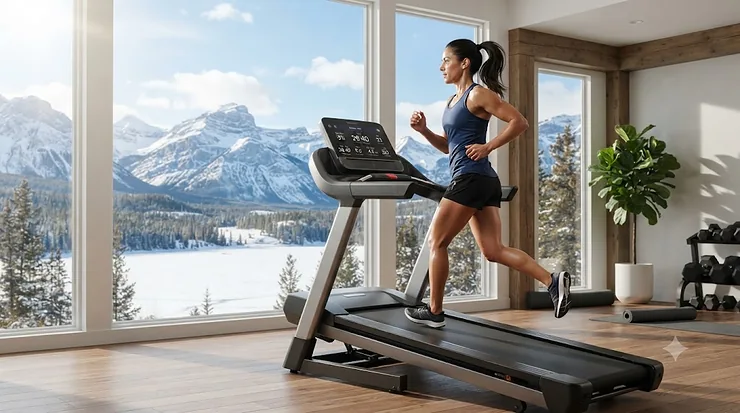
Here’s a confession most fitness marketing won’t make: almost every treadmill sold in Canada only goes one direction — up. Punch in “hill workout” and you’ll get an incline. Ask for a decline and most machines just shrug at you. A treadmill with decline feature is different — it’s a treadmill that can tilt the running deck downward, typically somewhere between -3% and -6%, so you can train the exact muscles that outdoor hills stress on the way down, not just the way up.
That gap matters more than most buyers realize. Every road race, every trail, every neighbourhood with a single hill in it eventually sends you downhill, and your quads pay the price if they’ve never practised it. Regular cardio like treadmill training also supports the broader physical activity targets Health Canada recommends for adults, so the machine you pick should be one you’ll actually use week after week, not just admire. This guide breaks down seven real, currently available machines — from budget-friendly options that sneak decline into a sub-C$1,000 price tag to commercial-grade units built for daily punishment — so you can figure out which one actually suits your knees, your goals, and your living room. We’ll lean on real specs, real aggregated reviewer sentiment, and honest trade-off analysis, not glossy marketing copy, to help you buy a treadmill with decline feature that you won’t regret in six months. If you’re specifically hunting for downhill running simulation, rehab-friendly cushioning, or just want to know whether the decline treadmill benefits are worth the extra cost, you’re in the right spot.
Quick Comparison Table
| Product | Decline Range | Incline Range | Best For |
|---|---|---|---|
| Sunny Health & Fitness SF-X7210 | -3% | Up to 45% | Best decline range on a tight budget |
| Sunny Health & Fitness SF-X7200SMART | -5% | Up to 50% | Gentlest option for rehab and walking |
| SOLE F85 | -6% | Up to 15% | Best folding all-rounder with decline |
| NordicTrack Commercial 2450 | -3% | Up to 12% | Fastest treadmill with true decline |
| Bowflex Treadmill 22 | -5% | Up to 20% | Best entertainment screen with decline |
| SOLE TT8 | -6% | Up to 15% | Deepest decline for serious hill training |
| NordicTrack Commercial X22i | -6% | Up to 40% | Widest incline-decline range on the market |
Look at that spread for a second — decline alone ranges from a gentle -3% up to a properly punishing -6%, and price follows a similar curve from entry-level to genuinely commercial-grade. The Sunny Health & Fitness SF-X7200SMART stands out as the only machine here explicitly built for slow, controlled walking rather than running, which makes it the natural fit if rehab or joint-friendly training is your priority. Meanwhile, the NordicTrack Commercial X22i and SOLE TT8 both hit -6% decline, but they get there through very different philosophies — one leans on tech and Google Maps terrain, the other on brute commercial-grade durability.
💬 Just one click — help others make better buying decisions too!😊
Top 7 Treadmills With Decline Feature: Expert Analysis
Choosing among these seven comes down to matching your body, your budget, and your goals to the right decline range — not just grabbing the biggest number on the spec sheet. Below, each model gets the full breakdown: what the specs actually mean day-to-day, who it suits, and what aggregated reviewer sentiment says about living with it long-term.
1. Sunny Health & Fitness SF-X7210 — biggest decline range on a budget
The SF-X7210 punches well above its price class by offering a genuinely wide -3% to 45% incline/decline range, something you’d expect to pay triple for. That 2.5 HP rear-drive motor isn’t going to win any speed records, but paired with the 51″ x 20″ (130 x 51 cm) shock-absorbing deck, it’s built for steady walks and jogs rather than sprint intervals. Based on the spec comparison, this is squarely a walker’s and light-jogger’s machine — the modest horsepower means marathoners and serious hill sprinters will want to look further down this list. Reviewers on retailer and fitness-equipment forums consistently note that the touchscreen’s SunnyFit TV connectivity is a pleasant surprise at this price, though some mention the display’s Wi-Fi setup takes a bit of patience. If you cannot verify certain long-term durability claims independently, it’s worth treating five-star testimonials from the brand’s own site with a healthy grain of salt and cross-checking third-party retailer reviews before buying.
Pros:
- ✅ Decline and incline range that rivals machines costing far more
- ✅ Shock-absorbing deck helps ease joint strain during longer sessions
- ✅ SunnyFit TV app adds scenic routes without a steep tech learning curve
Cons:
- ❌ 2.5 HP motor limits serious speed work and heavy daily mileage
- ❌ Smaller 51″ x 20″ deck can feel tight for taller runners
Expect to find the Sunny Health & Fitness SF-X7210 priced somewhere in the C$800–C$1,100 range at the time of research, though prices fluctuate with promotions — always check current pricing before buying. For anyone dipping a toe into decline training without committing serious money, it’s a smart-value verdict.
2. Sunny Health & Fitness SF-X7200SMART — gentlest decline for rehab and walking
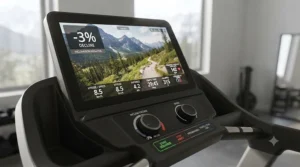
This one deliberately caps its top speed at 5 mph, which sounds like a limitation until you realize that’s exactly what makes it useful for rehab-focused or joint-conscious users. The -5% decline paired with double-deck cushioning and a 0.3–5 mph range means you can practise downhill mechanics at a genuinely controlled pace, without the machine tempting you into a full sprint. Here’s what the spec sheet won’t tell you outright, but the design choices make obvious: this is a walking and hiking simulator first, a treadmill for running second. The multi-grip handrails at high, mid, and low positions are a small but meaningful detail for anyone managing balance concerns or working back from an injury. Aggregated reviewer sentiment on Sunny’s product pages and third-party retailers tends to praise the quiet operation and stable frame, while noting the compact 20.1″ x 43.3″ deck limits stride length for taller users.
Pros:
- ✅ -5% decline at genuinely controlled walking speeds for rehab-style training
- ✅ Double-deck cushioning noticeably reduces joint impact and noise
- ✅ Multi-grip handrails support users managing balance or mobility limits
Cons:
- ❌ 5 mph top speed rules out jogging or running entirely
- ❌ Compact deck length may feel cramped for users over 6 feet tall
At around C$1,000–C$1,300 (prices may vary), this is arguably the single best-value pick on this list if “treadmill for rehab training” or gentle low-impact cardio machine use is genuinely your priority rather than an afterthought.
3. SOLE F85 — best folding all-rounder with decline
The SOLE F85 sits in that sweet spot where “folding for small spaces” and “serious machine” actually coexist. Its 4.0 HP motor and 22″ x 60″ (56 x 152 cm) deck put it in the same weight class as treadmills costing hundreds more, and the 15 levels of incline paired with 6 levels of decline give you genuine terrain variety rather than a token gesture. What most buyers overlook about this model is that SOLE doesn’t lock any of its apps behind a subscription — Netflix, YouTube, and Zwift compatibility work from day one on the 15.6″ touchscreen, unlike some rivals that need a monthly fee to unlock full functionality. Reviewers consistently report that the Cushion Flex Whisper Deck genuinely softens impact for users managing joint issues, with one recurring theme being how much more comfortable it feels than typical apartment-gym treadmills. The trade-off is honest, too: at roughly 319 lbs (145 kg), “folding” doesn’t mean “light.”
Pros:
- ✅ Full 22″ x 60″ deck folds away despite commercial-grade components
- ✅ No monthly subscription required to use built-in streaming apps
- ✅ Lifetime frame and motor warranty backs up the build quality
Cons:
- ❌ Heavy even folded, making relocation within the home a two-person job
- ❌ Console lacks live auto-adjusting terrain like iFIT-based rivals
Sale pricing has landed around C$2,199.99 at the time of research, positioning the SOLE F85 as a strong mid-range value pick — check current price before buying, since SOLE runs frequent promotions.
4. NordicTrack Commercial 2450 — fastest treadmill with true decline
If speed is your priority, the NordicTrack Commercial 2450 is the standout here, reaching up to 14 mph (22.5 km/h) — a full 2 mph faster than most rivals on this list. That 4.25 CHP motor and RunFlex cushioning system are engineered for serious interval and marathon-pace training, and the -3% to 12% incline/decline range, while more modest than the deepest declines on this list, is enough to simulate rolling hills and gentle downhill stretches realistically. Based on the spec comparison, this is a runner’s machine first and a walker’s machine second — the sheer speed ceiling would be wasted on someone who only ever walks. Here’s the honest caveat reviewers flag repeatedly: much of the automatic incline/decline adjustment magic depends on an iFIT subscription, so budget for that ongoing cost, not just the treadmill itself. Without iFIT, you’re manually setting incline and decline like any other machine.
Pros:
- ✅ 14 mph top speed suits serious interval and marathon-pace training
- ✅ Wide 24″ pivoting touchscreen and RunFlex cushioning ease long runs
- ✅ Widest running deck in NordicTrack’s standard folding lineup
Cons:
- ❌ Full value depends on an ongoing iFIT subscription
- ❌ -3% decline is shallower than several rivals on this list
Expect a price range somewhere around C$3,000–C$3,400 CAD, subject to change — this sits in premium territory, and it earns that price mainly through raw speed capability rather than decline depth.
5. Bowflex Treadmill 22 — best entertainment screen with decline
Bowflex built the Treadmill 22 as a direct answer to NordicTrack’s big-screen ambitions, and the 22″ HD touchscreen paired with a -5% to 20% incline/decline range delivers a genuinely broad training window. The SoftDrop hydraulic folding system deserves a specific mention: reviewers repeatedly note it lowers and locks with none of the jarring “letting go and hoping” feeling that cheaper folding decks produce. What the spec sheet doesn’t fully capture is how the -5% decline meaningfully changes hill-recovery workouts — you can chain an incline climb straight into a decline “descent” without stepping off, which is harder to replicate outdoors. JRNY, Bowflex’s training platform, ships with two free months, after which it becomes a recurring cost much like iFIT — a detail that’s easy to miss when comparing sticker prices alone.
Pros:
- ✅ Broad -5% to 20% incline/decline range for varied hill simulation
- ✅ SoftDrop hydraulic folding genuinely eases day-to-day storage
- ✅ Compatible with JRNY plus third-party platforms like Zwift
Cons:
- ❌ JRNY subscription cost adds up once the free trial period ends
- ❌ Premium price sits above several rivals offering a similar decline range
Pricing tends to land around C$3,000–C$3,600 at the time of research, making the Bowflex Treadmill 22 a genuine premium contender for anyone who wants both decline capability and a serious entertainment screen in one box.
6. SOLE TT8 — deepest decline for serious hill training
The SOLE TT8 is the one machine on this list built with two separate motors dedicated purely to running the incline and decline mechanism, and it shows: the -6% decline is the deepest available here alongside the X22i, and reviewers consistently describe the transition between grades as smoother and quieter than rivals in a similar price bracket. This is a light-commercial machine in the truest sense — non-folding, steel-framed, and rated for 400 lbs (181 kg), which tells you it’s designed for households that will actually put daily miles on it rather than the occasional rainy-day walk. Based on the spec comparison, the reversible 2-ply belt is a small but clever touch: flip it once the first side wears, and you effectively double the belt’s working life, a detail original Amazon-style listings rarely explain in plain terms. The trade-off for that commercial-grade durability is a permanent footprint — there’s no folding this one away after a session.
Pros:
- ✅ Industry-leading -6% decline via a dedicated decline motor
- ✅ Commercial-grade steel frame built for heavy daily household use
- ✅ Reversible belt design meaningfully extends component lifespan
Cons:
- ❌ Does not fold, requiring a permanently dedicated floor space
- ❌ Basic tablet-holder setup instead of a built-in streaming touchscreen ecosystem
Pricing has ranged from roughly C$2,400 up to C$3,300 depending on promotions and retailer — always confirm the current price, as SOLE runs frequent sales on this model. For anyone serious about downhill running simulation specifically, this is one of the strongest cases on the list.
7. NordicTrack Commercial X22i — widest incline-decline range on the market
At -6% decline and a genuinely startling 40% incline, the NordicTrack Commercial X22i isn’t really competing with typical home treadmills anymore — it’s closer to an incline trainer that happens to also run flat. The 4.0 CHP motor, 22″ HD touchscreen, and Google Maps-integrated iFIT routes mean you can technically run or hike any real-world trail’s elevation profile from your basement. What most buyers overlook here is the safety-speed cap: at steep grades, the machine automatically limits top speed (down to around 6 mph at maximum incline or decline), which is a sensible engineering choice reviewers appreciate once they understand why it’s there rather than assuming it’s a flaw. The sled-push mode is a genuinely unusual bonus, letting you power the belt with leg drive alone for strength-focused sessions. This machine is available through select Canadian retailers including Canadian Tire, which helps with delivery logistics that pure US-based online orders sometimes complicate.
Pros:
- ✅ Widest incline-decline spread of any machine on this list
- ✅ Google Maps-integrated routes simulate real elevation profiles
- ✅ Unique sled-push mode adds strength-training variety
Cons:
- ❌ Large non-folding footprint demands a genuinely dedicated space
- ❌ Full workout library requires an ongoing iFIT subscription
Expect a price range in the C$3,500–C$4,500 territory at the time of research — this is the splurge pick, justified mainly for hikers, trail runners, and anyone who wants the single widest terrain-simulation range available today.
Top 7 Treadmills: Specs & Value Comparison
| Product | Motor | Max Speed | Price Range (CAD) | Best For |
|---|---|---|---|---|
| Sunny Health & Fitness SF-X7210 | 2.5 HP | 10 mph | C$800–C$1,100 | Budget decline on a small footprint |
| Sunny Health & Fitness SF-X7200SMART | N/A (walking-focused) | 5 mph | C$1,000–C$1,300 | Rehab and low-impact walking |
| SOLE F85 | 4.0 HP | 12 mph | Around C$2,199.99 | Folding all-rounder |
| NordicTrack Commercial 2450 | 4.25 CHP | 14 mph | C$3,000–C$3,400 | Speed-focused runners |
| Bowflex Treadmill 22 | 4.0 CHP | 12 mph | C$3,000–C$3,600 | Entertainment-focused households |
| SOLE TT8 | 4.0 HP | 12 mph | C$2,400–C$3,300 | Daily heavy use, no folding needed |
| NordicTrack Commercial X22i | 4.0 CHP | 12 mph | C$3,500–C$4,500 | Hikers and trail-terrain training |
Reading across this table, motor power and top speed track fairly closely with price, but decline depth doesn’t always follow the same curve — notice that the budget Sunny Health & Fitness SF-X7200SMART matches the mid-range Bowflex Treadmill 22 on decline percentage despite a massive price gap. That’s because decline mechanisms are relatively inexpensive to engineer compared to raw motor horsepower, speed range, and touchscreen technology, which is where most of the price difference actually gets spent.
Practical Usage Guide: Setting Up and Progressing Into Decline Training
Buying the machine is the easy part. Using decline safely from week one is where most people either build lasting strength or talk themselves into a strained calf. Start with short exposures — five to eight minutes at your lowest decline setting, walking pace only, twice a week for the first two weeks. Your quads absorb dramatically more eccentric load on a decline than they do walking flat, and that unfamiliar loading is exactly what causes the notorious next-day soreness if you rush it.
A common first-30-days mistake is treating decline like incline in reverse — cranking it up because “it feels easier.” It isn’t easier on your joints; it just feels less cardiovascularly taxing while quietly loading your quads and knees harder. Set your handrail position within easy reach for your first several sessions until your balance adjusts to the forward-leaning sensation of a declined belt. For maintenance, wipe down the belt weekly and check tension monthly — a decline mechanism adds mechanical complexity, so listen for any new grinding or hesitation when the deck tilts, and address it before it becomes a bigger repair.
Progression should be boring and linear: add one decline level every one to two weeks, and only increase speed once the current grade feels genuinely comfortable rather than merely tolerable. Runners specifically training for a hilly race should pair decline sessions with dedicated rest days, since eccentric muscle damage from downhill-style loading takes longer to recover from than typical flat-belt cardio.
Real-World Scenarios: Who Actually Needs a Treadmill With Decline Feature
Picture three very different households, because the “right” treadmill genuinely depends on who’s stepping on it. First, there’s the trail-race hopeful training for a hilly half-marathon in the Gatineau hills — someone logging 40+ km a week who needs -6% decline capability, a durable non-folding frame, and enough speed range to hold marathon pace comfortably. For that profile, the SOLE TT8 or NordicTrack Commercial X22i makes the most sense, since both deliver deep decline and commercial-grade durability that daily heavy mileage demands.
Second, consider someone recovering from a knee procedure under a physiotherapist’s guidance, cleared for gentle, controlled downhill-pattern walking as part of rehab. Speed isn’t the priority here — control and cushioning are. The Sunny Health & Fitness SF-X7200SMART, with its 5 mph ceiling and double-deck cushioning, matches that need far better than any high-speed commercial machine would, and its lower price frees up budget for other rehab equipment.
Third, picture a busy suburban household in a condo with limited square footage, wanting variety for casual evening walks and the occasional jog, plus entertainment to make the time pass. The SOLE F85 or Bowflex Treadmill 22 both fold away, both offer real decline capability without commercial-grade bulk, and both come with enough streaming or app integration to keep things interesting. Matching your actual weekly use — not your aspirational one — to the machine’s design intent is the single biggest factor in whether a decline treadmill purchase pays off.
Decline Treadmill Benefits: What the Research Actually Shows
The core decline treadmill benefits come down to one physiological concept: eccentric loading. When your leg muscles lengthen under tension — exactly what happens as your quads brake your body’s momentum on a downhill stride — they adapt differently than they do from flat or uphill (concentric-dominant) training. Peer-reviewed research on sloped walking biomechanics has found measurably greater eccentric muscle contraction in the knee extensors during downhill movement than during level walking, and the effect scales with the steepness of the grade — which is the mechanical reason decline training builds a specific kind of resilience that flat-belt cardio simply can’t replicate.
That’s not just an academic curiosity — it translates directly into fewer surprises on race day. Runners who never train downhill segments often experience unusually severe next-day soreness and temporarily reduced strength after a hilly race, a pattern well documented in exercise-science literature on downhill running’s effect on muscle damage markers and recovery time. Controlled decline training on a treadmill lets you introduce that eccentric stress gradually, in a predictable, weather-independent environment, rather than getting blindsided by it during an actual race. It won’t eliminate downhill-related soreness entirely — some adaptation cost is unavoidable — but it meaningfully blunts the shock of your first hilly event.
Treadmill Incline and Decline Combo Canada: How to Choose the Right Range
Shopping for a treadmill incline and decline combo Canada-wide means weighing a handful of criteria in order of actual importance, not marketing emphasis:
- Decline depth first. If downhill-specific training is your goal, prioritize -5% or -6% machines like the SOLE TT8 or NordicTrack Commercial X22i over shallower -3% options.
- Motor power second. A 4.0+ HP or CHP motor handles daily running comfortably; anything under 3.0 HP is better suited to walking-paced use.
- Deck size third. Taller users or runners need at least 22″ x 60″; walkers can manage with smaller decks like the Sunny Health & Fitness SF-X7200SMART‘s.
- Subscription dependency fourth. Decide honestly whether you’ll actually pay for iFIT or JRNY long-term, since several machines’ “smart” features are locked behind them.
- Fold-ability fifth. Non-folding models like the SOLE TT8 demand permanent floor space; folding models trade some structural mass for flexibility.
- Warranty depth last but not least. Lifetime frame and motor coverage, common across SOLE and NordicTrack models, meaningfully changes the long-term value equation.
A common mistake buyers make here is fixating on the biggest incline number while glossing over decline entirely, then discovering months later that hill-recovery training was actually what they wanted all along. Reversing that priority order — decline depth first, everything else after — tends to produce far fewer buyer’s-remorse stories.
Downhill Running Simulation: What to Expect from Real-World Performance
Stepping onto a declined treadmill belt for the first time surprises most people. Your stride naturally shortens and your foot strike shifts forward, mimicking exactly what happens on a real downhill trail — your body is instinctively managing momentum it didn’t have to deal with on flat ground. At a gentle -3%, most walkers barely notice a difference beyond a slightly faster-feeling pace. At -5% to -6%, the sensation intensifies considerably: your quads engage noticeably harder to control your descent, and your balance systems work overtime for the first several sessions.
What the spec sheet won’t tell you, but reviewers across multiple SOLE and NordicTrack product pages note repeatedly, is that speed caps kick in automatically at steeper declines for safety — you generally can’t sprint at maximum decline the way you might on a flat belt, and that’s by design, not a flaw. Expect roughly two to four sessions before the downhill sensation stops feeling foreign and starts feeling like useful training. Genuine downhill running simulation this way won’t perfectly replicate variable trail terrain, uneven footing, or wind resistance, but for controlled, repeatable eccentric-loading practice, it’s about as close as an indoor machine gets.
Treadmill for Rehab Training: Who Should Use Decline
A treadmill for rehab training context changes the entire buying calculus, and here’s the honest starting point: any decline-based rehab protocol should be cleared by a physiotherapist or physician first, since the eccentric loading that makes decline valuable for healthy athletes can aggravate certain knee, hip, or lower-back conditions if introduced too early or too aggressively. That caveat aside, gentle decline work at slow, controlled speeds is a common component of structured return-to-running and post-surgical rehab programs, precisely because it lets clinicians introduce eccentric loading in small, measurable doses. A widely cited review of eccentric exercise in rehabilitation settings notes that body-mass-driven eccentric activities such as downhill walking can deliver genuine rehabilitation benefits without inducing muscle damage, provided the dose and progression are managed carefully.
For that specific use case, prioritize machines with a genuinely low top speed and strong cushioning over ones boasting the widest incline range — the Sunny Health & Fitness SF-X7200SMART‘s 5 mph ceiling and double-deck cushioning fit this brief better than any high-speed commercial unit could. Multi-position handrails also matter more here than almost any other spec, since balance confidence during early rehab sessions directly affects whether someone actually uses the machine consistently or abandons it out of nervousness.
Low-Impact Cardio Machine: Decline Treadmills vs Traditional Cardio Equipment
| Factor | Decline Treadmill | Flat Treadmill | Outdoor Running | Elliptical |
|---|---|---|---|---|
| Eccentric muscle training | Yes, adjustable | No | Only if hilly terrain nearby | Minimal |
| Weather dependency | None | None | High | None |
| Joint impact | Moderate (cushioned decks reduce it) | Moderate | Variable (surface-dependent) | Very low |
| Best For | Downhill-race prep, rehab, terrain variety | General cardio, budget buyers | Free, variable terrain | Ultra-low-impact cardio |
A decline treadmill occupies a genuinely useful middle ground as a low-impact cardio machine option — it delivers meaningfully more joint impact than an elliptical, but it’s the only machine on this table that can deliberately train eccentric downhill mechanics on demand, indoors, regardless of Canadian winter weather. If your knees categorically can’t tolerate any impact, an elliptical still wins outright. But if you specifically need downhill-pattern training and can’t rely on consistent access to actual hills nearby, nothing else on this comparison replicates that stimulus as directly. Long-term cost also favours the treadmill route once you factor in that outdoor running is “free” only until you account for winter footwear, visibility gear, and the sheer number of missed sessions bad weather causes in much of Canada.
Safety, Regulations & Certification for Home Treadmills in Canada
Before any decline treadmill reaches your living room, it needs to clear a basic but important bar: electrical safety certification. Health Canada’s own electrical product safety guidance is direct about this — any electrical product that plugs into an outlet must meet Canadian national safety standards and carry certification from an accredited body, and shoppers are advised to always check for marks such as CSA, cUL, or cETL before purchasing. Every model featured in this guide is sold through channels that carry recognized certification, but it’s worth confirming this marking yourself on the box or spec sheet before finalizing any purchase, particularly with imported or marketplace-only listings.
Beyond electrical certification, basic home-safety habits matter more with a decline machine than a standard flat treadmill, simply because the unfamiliar tilt sensation increases fall risk during the first few sessions. Keep the safety clip attached at all times, ensure adequate clearance behind the machine (most manufacturers recommend at least 1.2 m/4 feet of runout space), and if you’re introducing decline training as part of a structured rehab program, loop in your physiotherapist on the specific grades and durations you’re using. None of the products in this guide require special electrical wiring beyond a standard grounded household outlet, but always confirm amperage requirements against your specific model’s spec sheet before plugging in.
Frequently Asked Questions
❓ What is the best treadmill with decline feature for beginners?
❓ Is a -3% decline enough, or do I need -6%?
❓ Can a treadmill with decline feature help with rehab training?
❓ How much does a treadmill with decline feature cost in Canada?
❓ Do treadmills with decline feature need special electrical outlets?
Conclusion
A treadmill with decline feature isn’t a gimmick tacked onto a spec sheet to justify a higher price — it’s genuinely the missing half of terrain training that flat and incline-only machines simply can’t offer. Whether you land on the budget-friendly Sunny Health & Fitness SF-X7210, the rehab-friendly Sunny Health & Fitness SF-X7200SMART, the all-rounder SOLE F85, the speed-focused NordicTrack Commercial 2450, the entertainment-forward Bowflex Treadmill 22, the commercial-grade SOLE TT8, or the terrain-simulating NordicTrack Commercial X22i, the right choice comes down to matching decline depth, motor power, and footprint honestly to how you’ll actually use it — not how you imagine you might.
Downhill running simulation, rehab-focused walking, and genuine decline treadmill benefits all point toward the same conclusion: the extra investment in a decline-capable machine pays off specifically for anyone who regularly encounters real hills, is recovering from injury under guidance, or simply wants a more complete cardio tool than a flat belt provides. Take the time to match the specific machine to your specific goal, and this becomes one of those rare fitness purchases that actually gets used for years rather than gathering dust as a laundry rack.
✨ Don’t Miss These Exclusive Deals!
🔍 Take your home cardio setup to the next level with these carefully selected treadmills. Click on any highlighted model to check current pricing and availability. These machines will help you build the downhill-ready strength and low-impact routine your body will thank you for!
Recommended for You
- Budget Treadmill With Manual Incline: 7 Honest Picks (2026)
- Auto Incline Treadmill: 7 Best Picks for Canadian Homes (2026)
- Best Incline Trainer 2026: 7 Top Picks That Actually Deliver
Disclaimer: This article contains affiliate links. As an Amazon Associate, I earn from qualifying purchases. If you purchase products through these links, we may earn a small commission at no additional cost to you.
✨ Found this helpful? Share it with your friends! 💬🤗
