In This Article
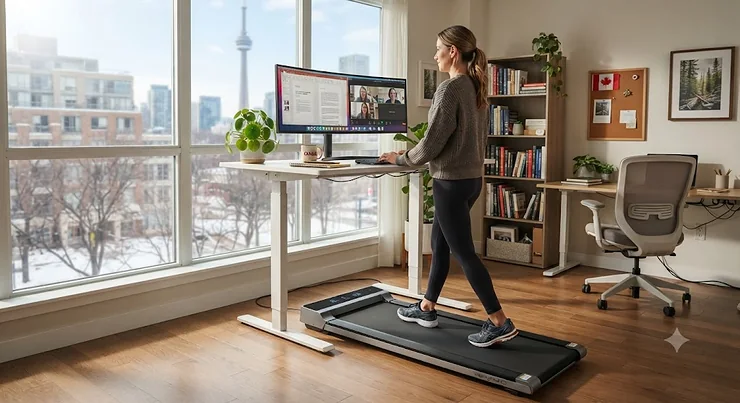
Somewhere around the third hour of back-to-back video calls, your legs start sending a very specific complaint up the chain of command: we did not sign up for this much sitting. An under-desk walking treadmill is the answer a growing number of Canadian home offices have landed on — a slim, motorized belt that slides beneath a standing desk and turns “one more email” into a few hundred extra steps instead of a few more minutes glued to a chair.
This isn’t a fringe gadget anymore. Statistics Canada’s most recent measured data shows Canadian adults spend the majority of their waking hours sedentary, and remote and hybrid work has only stretched that further for anyone whose “commute” is now fifteen steps to a spare bedroom. A good under-desk walking treadmill doesn’t replace a real workout, and it won’t turn your Tuesday stand-up into a marathon. What it does is quietly claw back movement during the hours you’d otherwise spend welded to a chair — and in 2026, the category has matured enough that there’s a genuinely good option whether you’ve got C$300 or C$1,700 to spend.
Below, we’ve dug into seven real, currently listed models sold in Canada — from bare-bones budget pads to a 159 kg (350 lb) capacity flagship — and broken down exactly what the spec sheet doesn’t tell you: which weight limit numbers you can trust, which app connectivity features are worth the setup hassle, and which pads survive being dragged out from under a desk five days a week.
What Is an Under-Desk Walking Treadmill?
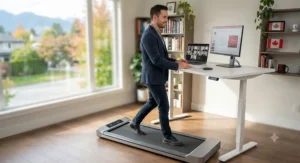
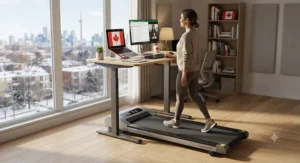
An under-desk walking treadmill (also called a walking pad) is a low-profile, motorized treadmill — typically 10–18 cm (4–7 in) tall with no permanent handrails — built to sit beneath a standing desk so you can walk at 1–6 km/h (0.5–4 mph) while you work. Unlike a full-size treadmill, it’s designed for slow, sustained movement during desk work, not running.
That low profile is the entire point. A traditional treadmill is built around handrails, a console, and enough deck length for a full running stride — none of which fits under furniture. Strip those away, flatten the motor housing, and cap the top speed at a brisk walk, and you get a machine that disappears under a desk between meetings instead of dominating a spare room.
Quick Comparison: Top Under-Desk Walking Treadmill Picks
| Pick | Best For | Speed Range | App Connectivity | Price Range (CAD) |
|---|---|---|---|---|
| TODO Under Desk Treadmill | Best budget under-desk treadmill | 0.8–8.0 km/h (0.5–5.0 mph) | No (remote only) | around C$300–C$350 |
| UREVO SpaceWalk 3S | Best app connectivity for the price | 1.0–6.4 km/h (0.6–4.0 mph) | Yes — free app, auto-incline | C$350–C$480 |
| WalkingPad A1 Pro | Best weight limit in a compact walking pad | 0.8–6.0 km/h (0.5–3.72 mph) | Yes — KS Fit app | C$900–C$1,000 |
| DeerRun Foldable Walking Pad | Best value for heavier users | 1.0–12.0 km/h (0.6–7.5 mph) | Yes — app and remote | C$380–C$480 |
| LifeSpan Fitness TR1000-DT3 | Best premium, permanent setup | 0–6.4 km/h (0–4.0 mph) | Limited (optional Bluetooth console) | C$1,500–C$1,700 |
Even in this shortlist, the spread is the story: the cheapest and priciest options here differ by more than C$1,300, yet both are legitimately good at what they’re built for. If your goal is just testing whether a treadmill for work from home actually changes your daily habits, the TODO Under Desk Treadmill removes almost all the financial risk. If you already know you’ll use it daily and want a machine that won’t need replacing in eighteen months, the LifeSpan Fitness TR1000-DT3 is built for that kind of commitment. Everything else in this guide sits somewhere on that spectrum.
💬 Just one click — help others make better buying decisions too!😊
Top 7 Under-Desk Walking Treadmills: Expert Analysis
We prioritized real, currently sold products across budget, mid-range, and premium tiers, and deliberately left out at least one popular walking pad brand — Sperax — after the U.S. Consumer Product Safety Commission logged over 200 reports of uncontrolled speed and thermal hazards on its units in 2026. That’s the kind of detail a spec sheet won’t volunteer, and it’s exactly the sort of thing worth checking before you buy any walking pad, not just the ones on this list.
Here’s the full spec breakdown for the seven models that made the cut:
| Product | Speed Range | Weight Limit | App Connectivity | Price Range (CAD) | Best For |
|---|---|---|---|---|---|
| TODO Under Desk Treadmill | 0.8–8.0 km/h (0.5–5.0 mph) | 110 kg (242 lb) | No | C$300–C$350 | Budget-first testing |
| UREVO SpaceWalk 3S | 1.0–6.4 km/h (0.6–4.0 mph) | 120 kg (265 lb) | Yes, free app | C$350–C$480 | App connectivity + incline |
| Goplus 2-in-1 Folding Treadmill | 0–12.0 km/h (0–7.5 mph) | 120 kg (265 lb) | Yes, app + Bluetooth | C$450–C$550 | Walking and light jogging |
| WalkingPad A1 Pro | 0.8–6.0 km/h (0.5–3.72 mph) | up to 136 kg (300 lb) | Yes, KS Fit app | C$900–C$1,000 | Highest weight limit, compact |
| AnthroDesk EgoFit Walker Pro M1 | up to 5.8 km/h (3.6 mph) | ~100 kg (220 lb) | Yes, app + remote | C$450–C$550 | Smallest footprint |
| DeerRun Foldable Walking Pad | 1.0–12.0 km/h (0.6–7.5 mph) | 136 kg (300 lb) | Yes, app + remote | C$380–C$480 | Budget pick, higher capacity |
| LifeSpan Fitness TR1000-DT3 | 0–6.4 km/h (0–4.0 mph) | 159 kg (350 lb) | Limited | C$1,500–C$1,700 | Permanent, daily-use setup |
Line these seven up and a pattern jumps out immediately: weight limit and app connectivity don’t rise and fall together, and price doesn’t track either one cleanly. The LifeSpan Fitness TR1000-DT3 carries the highest capacity in the group but has the weakest software experience, while the budget-tier DeerRun Foldable Walking Pad matches a premium-tier 136 kg (300 lb) limit for a third of the cost. If capacity is your non-negotiable, don’t assume the most expensive machine automatically wins it.
1. TODO Under Desk Treadmill — quietest budget pick with a genuine jogging-adjacent top speed
Most sub-C$350 walking pads cap out around 3.5–4 km/h; this one climbs to 8.0 km/h (5.0 mph), which is unusual for the price bracket. That extra headroom comes from a 0.75 HP continuous-duty motor that Todo has tuned to stay under 55 decibels — quiet enough to sit through a video call without anyone asking what that hum is.
The 110 kg (242 lb) weight limit sits on the lower end of this list, and the deck is a modest 104 x 39 cm (41 x 15.3 in), so this isn’t the machine for a household of mixed body types. What it does deliver is genuine portability: at 18 kg (40 lb), it’s light enough for one person to slide out from under a desk and lean against a wall without help.
Reviewers consistently note the motor holds its speed reliably over long sessions, but the infrared remote (no companion app) requires direct line of sight, which gets annoying once your desk is cluttered with monitor cables. A built-in 30-minute auto-shutoff also means back-to-back long meetings require a manual restart mid-walk — a small but real friction point users mention repeatedly.
Pros:
- ✅ Real 8.0 km/h top speed rare at this price
- ✅ Quiet motor stays under 55 dB
- ✅ Light enough at 18 kg to move solo
Cons:
- ❌ No app — infrared remote only
- ❌ 30-minute auto-shutoff interrupts long calls
At around C$300–C$350, the TODO Under Desk Treadmill is the lowest-risk way to find out whether a treadmill for work from home actually earns a permanent spot in your routine before you spend real money on one.
2. UREVO SpaceWalk 3S — auto-incline and full app tracking without a subscription
The standout here isn’t speed — it tops out at a modest 6.4 km/h (4.0 mph) — it’s the nine-level auto-incline, which lets you raise the calorie burn of a walk without touching the speed dial mid-meeting. That matters more than it sounds: changing incline is silent and doesn’t disrupt your stride, while bumping up speed on a narrow belt while typing is how ankles get twisted.
The belt itself is 42 cm (16.5 in) wide, noticeably roomier than most compact pads, which makes a real difference if you tend to walk with your feet slightly splayed. Weight capacity lands at 120 kg (265 lb), and the free UREVO app includes route simulations and HIIT/MIIT interval modes — genuinely useful app connectivity that doesn’t lock core features behind a paywall, unlike some competitors.
Aggregated reviews describe the unit as noticeably quieter and more “planted” underfoot than similarly priced folding pads, though several buyers flag that at 25.7 kg (56.65 lb) it’s heavier than expected for something marketed as foldable, making daily storage under a bed less practical than the listing photos suggest.
Pros:
- ✅ 9-level auto-incline adds intensity without more speed
- ✅ Wide 42 cm belt comfortable for typing posture
- ✅ Full app connectivity with no subscription fee
Cons:
- ❌ Heavier than expected for a “foldable” design
- ❌ 6.4 km/h top speed rules out jogging
In the C$350–C$480 range, this is the pick if app connectivity and incline variety matter more to you than raw speed.
3. Goplus 2-in-1 Folding Treadmill — the only one here fast enough to actually jog on
Where most walking pads plateau around walking pace, the Goplus 2-in-1 climbs to 12.0 km/h (7.5 mph) — enough for a genuine light jog, not just a brisk office shuffle. That’s backed by a 2.25 HP motor and a collapsible handrail, which folds down rather than away entirely, so you get stability at higher speeds without the machine disappearing to walking-pad dimensions when you’re done.
At 74 lb (33.6 kg) and 124 x 68 x 107 cm (49 x 27 x 42 in), it’s noticeably bulkier than the slim pads on this list — this is a treadmill that happens to fit under a desk, rather than a walking pad built specifically for that purpose. The trade-off is versatility: a 120 kg (265 lb) weight limit, a Bluetooth speaker for calls or podcasts, and app plus remote control together.
Review sentiment is consistently positive on the dual-use design but flags reduced stability once you push toward the top of the speed range, and several buyers note the larger footprint doesn’t tuck away as neatly as they’d hoped.
Pros:
- ✅ 12.0 km/h top speed enables real jogging, not just walking
- ✅ Collapsible handrail adds safety at higher speeds
- ✅ Bluetooth speaker plus full app connectivity
Cons:
- ❌ Bulkier footprint than dedicated walking pads
- ❌ Less stable near top speed
Priced around C$450–C$550, the Goplus 2-in-1 Folding Treadmill earns its spot if you want one machine that covers both desk-walking and an actual cardio session at lunch.
4. WalkingPad A1 Pro — the compact walking pad with a genuinely high weight limit
Compact walking pad and “high weight limit” don’t usually belong in the same sentence, but the WalkingPad A1 Pro is the exception: it’s available in a 136 kg (300 lb) capacity configuration while still folding down to roughly half its unfolded length. That’s a meaningfully higher weight limit than most slim pads in this price class, which typically cap around 100–120 kg.
The 42 x 119 cm (16.5 x 47 in) belt is generous for a folding design, and the KS Fit app adds a child lock and a no-load auto-stop feature that kills the belt the instant you step off — a genuinely useful safety layer for households with kids or pets nearby. Two wheels built into the frame make relocating the 28 kg (61.73 lb) unit a one-person job.
Reviewers consistently praise the weight capacity and portability wheels, but repeatedly mention the deck feels tight for anyone over about 183 cm (6 ft), and the folding hinge is noticeable underfoot on longer sessions — a fair trade-off, most conclude, for the compact footprint when folded.
Pros:
- ✅ 136 kg weight limit rare in a folding compact walking pad
- ✅ No-load auto-stop shuts off belt instantly when you step off
- ✅ Built-in wheels make relocating simple
Cons:
- ❌ Premium price point near C$1,000
- ❌ Deck feels cramped for users over 183 cm
At C$900–C$1,000, it’s the priciest compact option here, but the weight limit and safety features are aimed squarely at buyers who plan to use this daily, not occasionally.
5. AnthroDesk EgoFit Walker Pro M1 — smallest footprint for tiny home offices
If your home office is a converted closet or a corner of the living room, footprint matters more than top speed. The EgoFit Walker Pro M1 measures just 97.5 x 55.4 cm (38.4 x 21.8 in) — the smallest of the seven machines here — while still packing a fixed 5% incline that adds a steady calorie burn without requiring you to touch a single setting mid-call.
Top speed is a modest 5.8 km/h (3.6 mph), and the 42 cm (16.54 in) belt is on par with pricier competitors. At 22 kg (48.5 lb), it’s light enough to lean against a wall, and both app and physical remote control are included, giving you a choice depending on whether your phone is already occupied on a call.
Aggregated review sentiment is strongly positive on the compact footprint specifically — condo and apartment dwellers in cities like Toronto and Vancouver cite it as the reason they chose this over larger pads — though the short deck draws consistent complaints from taller users, and the low top speed rules out anything faster than a leisurely walk.
Pros:
- ✅ Smallest footprint of any model tested here
- ✅ Fixed 5% incline adds effort with zero setting changes
- ✅ Dual app and remote control included
Cons:
- ❌ Short deck uncomfortable for users over ~183 cm
- ❌ 5.8 km/h top speed unsuitable for jogging
New units run C$450–C$550, though refurbished listings occasionally dip closer to C$400 — a fair trade for buyers prioritizing square footage over speed.
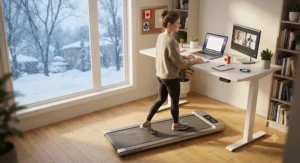
6. DeerRun Foldable Walking Pad — highest weight limit with manual incline, for less
The DeerRun matches the WalkingPad A1 Pro‘s 136 kg (300 lb) weight limit while costing roughly half as much, which is the kind of value gap that’s worth pausing on. It adds a manual 9% incline and a handlebar — genuinely useful for anyone stepping on and off frequently between calls, since a handhold at higher speeds meaningfully reduces the chance of a stumble.
Top speed reaches 12.0 km/h (7.5 mph), putting it in the same jogging-capable bracket as the Goplus, and both app and remote control are included standard. As a newer entrant to the Canadian market, it doesn’t have the multi-year review history of WalkingPad or LifeSpan, so early buyers are effectively part of the brand’s proving ground.
The reviews that do exist highlight the sturdy handlebar and the unusually generous weight limit for the price, though a handful of buyers flag slower-than-ideal customer support response times — worth weighing if after-sales service matters to you as much as the hardware.
Pros:
- ✅ 136 kg weight limit matches machines twice the price
- ✅ Manual 9% incline for added intensity
- ✅ Handlebar improves stability at higher speeds
Cons:
- ❌ Thinner review history than established brands
- ❌ Manual incline requires stopping to adjust
At C$380–C$480, this is arguably the strongest budget under-desk treadmill pick on this list for anyone whose weight limit requirements ruled out the cheaper TODO or UREVO options.
7. LifeSpan Fitness TR1000-DT3 — the desk-treadmill brand with the deepest track record
LifeSpan has been building dedicated treadmill desks longer than most competitors have existed, and the TR1000-DT3 reflects that focus: a 159 kg (350 lb) weight limit and a 51 x 109 cm (20 x 43 in) belt, both the largest in this roundup by a comfortable margin. The 2.25 HP continuous-duty motor is rated for sustained low-speed use — the exact demand profile of eight hours of desk-walking, rather than short bursts.
That capability comes at a cost, literally and physically: at 53 kg (117 lb), it’s by far the heaviest machine here, and the base “Retro” keypad console is functional but basic — a Bluetooth-enabled OmniHub display is available as a roughly C$135 add-on. The companion smartphone app, worth noting honestly, carries a poor rating on the iOS App Store, so treat app connectivity here as a “nice to have someday” rather than a current strength.
Long-established in the category, LifeSpan‘s own more recent buyer feedback flags softer build materials on newer production runs compared to older units — a detail worth knowing going in, even from a brand with this much history.
Pros:
- ✅ Highest weight limit in this lineup at 159 kg
- ✅ Widest belt for genuine stride comfort
- ✅ Long-established brand with real parts and warranty support
Cons:
- ❌ Heaviest, least portable option here
- ❌ Companion app poorly reviewed
At C$1,500–C$1,700, the LifeSpan Fitness TR1000-DT3 is the pick for someone who’s already decided a walking pad is permanent furniture, not a trial run.
How to Choose an Under-Desk Walking Treadmill
Picking between seven legitimate options comes down to matching specs to your actual desk setup, not chasing the highest number on any single spec. Work through these in order:
- Confirm your desk clearance first. Measure the gap under your desk at its lowest usable height — most walking pads need at least 15 cm (6 in) of clearance, and a few centimetres of miscalculation means returning a treadmill you can’t actually use.
- Set a real weight limit, not an optimistic one. Manufacturers rate weight limit at the point of mechanical failure risk, not comfortable long-term use — as a rule of thumb, look for a rated capacity at least 20% above your actual body weight.
- Decide if you need app connectivity or just a good remote. If you already track steps on a phone or watch, app connectivity that syncs to Apple Health or Google Fit adds real value; if you just want start/stop and speed control, a simple remote is one less thing to charge.
- Pick a speed range that matches your intent. Anything topping out around 4 km/h is built for desk-walking only; if you also want a lunchtime jog option, look at models reaching 10–12 km/h like the Goplus or DeerRun.
- Weigh portability against your storage plan. A pad you’ll slide under a bed daily needs to be genuinely light (under 25 kg); one that lives permanently under a standing desk can afford to be heavier and sturdier.
- Check noise ratings if you’re on frequent calls. Look for models specifically advertising sub-55 dB operation — the difference between “background hum” and “coworkers asking what that noise is” is smaller than you’d think.
- Read recent safety notices, not just star ratings. A high average review score doesn’t rule out a live safety recall — a quick search of the brand name plus “recall” or “CPSC” takes thirty seconds and can save a serious injury.
Canada’s own movement research backs up why this exercise is worth the effort: the Canadian Society for Exercise Physiology’s 24-Hour Movement Guidelines specifically call out reducing prolonged sitting as a distinct health target, separate from — and just as important as — hitting a weekly exercise quota.
Budget Under-Desk Treadmill vs Premium Models: What Extra Money Actually Buys You
The gap between a C$300 budget under-desk treadmill and a C$1,700 flagship isn’t just brand markup — though there’s some of that too. It’s concentrated in three areas: motor duty cycle, weight limit headroom, and software polish.
A budget under-desk treadmill like the TODO or DeerRun uses a motor rated for intermittent daily use — plenty for a few hours of walking meetings, but not necessarily engineered for eight-hour continuous shifts year after year. Premium options like the LifeSpan TR1000-DT3 use continuous-duty motors specifically rated for that longer runtime, which is where a chunk of the price difference actually goes, even though the top speed on paper looks similar or even lower.
Weight limit headroom is the second real differentiator, and it’s not linear with price — the budget-tier DeerRun matches the premium-tier WalkingPad A1 Pro‘s 136 kg capacity for roughly 40% of the cost, while the far pricier LifeSpan only edges ahead by another 23 kg. App connectivity, meanwhile, is the least predictable variable of all: the mid-priced UREVO SpaceWalk 3S offers app features that outperform the far more expensive LifeSpan‘s poorly rated companion app entirely.
Ready to compare weight limits and prices side by side? 📊 Scroll back up to the full spec table before you decide.
The honest takeaway: if your budget caps out around C$400, you’re not settling for a broken product — you’re accepting a shorter expected motor lifespan and simpler software in exchange for a legitimately functional machine.
Compact Walking Pad vs Full-Size Treadmill Desk
A compact walking pad and a full-size treadmill desk solve the same underlying problem — reduce sitting time — through genuinely different trade-offs, and confusing the two before you buy is one of the most common regrets we see in aggregated reviews.
A compact walking pad, like the EgoFit Walker Pro M1 or WalkingPad A1 Pro, slides under an existing standing desk and stores away when not in use — footprints as small as 97.5 x 55.4 cm mean it disappears into a closet or under a bed between sessions. A full-size treadmill desk, like the LifeSpan TR1000-DT3 paired with its dedicated desk surface, is a furniture-scale commitment: it stays assembled permanently, occupies a fixed floor footprint of roughly 1.5 x 1 m, and typically supports a higher weight limit and longer duty cycle as a direct result of that permanence.
| Factor | Compact Walking Pad | Full-Size Treadmill Desk |
|---|---|---|
| Typical footprint | 0.5–0.7 m² | 1.2–1.6 m² |
| Storage | Slides away, foldable | Permanent installation |
| Typical weight limit | 100–136 kg | up to 159 kg |
| Typical price (CAD) | C$350–C$1,000 | C$1,400–C$1,800+ |
| Best For | Renters, small spaces, testing the habit | Committed daily users with dedicated space |
The table makes the decision look purely spatial, but the real driver is commitment level. Renters and apartment dwellers consistently favour the compact walking pad category precisely because it doesn’t require redesigning a room, while buyers who’ve already proven the habit sticks tend to graduate toward a full-size treadmill desk for the extra weight limit and motor durability. Neither is objectively better — they’re built for different stages of the same habit.
Weight Limit: What the Number Actually Means
Every walking pad listing leads with top speed, but weight limit is the spec most likely to bite you later if you get it wrong. Manufacturers rate weight limit at the point of mechanical stress, not comfortable long-term use, and running a machine consistently near that ceiling shortens motor and belt lifespan faster than any spec sheet lets on.
The fix is simple: buy a weight limit at least 20% above your actual body weight, not right up to the rated number. Among the seven models here, that pushed the WalkingPad A1 Pro and DeerRun Foldable Walking Pad (both rated to 136 kg / 300 lb) ahead of the TODO Under Desk Treadmill and Goplus 2-in-1 Folding Treadmill (both capped at 120 kg / 265 lb or less) for anyone near the higher end of the weight range. It’s also why the LifeSpan Fitness TR1000-DT3‘s 159 kg (350 lb) ceiling exists in the first place — a machine built for eight-hour daily shifts needs headroom a lighter-duty pad simply doesn’t.
App Connectivity: Which Features Are Worth Paying For
“App connected” gets printed on nearly every walking pad box in 2026, but the phrase covers wildly different experiences, and marketing language does its most quiet exaggerating right here.
At one end, the UREVO SpaceWalk 3S includes a genuinely useful free app with route simulation and HIIT/MIIT interval modes — features you’d actually open mid-week. At the other, the LifeSpan Fitness TR1000-DT3‘s companion app carries a poor rating on the iOS App Store, which means its “smart” branding is doing more work than its actual software. Before assuming app connectivity justifies a higher price, check three things: whether the specific app syncs to Apple Health or Google Fit, whether it requires a paid subscription for basic tracking, and whether it’s rated above 4 stars on the app store the manufacturer actually links to — not just mentioned in the product listing copy.
Setting Up Your Treadmill for Work From Home Success
Getting a walking pad is the easy part; making it a durable part of your treadmill for work from home routine takes a bit of deliberate setup in the first 30 days.
Start with desk height, not the treadmill itself. Most sit-stand desks need to sit 5–8 cm higher than your normal standing height once the pad’s 10–18 cm deck is factored in — measure this before your first session, not during it, since typing at the wrong height will sour you on the whole idea faster than any hardware flaw would.
Ease into speed gradually: most reviewers who abandon a walking pad within the first month cite starting too fast, not the equipment itself. A 1.5–3 km/h (1–2 mph) pace is genuinely comfortable for typing and calls; save anything faster for dedicated walking breaks without a keyboard involved. Build a simple weekly maintenance habit too — wipe the belt with a dry cloth weekly, and check belt tension monthly per the manual, since a loose belt is the single most common cause of the “clunking” noise new owners report in reviews.
Finally, protect your quietest calls: mute your mic by default during any faster-paced stretch, and if your model includes app connectivity, use it to log a baseline in week one so you can actually see whether the routine is working after 30 days instead of guessing.
Who Should Buy One? Real-World Scenarios
The remote-work skeptic testing the waters. If you’re not sure a walking pad will actually get used, the TODO Under Desk Treadmill or UREVO SpaceWalk 3S keep the financial downside small — both sit comfortably under C$500 — while still delivering real specs, not a toy-grade experience that sours you on the whole category.
The larger-frame buyer who’s been burned by low weight limits before. If your weight sits above 90 kg, the DeerRun Foldable Walking Pad or WalkingPad A1 Pro (both rated to 136 kg) remove the anxiety of wondering whether you’re stressing a machine rated closer to your actual weight than it should be.
The small-space renter in a downtown condo. For anyone working from a studio or a one-bedroom in a dense Canadian city, the AnthroDesk EgoFit Walker Pro M1‘s 97.5 x 55.4 cm footprint is the difference between a machine that fits and one that doesn’t, full stop.
The committed daily user ready to make it permanent. If you’ve already tested the habit with a cheaper pad and know it sticks, the LifeSpan Fitness TR1000-DT3‘s 159 kg capacity and continuous-duty motor are built for exactly that longer-term, higher-frequency use case — and the Robert Half research on Canadian remote work patterns suggests hybrid arrangements are stable enough for many Canadians that this kind of investment pays off over years, not months.
Common Mistakes When Buying an Under-Desk Walking Treadmill
Even careful shoppers trip over the same handful of issues repeatedly, based on the complaints that show up most often in aggregated reviews across all seven products above.
The most common mistake is buying purely on top speed. A 12.0 km/h top speed sounds impressive, but if you’re walking at 2 km/h for six hours a day, the extra speed range you paid for sits unused — money better spent on weight limit headroom or a continuous-duty motor instead.
A close second is skipping the desk-clearance measurement entirely, ordering a pad, and discovering it’s a centimetre too tall for a desk that doesn’t adjust high enough. Measure your actual clearance before ordering, every time, regardless of how confident you feel about “average” desk heights.
Buyers also frequently underestimate noise sensitivity — a pad that sounds fine in a showroom video can be genuinely distracting during a live video call in a quiet home office, which is exactly why the sub-55 dB rating on models like the TODO Under Desk Treadmill matters more than it looks on a spec sheet.
Finally, don’t assume “foldable” means “lightweight.” As the UREVO SpaceWalk 3S review sentiment makes clear, several genuinely foldable pads still weigh over 25 kg — fine for a pad that lives permanently under a desk, but a poor fit if your plan was to slide it under a bed every evening.
Long-Term Cost, Maintenance, and Safety Certifications
The sticker price is only the entry cost. Belts typically need replacement every 2–4 years of regular use depending on frequency, running roughly C$40–C$90 for a compatible replacement belt on most of the models here. Budget models with lighter-duty motors, like the TODO or DeerRun, may see that maintenance cycle arrive sooner under daily eight-hour use than the continuous-duty motor in the LifeSpan TR1000-DT3, which is engineered specifically to delay it.
Electrical safety certification is worth checking before anything else, though it’s easy to overlook amid speed and capacity specs. Look for CSA or cCSAus certification markings on any electric treadmill sold in Canada — the CSA Group’s electrical standards program is the recognized safety-testing body for household electrical appliances here, and a certified mark is a genuine signal the motor and wiring have passed independent testing, not just a badge printed on the box.
Total cost of ownership over three years, factoring in one belt replacement, lands roughly as follows: the TODO and DeerRun sit around C$350–C$550 all-in; the UREVO SpaceWalk 3S and Goplus land near C$500–C$650; and the LifeSpan TR1000-DT3, even with its higher upfront cost, adds a comparatively modest C$1,600–C$1,800 over the same window thanks to its lower expected maintenance frequency. Viewed over three years rather than at checkout, the price gap between budget and premium narrows considerably — though it never fully closes.
Frequently Asked Questions
❓ How much does a good under-desk walking treadmill cost in Canada?
❓ What weight limit should I look for in a walking pad?
❓ Can I run on an under-desk walking treadmill?
❓ Do walking pads offer real app connectivity, or is it just marketing?
❓ Is a compact walking pad quiet enough for video calls?
Conclusion
Seven machines, three price tiers, and one consistent finding: there’s no single “best” under-desk walking treadmill, only the one that matches your actual desk, body, and budget. If you’re testing whether this habit sticks at all, the TODO Under Desk Treadmill removes the financial risk. If a higher weight limit is your priority, the DeerRun Foldable Walking Pad delivers premium-tier capacity at a budget-tier price. If app connectivity genuinely matters to your routine, the UREVO SpaceWalk 3S offers more useful software than machines costing twice as much. And if you’ve already decided this is permanent furniture, not an experiment, the LifeSpan Fitness TR1000-DT3 is built for years of daily use, not months.
Whichever you land on, the underlying case for a treadmill for work from home holds regardless of price tier: it’s one of the few habit changes that requires zero extra time carved out of your day — you’re already at your desk anyway. The only real decision left is which specific machine fits under it.
Recommended for You
- Walking Treadmill vs Under-Desk Treadmill: 7 Best Picks (2026)
- 7 Best Walking Treadmills For Canadians in 2026 (Tested Data)
- Treadmill For New Runners: 7 Best Picks In Canada (2026)
Disclaimer: This article contains affiliate links. As an Amazon Associate, I earn from qualifying purchases. If you purchase products through these links, we may earn a small commission at no additional cost to you.
✨ Found this helpful? Share it with your friends! 💬🤗
