In This Article
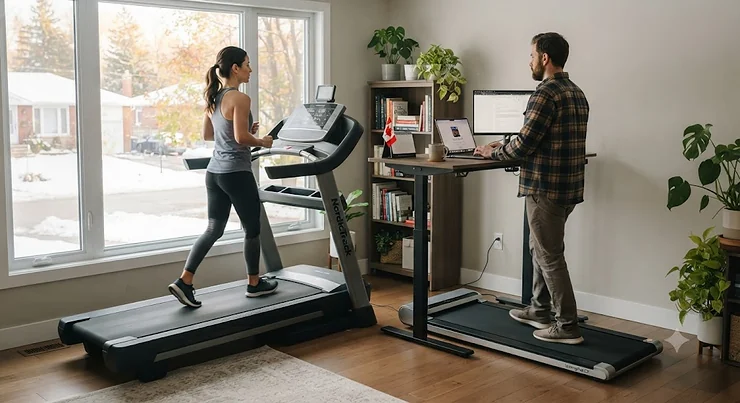
Somewhere between the third Zoom call of the day and the fourth cup of coffee, most of us realize we haven’t stood up in two hours. That’s the itch that sends Canadians searching for walking treadmill vs under-desk treadmill comparisons at 11 p.m., half-convinced a slab of moving rubber under the desk is going to fix a decade of sedentary habits. It might not fix everything, but it can genuinely change how your workday feels, and which machine you buy depends entirely on how you actually work. A walking treadmill, in the traditional sense, usually means a compact but freestanding unit with a console, sometimes handrails, and a speed range that stretches from a stroll into an honest jog. An under-desk treadmill strips all of that away: no permanent console, a deck barely taller than a doorstop, and a top speed that rarely exceeds a brisk walk, because that’s the only speed compatible with typing an email without spilling your coffee. Roughly 27.5% of working-age Canadians meet the recommended limits on daily sedentary time, according to the Public Health Agency of Canada’s Physical Activity, Sedentary Behaviour and Sleep indicators, and the average adult logs 9.3 hours a day sitting or lying down. That gap is exactly what this category of equipment tries to close, one slow, steady step at a time. Below, we’ll break down seven real products from budget under-desk pads to premium full-size units, compare them head-to-head on the numbers that actually matter for a home office, and walk through how to choose without guessing.
Quick Comparison: Walking Treadmill vs Under-Desk Treadmill
Before diving into individual products, it helps to see how the two categories stack up in general terms — because the differences aren’t cosmetic, they change how (and where) you can use the machine.
| Feature | Under-Desk Treadmill | Walking Treadmill (Full-Size) |
|---|---|---|
| Typical height/clearance | 10-18 cm (4-7 in) | 20-25 cm (8-10 in) deck height |
| Top speed | 4-6.5 km/h (2.5-4 mph) walking only | Up to 19 km/h (12 mph), walk-to-run |
| Handrails/console | Usually none; folding handle on some 2-in-1s | Permanent handrails and full console |
| Best fit under a standard desk | Yes, most standard desks (71-76 cm) | Rarely — needs a dedicated treadmill desk |
| Typical price range (CAD) | C$380-C$800 | C$1,000-C$4,000+ |
| Best for | Desk-bound walking while working | Dedicated workout sessions, faster pace |
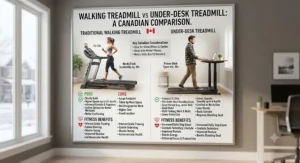
The pattern here is pretty simple once you see it laid out: under-desk models trade speed and bulk for the ability to slide under furniture you already own, while full-size walking treadmills trade portability for a genuinely faster, more varied workout — at the cost of needing a dedicated treadmill desk or a lot of floor space. Neither is objectively “better”; the right pick depends on whether your goal is light movement during work hours or a proper cardio session that happens to double as a desk.
💬 Just one click — help other gift-givers find the right glass too! 😊
Top 7 Treadmills for Office Walking: Expert Analysis
We researched real, currently available products across three price tiers — budget, mid-range, and premium — and across both categories, so you can see exactly how a C$400 walking pad stacks up against a C$3,800 full-size unit. Specs are paired with what they actually mean day-to-day, not just numbers on a spec sheet.
1. UREVO Strol 2E — best budget entry with a real safety handle
The UREVO Strol 2E is a 2-in-1 folding treadmill, meaning it ships with a removable handle that turns a bare walking pad into something with an actual grab bar — a detail that matters more than it sounds like it should the first time you misjudge your stride. Under the hood it runs a 2.25HP motor across a 15 x 40.1-inch belt, walking up to roughly 4 mph and, with the handle attached, running up to 6.2 mph, with a 265-lb weight capacity that comfortably covers most households. Based on the spec comparison against similarly priced pads, the UREVO Strol 2E punches above its price bracket mainly because of that removable handle — most sub-C$400 walking pads skip handrails entirely, and reviewers consistently note the added stability is noticeable in the first week of use, before your balance adapts to walking without visual feedback on a screen. Aggregated review sentiment across major retailers describes the deck as “surprisingly quiet” for the price and flags the companion app as clunky but functional; a recurring minor complaint is that the remote’s magnetic mount can slip loose on carpeted floors.
Pros:
- ✅ Removable handle adds real stability for beginners
- ✅ Dual-use walking and running modes in one unit
- ✅ Strong value at its price point
Cons:
- ❌ App interface feels dated compared to newer competitors
- ❌ Magnetic remote mount can loosen on soft flooring
At a price in the C$380-C$480 range, the UREVO Strol 2E is a sensible starting point for anyone unsure whether an office treadmill habit will actually stick.
2. Egofit Walker Pro M1 — smallest footprint on this list
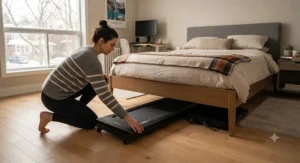
The Egofit Walker Pro M1 is built around one obsession: fitting under desks that other treadmills simply can’t. At 38.4 x 21.9 x 6.9 inches and roughly 48.5 lbs, it’s genuinely one of the most compact motorized decks on the market, with a 2.0HP DC motor driving a 16.5 x 34.25-inch walking surface at 0.6-3.1 mph (1-5 km/h). That speed ceiling is deliberately conservative — this is a “walk while you think” machine, not a cardio machine — and the fixed 5% incline is there to raise calorie burn without raising the risk of losing your footing mid-sentence on a call. What most buyers overlook about a compact unit like this is that a smaller footprint usually comes with a lower weight capacity, and at 220 lbs (100 kg), the Egofit Walker Pro M1 is one of the more restrictive options here — worth checking against your own numbers before ordering. Reviewers on Egofit’s own site and third-party retailers consistently praise how quiet the motor is (rated under 70dB at top speed, so it rarely interrupts a call), while a recurring critique is that the narrow deck takes a session or two to get comfortable with if you have a wider natural stride.
Pros:
- ✅ Smallest footprint of any unit on this list
- ✅ Whisper-quiet motor, rated under 70dB
- ✅ Wireless remote plus companion app included
Cons:
- ❌ Lower 220-lb weight capacity than most rivals
- ❌ Narrow deck may feel tight for wider strides
Priced in the C$400-C$550 range, the Egofit Walker Pro M1 is the pick for anyone whose desk setup simply has no room to spare.
3. Goplus SuperFit 2-in-1 Folding Treadmill — best convertible handlebar design
Unlike the low-profile pads above, the Goplus SuperFit 2-in-1 Folding Treadmill is built to stand up on its own two feet — literally. Fold the handlebar down and it slides under a desk at 0-2.5 mph; fold it up and it becomes a genuine 0-7.5 mph treadmill with side rails for balance. The 2.25HP motor and 16 x 39.3-inch belt sit in the same class as the other mid-range options here, but the 265-lb capacity and adjustable handlebar are what separate it from pure walking pads. Based on the spec comparison, this is the closest thing on our list to a true hybrid: reviewers who bought it specifically to replace a gym treadmill report the upright mode is genuinely usable for interval walking or light jogging, not just a marketing checkbox. Aggregated feedback flags the handlebar height as fixed once raised — a minor annoyance for taller users — and notes the fold-down process takes a bit of practice the first few times.
Pros:
- ✅ True dual-mode: desk pad and upright treadmill
- ✅ 7.5 mph top speed rivals full-size units
- ✅ Handheld remote plus app control
Cons:
- ❌ Handlebar height isn’t adjustable once raised
- ❌ Folding mechanism has a learning curve
Expect to pay around C$450-C$550, which makes the Goplus SuperFit 2-in-1 Folding Treadmill one of the better value hybrids if you want one machine that does both jobs.
4. DeerRun Z10 Pro — best automatic incline for the price
Incline is the feature most budget under-desk treadmills skip entirely, which is what makes the DeerRun Z10 Pro stand out: it offers 12 automatic incline levels on a 3.5HP motor, walking at 0.6-3.8 mph in desk mode and up to 7.5 mph in a separate running mode. The belt measures 15.75 x 41.5 inches with a 300-lb capacity, both comfortably above the class average. Here’s what the spec sheet won’t tell you directly — automatic incline on a machine this size isn’t about training for hills, it’s about quietly raising your calorie burn during a normal workday without changing your walking speed, since a 5-10% incline can increase energy expenditure by a meaningful margin at the same pace. Reviewers consistently mention the dual LED displays (one for the desk, one facing outward) as genuinely useful for glancing at stats without breaking focus, and the PitPat app integration gets generally positive marks, though a handful of users note the incline motor adds a faint hum that’s noticeable in a silent room.
Pros:
- ✅ 12 automatic incline levels, rare at this price
- ✅ Dual LED displays for easy stat-checking
- ✅ Higher 300-lb weight capacity
Cons:
- ❌ Incline motor adds slight background hum
- ❌ Running mode requires switching setups
At around C$580-C$680, the DeerRun Z10 Pro is worth the premium over basic pads if incline-driven calorie burn matters to you.
5. WalkingPad C2 — best app ecosystem and auto-speed control
The WalkingPad C2 is arguably the most recognizable name in this category, and the standout feature is FootSense — a sensor system that automatically adjusts belt speed to match your stride without touching a remote. Its 3HP brushless motor drives a generous 47.2 x 15.7-inch belt at 1-4 mph, with a 220-lb capacity and a folded thickness of just 5.4 inches for storage. On paper, this means the WalkingPad C2 behaves less like a treadmill you operate and more like a treadmill that reads you — speed up your stride and it accelerates, slow down and it eases off, which reviewers repeatedly single out as the single biggest quality-of-life improvement over remote-only competitors. The KS Fit app adds step tracking, goal-setting, and Kinomap compatibility for guided walking routes, though a common thread in aggregated reviews is that Bluetooth connectivity occasionally drops mid-session, requiring a quick app restart.
Pros:
- ✅ FootSense auto-speed adjustment, no remote needed
- ✅ Wide 47.2-inch belt, roomy for most strides
- ✅ Slim 5.4-inch folded profile for storage
Cons:
- ❌ Bluetooth connection can drop occasionally
- ❌ 220-lb capacity limits some households
Typically priced around C$600-C$800, the WalkingPad C2 suits buyers who want the most hands-off, tech-forward experience in the under-desk category.
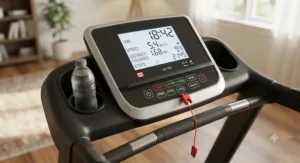
6. LifeSpan TR1000-DT5 Treadmill Desk — best integrated desk-and-treadmill combo
Step up to the premium tier and the LifeSpan TR1000-DT5 Treadmill Desk changes the conversation entirely — this isn’t a pad you slide under an existing desk, it’s a purpose-built combo with a commercial-grade 2.25HP continuous-duty DC motor, a 20 x 44-inch belt, and a 4.6-inch step-up height engineered specifically for all-day desk use. Speed tops out at a modest 0.4-4.0 mph, which is intentional: LifeSpan’s whole design philosophy, backed by a 10-year frame warranty, is built around low-impact, low-noise, sustained walking rather than workouts. Here’s what most buyers overlook about integrated treadmill desks: because the desk surface and treadmill are engineered together from the start, cable management, desk height, and belt vibration are all solved in one purchase rather than pieced together from mismatched parts, which is precisely why home-based treadmill desk users in a peer-reviewed study described it as “a game changer” for sustaining the habit long-term, according to research published in PMC/NCBI. Aggregated owner feedback highlights the whisper-quiet motor and shock-absorbing deck as the standout features, with the main complaint being the considerable footprint and weight, which makes it a poor fit for small apartments.
Pros:
- ✅ Purpose-built desk and treadmill engineered together
- ✅ 10-year frame warranty signals serious durability
- ✅ Whisper-quiet, shock-absorbing deck
Cons:
- ❌ Large footprint, unsuitable for tight spaces
- ❌ Premium price puts it out of reach for casual users
Pricing generally lands in the C$2,200-C$2,800 range through LifeSpan’s Canadian distributor, positioning the LifeSpan TR1000-DT5 Treadmill Desk as an investment for people who know the habit will stick.
7. Bowflex Treadmill 22 — best full-size walking treadmill for serious sessions
If your definition of “office treadmill” includes actual training, not just background movement, the Bowflex Treadmill 22 represents the top of what a full-size walking treadmill looks like. Its 4HP motor and 60 x 22-inch belt run from a crawl up to 12 mph, with incline adjusting from -5% to +20% — numbers that put it in an entirely different category from every under-desk pad on this list. The 22-inch HD touchscreen console, JRNY app integration, and Bluetooth heart-rate handles mean this machine is designed for dedicated workout blocks bookending the workday, not walking while typing. Based on the spec comparison, the trade-off is obvious: at 400-lb capacity and a full-size deck, the Bowflex Treadmill 22 cannot slide under a standard desk the way the other six products can, so it belongs beside a treadmill desk setup or in a home gym corner, used before or after work rather than during it. Reviewers consistently praise the touchscreen responsiveness and the negative incline feature (rare outside commercial gyms), while noise levels of 46-67 decibels during faster running are a fair trade for the extra performance headroom.
Pros:
- ✅ 12 mph top speed with full incline/decline range
- ✅ 22-inch HD touchscreen with JRNY app
- ✅ Commercial-grade 4HP motor and 400-lb capacity
Cons:
- ❌ Too large to fit under a standard desk
- ❌ Premium price point, around C$3,600-C$3,900
For Canadians who want one machine to cover both a real cardio session and, with a treadmill desk accessory, occasional walking meetings, the Bowflex Treadmill 22 is the ceiling of this comparison.
Top 7 Products at a Glance
| # | Product | Motor | Speed Range | Capacity | Price Range (CAD) | Best For |
|---|---|---|---|---|---|---|
| 1 | UREVO Strol 2E | 2.25HP | Up to 4/6.2 mph | 265 lbs | C$380-C$480 | Budget first-timers |
| 2 | Egofit Walker Pro M1 | 2.0HP | 0.6-3.1 mph | 220 lbs | C$400-C$550 | Tightest desk spaces |
| 3 | Goplus SuperFit 2-in-1 | 2.25HP | Up to 7.5 mph | 265 lbs | C$450-C$550 | Hybrid desk/gym use |
| 4 | DeerRun Z10 Pro | 3.5HP | 0.6-3.8/7.5 mph | 300 lbs | C$580-C$680 | Incline-driven burn |
| 5 | WalkingPad C2 | 3HP | 1-4 mph | 220 lbs | C$600-C$800 | Hands-off auto-speed |
| 6 | LifeSpan TR1000-DT5 | 2.25HP | 0.4-4.0 mph | 350 lbs | C$2,200-C$2,800 | All-day integrated setup |
| 7 | Bowflex Treadmill 22 | 4HP | Up to 12 mph | 400 lbs | C$3,600-C$3,900 | Serious cardio sessions |
Looking at the table as a whole, the jump in price from the WalkingPad C2 to the LifeSpan TR1000-DT5 isn’t a rounding error — it’s the line between “walking pad you place under furniture” and “furniture built around a treadmill,” and that distinction should drive your decision more than any single spec. For most home office setups, one of the first five products will do everything you actually need; the last two are for people who have already decided this is a long-term habit worth a serious budget.
Practical Usage Guide: Setting Up Your Treadmill for Office Success
Getting a new treadmill under your desk is the easy part; getting your body and your workflow to cooperate with it takes about two weeks. Start slow — 1-2 mph for the first few sessions, even if the manual says you can go faster, because typing accuracy and walking rhythm need time to sync up. Most first-time users find that mouse-heavy tasks (design work, spreadsheets with lots of clicking) are harder to do while walking than typing-heavy tasks, so schedule your walking blocks around email, writing, and reading rather than pixel-precise work. On the maintenance side, wipe the belt weekly with a dry cloth, check belt alignment monthly (a belt that drifts to one side usually means the deck needs releveling, not replacing), and lubricate silicone-belt models every 3-6 months per the manufacturer’s schedule — skipping this is the single most common reason cheap treadmills die early. A common first-30-days mistake is walking for hours at a stretch right away; ease in with 20-30 minute blocks, two to three times a day, and let your desk height, not your treadmill’s top speed, set the pace.
Real-World Scenarios: Finding the Best Treadmill for Office Walking
Picking between these seven options gets easier once you match the machine to your actual workday rather than the spec sheet. A freelance writer working from a 120 cm desk in a condo with limited floor space is the textbook case for the Egofit Walker Pro M1 — narrow footprint, quiet motor, and a speed range that won’t tempt overexertion during a four-hour writing block. A customer support rep who’s on calls most of the day but wants a real workout before and after shifts fits the Bowflex Treadmill 22 profile better, using it for a dedicated 30-minute session rather than background movement. Someone newly committed to reducing sedentary time, unsure if the habit will stick, and working with a modest budget should start with the UREVO Strol 2E or the Goplus SuperFit 2-in-1 — both are inexpensive enough that abandoning the habit isn’t an expensive mistake, and the Goplus SuperFit 2-in-1 in particular retains resale and reuse value because it doubles as a standalone treadmill. For a household office shared by two adults with different strides and step counts, the wider 47.2-inch belt on the WalkingPad C2 and its auto-adjusting FootSense speed reduce the friction of constantly re-calibrating settings between users, which reviewers repeatedly cite as the reason it becomes the default option in shared spaces.
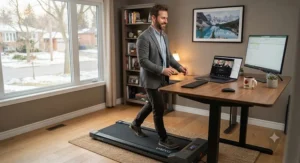
Problem-Solution Guide: Fixing Common Office Treadmill Frustrations
Problem: the treadmill is too loud for video calls. Most complaints trace back to an unlevel desk or an uneven floor rather than the motor itself; recheck the treadmill is sitting flat, and consider a rubber mat underneath, which several owners of the DeerRun Z10 Pro and Egofit Walker Pro M1 report noticeably dampens vibration noise.
Problem: typing accuracy drops while walking. This is almost always a speed issue — drop to 0.8-1.5 mph during detail-heavy tasks; every product on this list, including the WalkingPad C2‘s auto-speed mode, allows manual override for exactly this reason.
Problem: the belt feels sluggish or hesitant to start. Check the weight capacity against your own — units like the Egofit Walker Pro M1 at 220 lbs will visibly strain if used near or above that limit, which shortens motor life and feels like lag.
Problem: the remote keeps disconnecting or losing its magnetic grip. This is a documented minor complaint with the UREVO Strol 2E; relocating the remote’s mounting spot away from carpet edges usually resolves it.
Problem: no incline and calorie burn feels stagnant. Swap in a product with automatic incline, like the DeerRun Z10 Pro, or manually elevate the treadmill’s front edge slightly with a stable riser on flat-only models — never improvise with unstable materials.
What Is a Walking Treadmill vs an Under-Desk Treadmill?
A walking treadmill is a compact but freestanding machine with a console and often handrails, built for dedicated walking or light jogging sessions at speeds up to roughly 12 mph. An under-desk treadmill is a low-profile, console-free deck — typically under 18 cm tall — designed to slide beneath a standing desk so you can walk slowly (usually under 6.5 km/h) while working, not as a standalone workout. The core difference is purpose: one is built to fit your workday, the other is built to fit a workout.
That distinction matters more than most buying guides let on. A full walking treadmill, like the Bowflex Treadmill 22, is engineered for the kind of variable-intensity session you’d do at a gym — intervals, inclines, a genuine sweat. An under-desk unit, like the Egofit Walker Pro M1 or WalkingPad C2, is engineered to disappear into your workday so completely that colleagues on a call can’t tell you’re moving. Buyers who conflate the two often end up disappointed either way: someone expecting gym-level intensity from a walking pad will find it frustratingly slow, while someone expecting a bulky console treadmill to vanish under an IKEA desk will find it simply doesn’t fit.
How to Choose Between a Walking Treadmill and an Under-Desk Treadmill
- Measure your desk clearance first. Most standard desks sit 71-76 cm (28-30 in) high; subtract your chair or standing height comfort zone, and anything under about 18 cm of available clearance rules out full-size units entirely.
- Decide if this replaces a workout or supplements a workday. If you already exercise separately, prioritize a quiet, slow under-desk model; if this is meant to be your primary cardio, lean toward a full-size walking treadmill.
- Check your actual weight against the stated capacity, not just whether you technically qualify — machines running near their limit wear out faster and feel noticeably underpowered.
- Prioritize noise rating if you’re on calls often. Anything rated under 70dB, like the Egofit Walker Pro M1, is a safer bet for open-plan or shared home offices.
- Factor in whether you want manual or automatic speed control. Auto-adjusting sensors, like FootSense on the WalkingPad C2, reduce the friction of constant remote fiddling but add a small premium.
- Set a realistic budget tier. Entry-level pads in the C$380-C$550 range are enough to test whether the habit sticks before committing to a C$2,000+ integrated system.
- Confirm return policy and Canadian availability, since imported fitness electronics vary in warranty support once they cross the border.
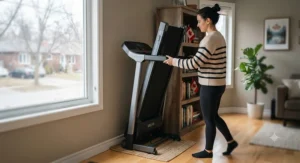
Under-Desk Treadmill Features That Actually Matter
Marketing copy for under-desk treadmills loves to list a dozen “features,” but only a handful genuinely change day-to-day use. Motor type matters more than horsepower alone — a brushless DC motor, like the one in the WalkingPad C2, tends to run quieter and last longer than cheaper brushed alternatives, even at similar HP ratings. Belt width matters more than belt length for desk use, since most walking happens in place rather than covering ground; anything under 40 cm (about 15.75 in) wide starts to feel cramped for larger strides, which is why the wider decks on the WalkingPad C2 and DeerRun Z10 Pro consistently earn better comfort feedback. Auto-start and auto-stop sensors, which pause the belt the moment you step off, are a genuine safety feature rather than a gimmick — they prevent the classic “walked away mid-call and forgot the belt was running” scenario. Incline, where available, is worth more than an extra 0.5 mph of top speed for raising calorie burn without increasing typing disruption, which is the whole logic behind the DeerRun Z10 Pro‘s inclusion here. Folding mechanism quality is the feature most reviews skip and most owners regret ignoring: a stiff, awkward fold means the treadmill quietly stops getting put away, which in small apartments often means it stops getting used at all.
Standing Desk Treadmill Comparison: Matching Setup to Workstation
Not every home office setup calls for a treadmill at all, and a fair comparison means weighing it against the alternatives you’re actually choosing between.
| Setup | Movement Level | Typical Cost (CAD) | Learning Curve | Best For |
|---|---|---|---|---|
| Sitting desk only | None | C$0-C$300 | None | Budget-first, low-movement roles |
| Standing desk (no treadmill) | Low (postural variety) | C$300-C$900 | Low | Reducing back strain, not calorie burn |
| Standing desk + under-desk treadmill | Moderate | C$700-C$1,700 combined | Moderate | Active movement during typing-heavy work |
| Integrated treadmill desk | Moderate-high | C$2,200-C$2,800+ | Low (once set up) | Long-term, all-day walking habit |
The analysis here is straightforward once the costs are side by side: a standing desk alone addresses posture but does very little for the sedentary-time numbers cited earlier in this article, while pairing it with a budget under-desk unit like the UREVO Strol 2E roughly doubles the cost but meaningfully increases daily movement. The jump to an integrated system like the LifeSpan TR1000-DT5 Treadmill Desk only pays off if you’re confident the habit is permanent, since retrofitting a standing desk with a separate treadmill later is usually cheaper than replacing a whole combo unit. Workers whose roles are genuinely typing-heavy consistently report the hybrid standing-desk-plus-treadmill setup as the best balance of cost and usability, according to guidance from the Canadian Centre for Occupational Health and Safety on active living at work.
💬 Which setup matches your workday? Share this guide with a colleague who’s still stuck sitting all day!😊
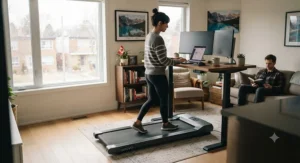
Height Clearance and Workstation Compatibility: The Measurements That Matter
This is the section most buying guides gloss over, and it’s the one that causes the most returns. Standard Canadian office desks sit at 71-76 cm (28-30 in), and most sit-stand desks lower to around 65-70 cm (25.5-27.5 in) at their minimum height — which means the real number you need isn’t your desk’s height, it’s the gap between the floor and the underside of the desk surface at its lowest practical working position, minus a couple of centimetres for clearance comfort. Among the products reviewed here, the Egofit Walker Pro M1 measures roughly 17.5 cm (6.9 in) tall, the WalkingPad C2 folds to 13.7 cm (5.4 in) and runs slightly taller in operation, and the LifeSpan TR1000-DT5 has a 11.7 cm (4.6 in) step-up height engineered specifically for its matched desk. Compare that to the Bowflex Treadmill 22, whose full-size deck sits considerably higher off the ground and simply isn’t designed to go under furniture at all — it’s meant to be walked up onto, not slid beneath something.
Workstation compatibility goes beyond raw clearance, too. Cable management becomes a real issue once a treadmill is in the mix — monitor arms, keyboard trays, and charging cables all need enough slack to move a little as you walk, and a fixed under-desk power outlet is worth more than people expect until they’re without one. Desk stability matters as well: a treadmill vibrating against a wobbly desk leg transmits that vibration straight into your monitor, which is a documented annoyance with lightweight IKEA-style desks paired with higher-power units like the DeerRun Z10 Pro. Before buying any treadmill in this comparison, measure twice — floor to desk underside, desk depth versus treadmill length, and available floor space in front of the desk for the treadmill to extend as you walk.
Remote Control, Apps, and Safety Certifications to Check Before You Buy
Control schemes vary more across this category than most buyers expect, and it’s worth understanding the trade-offs before assuming “remote control” means the same thing across every product. Physical remotes, like the one bundled with the UREVO Strol 2E, are simple and reliable but easy to misplace, and mounting quality (magnetic versus clipped) affects how often that happens. App-based control, as seen on the DeerRun Z10 Pro via the PitPat app and the WalkingPad C2 via KS Fit, typically adds step tracking, goal history, and sometimes guided walking content, but introduces a dependency on Bluetooth stability that a handful of reviewers flag as occasionally glitchy. Sensor-based auto-speed control, the WalkingPad C2‘s signature FootSense feature, removes the remote from the equation almost entirely by reading your stride directly — genuinely the most hands-off option here, though it comes at a price premium over remote-only competitors.
Safety certification is the part that’s easy to skip and shouldn’t be. Look for a CSA or cCSAus mark on the product listing or packaging before buying any electrical fitness equipment in Canada, since it confirms the unit has been tested against recognized Canadian and North American electrical safety standards, not just the manufacturer’s own claims. It’s also worth checking Canada’s consumer product recall database before finalizing a purchase, particularly for lesser-known imported brands; as a real example, Health Canada’s recall listing for a separate treadmill line recalled over a fire hazard is a reminder that this category isn’t immune to manufacturing defects, and a two-minute search before buying is cheap insurance.
Long-Term Cost and Maintenance: What Office Treadmills Really Cost to Own
The sticker price is only the starting point. Belt lubrication (for silicone-belt models), replacement remotes, and the occasional motor brush replacement on cheaper units add up to roughly C$30-C$80 a year in ongoing costs for budget and mid-range treadmills, while premium units like the LifeSpan TR1000-DT5 rely on sealed, low-maintenance components that reduce that figure but come with a much higher upfront investment. Cost-per-use tells a more honest story than sticker price alone: a C$450 Goplus SuperFit 2-in-1 used five days a week for two years works out to roughly C$0.87 per session, while a C$3,750 Bowflex Treadmill 22 used at the same frequency lands closer to C$7.21 per session in year one alone — though that figure improves considerably in years two through ten given the machine’s commercial-grade build quality and long service life. Electricity cost is negligible across the board, typically a few cents per hour of use for any of these motors. The real long-term cost variable is durability: brushless motors, higher HP ratings, and higher weight-capacity headroom (like the 300-350 lb ratings on the DeerRun Z10 Pro and LifeSpan TR1000-DT5) generally translate into fewer replacement purchases over a five-year window, which is worth weighing against the lower sticker price of narrower-margin budget units.
Frequently Asked Questions
❓ Can I run on an under-desk treadmill?
❓ How many calories does a walking desk treadmill burn per hour?
❓ Do under-desk treadmills need to be bolted down or professionally assembled?
❓ What desk height works best with a walking treadmill?
❓ Are under-desk treadmills loud enough to disturb video calls?
Conclusion
The honest answer to walking treadmill vs under-desk treadmill isn’t “one wins” — it’s that they’re solving two different problems that happen to share a category name. If your goal is quiet, low-speed movement stitched into a normal workday, an under-desk pick like the Egofit Walker Pro M1 or WalkingPad C2 is going to serve you better than any full-size machine ever will, purely because it fits the furniture and the moment. If your goal is a real workout that happens to double as an occasional walking meeting, something in the Bowflex Treadmill 22 or LifeSpan TR1000-DT5 Treadmill Desk class earns its higher price tag. Between those extremes sit genuinely solid middle options — the UREVO Strol 2E and Goplus SuperFit 2-in-1 for budget-conscious first attempts, the DeerRun Z10 Pro for anyone who wants incline without a big price jump. Measure your desk clearance, be honest about your weight capacity needs and noise tolerance, and pick the tier that matches how long you actually expect to use it — that single decision matters more than any individual spec on this page.
Recommended for You
- 7 Best Walking Treadmills For Canadians in 2026 (Tested Data)
- Treadmill For New Runners: 7 Best Picks In Canada (2026)
- 7 Best Treadmills for Small Apartments in Canada (2026)
Disclaimer: This article contains affiliate links. As an Amazon Associate, I earn from qualifying purchases. If you purchase products through these links, we may earn a small commission at no additional cost to you.
✨ Found this helpful? Share it with your friends! 💬🤗
