In This Article
Your knees keep score. Every sidewalk slab, every frozen January step, every downhill stretch on the way home from the grocery store gets logged somewhere between your femur and your shin. For a lot of Canadians, that ledger eventually shows up as a dull ache after a 30-minute walk — or a sharp one on the stairs the morning after.
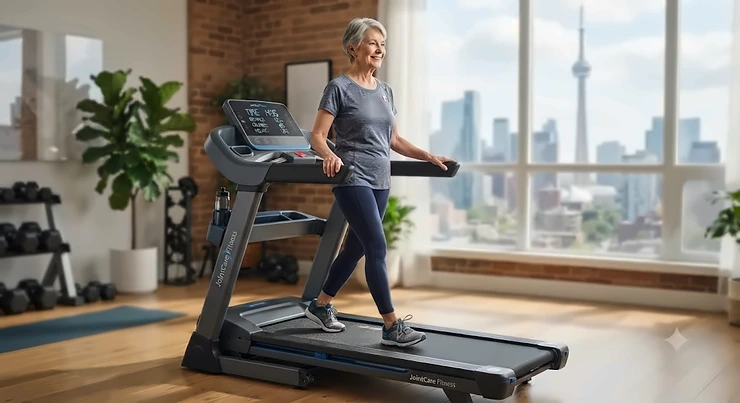
Here’s the good news: stopping isn’t the answer. The Arthritis Society Canada’s guidance on walking is blunt about it — keeping joints moving is one of the most important things a person with arthritis can do. The trick is changing what you move on. And that’s exactly where a low-impact treadmill for joint pain earns its floor space.
What Is a Low-Impact Treadmill for Joint Pain?
A low-impact treadmill for joint pain is a home treadmill engineered to reduce the jolt each footstrike sends through your ankles, knees and hips. It does this through deck cushioning (elastomers, springs or flexing deck mounts), a padded multi-ply belt, a long enough deck for a natural stride, and smooth speed and incline control.
That’s the definition. The reality is messier, because “cushioned” is the most abused word in treadmill marketing. A C$500 folding machine and a C$3,000 flagship can both print it on the box, and they mean wildly different things.
So in this guide, I’ve dug into real spec sheets, manufacturer warranty terms, Canadian recall data and aggregated owner feedback on seven machines sold through amazon.ca. No invented testing, no fantasy star ratings — just honest analysis of which low-impact treadmill for joint pain fits which body, budget and living room. Grab a coffee. Your knees will thank you for the next ten minutes.
Quick Comparison Table: 7 Knee-Friendly Treadmills at a Glance
| Treadmill | Cushioning System | Deck / Belt Size | Max User Weight | Approx. Price Range | Best For |
|---|---|---|---|---|---|
| Sole F80 | Cushion Flex Whisper Deck | 56 × 152 cm (22 × 60 in) | 160 kg (350 lb) | C$2,700–C$3,200 | Runners and heavier users with sore knees |
| Sole F63 | Cushion Flex Whisper Deck | 51 × 152 cm (20 × 60 in) | 147 kg (325 lb) | C$1,800–C$2,200 | Best all-round joint protection |
| NordicTrack T 6.5 S | Runner’s Flex (on/off) | 56 × 140 cm (22 × 55 in) | 136 kg (300 lb) | C$1,000–C$1,400 | Walkers who want adjustable firmness |
| Horizon Fitness T101 | 3-Zone Variable Response | 51 × 140 cm (20 × 55 in) | 136 kg (300 lb) | C$900–C$1,300 | Mid-range walkers and light joggers |
| XTERRA Fitness TR150 | XTRASoft Deck Cushioning | 41 × 127 cm (16 × 50 in) | 114 kg (250 lb) | C$550–C$750 | Budget walkers in small spaces |
| Sunny Health & Fitness SF-T4400 | Impact-absorbing deck | 39 × 124 cm (15.5 × 49 in) | 100 kg (220 lb) | Under C$700 | Entry-level, lighter users |
| UREVO SpaceWalk 5L | 12-point shock absorption | 100 × 40 cm (39.4 × 15.8 in) | 181 kg (400 lb) | C$450–C$650 | Under-desk incline walking |
Reading the table top to bottom, one pattern jumps out: deck length drops faster than price. The Sole F63 and Sole F80 are the only two here with a full 152 cm (60 in) deck, which matters because a cramped deck shortens your stride — and shortened, choppy strides are hard on irritated knees. Meanwhile, the UREVO SpaceWalk 5L is the surprise outlier: tiny deck, walking-only speeds, yet the highest weight rating on the list.
💬 Just one click — help others make better buying decisions too!😊
Top 7 Low-Impact Treadmills for Joint Pain: Expert Analysis
Prices below are ranges at the time of research — they shift often on amazon.ca, so always check current price before you buy.
1. Sole F63 — best all-round cushioned treadmill for knees
The Sole F63 is the machine most review outlets keep returning to when the brief is “sore knees, real workouts.” Its Cushion Flex Whisper Deck is Sole’s signature system, and Sole claims it reduces joint impact by up to 40% compared with running on a road surface — a manufacturer figure, so treat it as directional rather than lab-certified.
The spec sheet backs up the cushioning with sensible hardware. A 3.0 HP motor, speeds from 1 to 18 km/h and 15 incline levels mean you can walk briskly uphill instead of running flat — often the smartest move for arthritic knees. The 51 × 152 cm deck gives a full-length stride even for taller users, and the 147 kg (325 lb) capacity leaves a comfortable safety margin.
Who’s it for? Anyone who wants one machine to last a decade. The lifetime frame and motor warranty is the quiet star here; at this price, that coverage turns the Sole F63 into a long-term health purchase rather than a gadget. Reviewers consistently describe the deck as noticeably softer than big-box budget treadmills, while the recurring complaints centre on a basic LCD console and a hefty build that makes moving it a two-person job.
Pros:
- ✅ Full 152 cm deck supports a natural, unhurried stride
- ✅ Lifetime frame and motor warranty in Canada
- ✅ 15 incline levels for low-impact hill walking
Cons:
- ❌ Basic display lacks built-in streaming classes
- ❌ Heavy frame is awkward to relocate
Usually sits in the C$1,800–C$2,200 range — the best value-per-year pick for most sore-kneed buyers.
2. Sole F80 — best for heavier users and runners with bad knees
The Sole F80 is essentially the Sole F63 after a serious gym membership. It uses the same Cushion Flex Whisper Deck, but everything around that deck is beefier, which changes how the cushioning feels under load.
The 3.5 HP motor and larger 6.1 cm (2.4 in) rollers matter more than they look. Bigger rollers turn more slowly for the same belt speed, which means less wear and a smoother belt feel — and a jerky belt is precisely what aggravates an already-irritated knee. The 56 cm (22 in) width gives heavier or wider-stepping users room to walk without edge anxiety, and speeds reach 20 km/h for anyone still running.
Based on the spec comparison, this is the machine for users over roughly 115 kg or anyone logging daily runs. A flexing deck under a heavier body compresses more; a stronger frame and 160 kg (350 lb) capacity keep that flex controlled instead of mushy. Aggregated owner feedback praises the stability at speed and the three-year parts coverage, while the most common complaints are price and the sheer size, even folded.
Pros:
- ✅ Widest, longest deck in this lineup
- ✅ Larger rollers deliver smoother, quieter belt motion
- ✅ Three-year parts plus lifetime frame and motor coverage
Cons:
- ❌ Premium price is hard to justify for casual walkers
- ❌ Bulky footprint, even when folded upright
Expect roughly C$2,700–C$3,200 — expensive, but the best treadmill for bad knees if you’re big, tall or still running.
3. Horizon Fitness T101 — best mid-range 3-zone cushioning
The Horizon Fitness T101 brings a feature usually reserved for pricier machines: 3-Zone Variable Response Cushioning. The deck is softer where your foot lands, firmer where you push off, which is smart biomechanics rather than a gimmick.
Why zones matter: a uniformly soft deck can feel like walking on a gym mat — comfortable at first, tiring for your calves over 45 minutes. Softer landing plus firmer push-off gives you treadmill shock absorption without sapping energy. The 2.5 HP motor, 0.8–16 km/h speed range and 0–10% incline suit walkers and easy joggers, and the 136 kg (300 lb) capacity covers most households.
What most buyers overlook is the 140 cm (55 in) deck. It’s fine for walking, but taller joggers may feel their stride clip the motor hood. Reviewers consistently call it a solid, no-frills machine for walking or jogging a few times a week; some mention wobble at higher speeds and occasional mechanical issues after heavy use. Note also that an earlier T101-05 batch was recalled in Canada in 2022 for a software fix — more on that in the safety section below.
Pros:
- ✅ Zoned cushioning balances comfort with push-off energy
- ✅ Lifetime frame and motor warranty for peace of mind
- ✅ Folds compactly with easy-roll transport wheels
Cons:
- ❌ 55-inch deck feels short for tall runners
- ❌ Some shake reported above jogging speeds
Typically found around C$900–C$1,300 — strong value for walkers who want real deck cushioning without flagship pricing.
4. NordicTrack T 6.5 S — best for adjustable deck firmness
The NordicTrack T 6.5 S has one feature nobody else on this list offers: Runner’s Flex cushioning you can switch on or off. Softer on bad days, firmer when you want road-like feedback.
That toggle is more useful than it sounds. Many people with knee osteoarthritis have “good weeks” and “flare weeks.” On a flare week, flex on; when you’re rebuilding strength for outdoor hikes, flex off gets your joints used to firmer ground gradually. The 2.6 HP motor, 0–10% power incline and 16 km/h top speed place it firmly in walker-and-jogger territory, while the 56 cm (22 in) belt width is generous for this class.
The honest analytical take: this is an older design, and it shows. Reviews flag small 4.8 cm (1.9 in) rollers, a one-year parts warranty and noticeable motor noise. Aggregated owner sentiment lands around “good entry-level machine for walkers, not a bargain for runners.” Buy it for the adjustable cushioning and wide deck, not for longevity bragging rights.
Pros:
- ✅ On/off cushioning adapts to flare-ups
- ✅ Wide 22-inch belt feels stable underfoot
- ✅ EasyLift folding saves floor space
Cons:
- ❌ Short one-year parts warranty
- ❌ Smaller rollers and louder operation than premium rivals
Around C$1,000–C$1,400 when in stock — a fair choice for walkers who value flexibility over durability.
5. XTERRA Fitness TR150 — best budget cushioned deck
The XTERRA Fitness TR150 is the value play for walkers who want genuine deck cushioning without crossing C$800. Its XTRASoft Deck Cushioning is basic compared with Sole’s system, but it’s a meaningful step up from a bare board.
The specs tell you exactly who it’s built for. A 2.25 HP motor and 0.8–16 km/h range handle walking and occasional jogging; three manual incline levels let you set a gentle grade before you start. The 41 × 127 cm (16 × 50 in) surface is compact — great for apartments, less great for anyone over about 180 cm with a long stride. Capacity tops out at 114 kg (250 lb).
Here’s what to weigh: the lifetime frame warranty is excellent, but motor coverage is one year and parts and labour just 90 days. That makes it a sensible “test the habit” purchase rather than a ten-year investment. Reviewers generally report easy assembly and a quiet belt at walking speeds, with the recurring complaint being that the narrow deck feels confining for jogging.
Pros:
- ✅ Genuine deck cushioning at an entry-level price
- ✅ Lifetime frame warranty from XTERRA Canada
- ✅ Compact fold suits condos and apartments
Cons:
- ❌ Short 90-day parts and labour coverage
- ❌ Narrow 16-inch belt limits jogging comfort
Generally C$550–C$750 — excellent value for lighter walkers starting a daily routine.
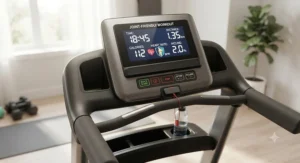
6. Sunny Health & Fitness SF-T4400 — lightest-footprint starter treadmill
The Sunny Health & Fitness SF-T4400 is a no-apologies budget machine, and it’s honest about it. Its impact-absorbing deck takes the edge off hard floors, which for a beginner walker is sometimes all that’s needed.
The 2.2 peak HP motor reaches about 14.5 km/h, and three manual incline levels go up to 4.3%. The belt measures 39 × 124 cm (15.5 × 49 in), the machine weighs around 45 kg, and a soft-drop hydraulic fold means it won’t slam shut on your toes. Capacity is 100 kg (220 lb) — the lowest here, which is the key filter.
Based on the spec sheet, this suits lighter users walking 20–30 minutes a day, not anyone rebuilding after knee surgery or running intervals. A short deck forces a shorter stride; for sensitive joints, walk slower and stay centred. Expert reviews describe it as stable and easy to use for beginners, while the common knocks are the short deck, the flimsy tablet holder and limited parts coverage (180 days).
Pros:
- ✅ Very affordable way to start low-impact walking
- ✅ Soft-drop hydraulic folding for safer storage
- ✅ Simple controls with handlebar pulse sensors
Cons:
- ❌ 220 lb limit excludes many adult users
- ❌ Short 49-inch belt restricts natural stride
Usually under C$700 — fine for light users, but stretch your budget if weight or height is borderline.
7. UREVO SpaceWalk 5L — best under-desk incline walking pad
The UREVO SpaceWalk 5L isn’t a treadmill in the classic sense — it’s a walking pad with an unusual trick: 0–9% automatic incline. Listings on amazon.ca pitch it with “12-point shock absorption,” which UREVO describes as eight silicone absorbers plus a suspended running board and four support points.
Why incline on a walking pad matters for joints: walking uphill at 5 km/h raises your heart rate without the pounding of faster speeds. The dual brushless 2.5 HP motor tops out at 6.4 km/h, so this is walking-only. The 100 × 40 cm belt is short, but at walking pace a shorter stride is less of a problem. Surprisingly, the 181 kg (400 lb) capacity beats every full treadmill here.
Who’s it for? Remote workers who sit eight hours and want to break it up without a hulking machine. At 23 kg and about 15.5 cm tall, it slides under a couch. Review sentiment highlights quiet operation and the incline as the standout; complaints focus on the small platform and the fact that it simply can’t do running.
Pros:
- ✅ Auto incline adds intensity without extra impact
- ✅ Highest weight capacity in this lineup
- ✅ Slim enough to store under furniture
Cons:
- ❌ No handrail stability for balance-challenged users
- ❌ Walking speeds only, capped at 6.4 km/h
Roughly C$450–C$650 — the smartest low-cost option for desk-bound walkers with cranky knees.
Top 7 Specs Side by Side
| Treadmill | Motor | Speed Range | Incline | Warranty Highlights | Best For |
|---|---|---|---|---|---|
| Sole F80 | 3.5 HP | 1–20 km/h | 15 levels | Lifetime frame/motor, 3-yr parts | Heavy users, runners |
| Sole F63 | 3.0 HP | 1–18 km/h | 15 levels | Lifetime frame/motor, 2-yr parts | Long-term all-rounder |
| NordicTrack T 6.5 S | 2.6 HP | Up to 16 km/h | 0–10% power | 1-yr parts | Flare-up flexibility |
| Horizon Fitness T101 | 2.5 HP | 0.8–16 km/h | 0–10% power | Lifetime frame/motor | Mid-budget walkers |
| XTERRA Fitness TR150 | 2.25 HP | 0.8–16 km/h | 3 manual | Lifetime frame, 1-yr motor | Budget walkers |
| Sunny Health & Fitness SF-T4400 | 2.2 peak HP | Up to 14.5 km/h | 3 manual (4.3%) | 3-yr frame, 180-day parts | Light beginners |
| UREVO SpaceWalk 5L | 2.5 HP brushless | 1–6.4 km/h | 0–9% auto | 1 yr + 180-day extension | Desk walking |
The warranty column is the one most shoppers skim, and it’s arguably the most revealing. Both Sole models and the Horizon Fitness T101 back their motors for life, which signals confidence in the components absorbing years of impact. Meanwhile, the NordicTrack T 6.5 S and budget models trade longer coverage for a lower sticker price — fine for walkers, riskier for anyone planning daily sessions.
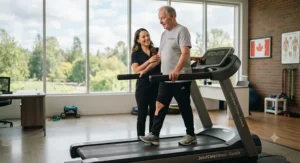
How Treadmill Shock Absorption Actually Works
Every treadmill is a sandwich: a steel frame, a deck board, and a belt riding on top. Treadmill shock absorption happens in the layers between — and knowing them lets you see through the brochure.
Deck cushioning
Deck cushioning is where most of the magic happens. The deck board sits on elastomer bumpers, springs or flexible isolators instead of bolting rigidly to the frame. When your foot lands, the deck flexes a few millimetres, stretching out the moment of impact. Sole’s Cushion Flex uses elastomer isolators; Horizon’s 3-Zone varies firmness front to back; NordicTrack’s Runner’s Flex lets you engage or bypass it.
Treadmill belt padding
Treadmill belt padding is the second layer. Multi-ply belts (the Sole models use two-ply) add a thin cushion and, just as importantly, stay flatter and smoother over time. A thin single-ply belt stretches, slips and creates micro-jerks — tiny but repetitive stresses your knees notice long before you do.
Frame rigidity
This is the counterintuitive one. Softness only helps if the frame beneath it is stiff. A wobbly frame adds sideways sway, and lateral instability is arguably worse for arthritic knees than vertical impact. That’s why the heavier Sole F80 can feel “more cushioned” than a lighter machine with softer bumpers.
If you want the textbook history of the machine itself, the treadmill entry on Wikipedia is a fun detour — these things started life as punishment devices in 19th-century prisons. Modern deck cushioning is a far kinder invention.
Practical Usage Guide: Setting Up a Cushioned Treadmill for Knees
Buying the machine is half the job. How you set it up decides whether it actually protects your joints.
Week one setup checklist
- ✅ Level it properly. Most treadmills have adjustable rear feet. An uneven deck twists the frame, which stiffens the cushioning on one side. Use a phone level app on the deck.
- ✅ Use a proper mat. A dense rubber equipment mat protects floors and dampens vibration — especially important in upper-floor condos and on basement concrete.
- ✅ Check belt tension and centring. A loose belt slips on push-off; too tight and it wears rollers. Your manual lists the exact test (usually lifting the belt edge a few centimetres at the midpoint).
- ✅ Turn on the cushioning. Obvious on the NordicTrack T 6.5 S, but worth checking in the settings of any adjustable model.
First 30 days: pacing your joints
Start at 15–20 minutes, three or four days a week, at a comfortable walking speed of roughly 4–5 km/h. Add five minutes per week before you add speed. Once you’re comfortable, add 1–3% incline rather than going faster — incline walking raises effort without increasing footstrike force the way running does.
For context, the Canadian 24-Hour Movement Guidelines for adults recommend at least 150 minutes of moderate-to-vigorous aerobic activity a week. Five 30-minute brisk incline walks gets you there with zero running.
Maintenance schedule
- 🔧 Weekly: wipe the belt and deck edges; dust is the enemy of smooth belt travel.
- 🔧 Every 3 months: check belt tension and alignment.
- 🔧 Every 6–12 months (or per manual): lubricate under the belt with the manufacturer’s silicone lubricant. A dry deck creates drag, and drag creates jerky footfalls.
Real-World Scenarios: Matching the Machine to Your Knees
Specs are abstract. People aren’t. Here are three realistic profiles and the reasoning behind each match.
Scenario 1: The retiree with knee osteoarthritis in Winnipeg
Margaret-type profile: late 60s, mild-to-moderate knee OA, walks daily from May to October but loses five months to ice. Budget around C$2,000. She needs a long deck, handrails, gentle speeds and serious cushioning. The Sole F63 fits: full-length deck, 15 incline levels for “hill” walks without pace changes, and a warranty that outlasts most furniture. Frequency: daily, 30–40 minutes.
Scenario 2: The remote worker with a stiff knee in a Toronto condo
Early 30s, patellofemoral pain from years of desk sitting, 60 m² apartment, downstairs neighbours. Budget under C$700. The UREVO SpaceWalk 5L makes sense here: quiet brushless motor, 9% incline for workout days, and it disappears under the sofa. Frequency: 2–3 hours of slow desk walking spread across the workday, plus two short incline sessions weekly.
Scenario 3: The former runner managing old injuries in Calgary
Mid-40s, 105 kg, meniscus history, still wants to jog intervals twice a week. Budget flexible. The Sole F80 is the pick: a 56 cm belt and stiff frame keep the stride stable, bigger rollers smooth the belt, and 160 kg capacity means the cushioning won’t bottom out. Frequency: four sessions weekly — two incline walks, two short jog intervals.
The pattern across all three? Match the machine to your weight, stride and frequency first, then to your budget. Cushioning is only as good as the frame holding it up.
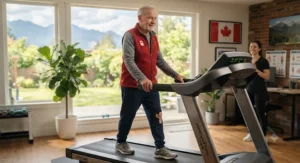
Problem → Solution: Fixing Common Joint Complaints on the Treadmill
Even the best treadmill for bad knees can’t fix bad habits. Here are the problems owners report most often — and what actually helps.
Problem 1: Knee pain increases after longer sessions.
Problem 2: The deck feels 'hard' despite the marketing.
Problem 3: Holding the handrails 'for safety.'
Problem 4: Shin or kneecap pain on incline.
Problem 5: Belt hesitates or surges.
How to Choose a Low-Impact Treadmill for Joint Pain
Want the short version? Here are seven steps, in order of importance for sore joints.
- Confirm real deck cushioning. Look for a named system (Cushion Flex, 3-Zone, Runner’s Flex) rather than vague “shock-absorbing” language — named systems are usually engineered, not just rubber pads.
- Measure your stride against the deck. Walkers can manage 127–140 cm; joggers and anyone over about 183 cm should prioritise 152 cm (60 in) decks.
- Check belt width. Wider belts (51–56 cm) reduce edge anxiety, which prevents the cramped, cautious gait that strains knees.
- Match capacity to your weight plus a margin. Aim for a rating at least 20–25 kg above your body weight so cushioning isn’t working at its limit.
- Prioritise incline over top speed. For most people with joint pain, a good incline motor adds more usable training than an extra 4 km/h.
- Read the warranty like a spec. Lifetime frame and motor coverage suggests components built to tolerate years of impact.
- Consider step-up height and handrails. Lower decks and full-length rails matter for seniors and anyone with balance concerns.
Follow those steps in that order and a lot of the confusing model names suddenly narrow to two or three choices.
Treadmill Belt Padding vs Deck Cushioning: Features That Actually Matter (And Those That Don’t)
Treadmill marketing loves a long feature list. For joint pain, only a handful move the needle.
Features that genuinely matter
- ⚡ Deck cushioning quality — the single biggest factor for footstrike comfort. The difference between the Cushion Flex on the Sole F63 and a basic budget deck is something reviewers consistently notice.
- ⚡ Treadmill belt padding and belt quality — a two-ply belt stays flat and smooth longer. Smoothness protects joints as much as softness does.
- ⚡ Deck length and width — they determine whether you walk naturally or shuffle defensively.
- ⚡ Incline range — the joint-friendly way to increase intensity.
- ⚡ Roller size — larger rollers (like the 6.1 cm set on the Sole F80) mean smoother belt travel and less wear.
Features that matter less than you’d think
- 📺 Giant touchscreens — lovely, but they add cost without protecting a single cartilage cell. A tablet holder does the job.
- 🏃 Top speeds above 16 km/h — irrelevant for walkers and most people managing joint pain.
- 🎵 Built-in speakers — nice-to-have at best.
- 📉 Decline modes — occasionally useful, but downhill walking loads the front of the knee, so many people with joint pain use it sparingly.
The takeaway: spend your money on the deck, belt and frame. Everything with a screen can be replaced by the phone already in your pocket.
Low-Impact Treadmill vs Other Joint-Friendly Cardio
Is a treadmill even the right tool? It depends on your joints, and it’s worth comparing honestly.
| Option | Joint Impact | Weather-Proof? | Weight-Bearing Benefit | Best For |
|---|---|---|---|---|
| Cushioned treadmill (e.g., Sole F63) | Low–moderate | ✅ Yes | ✅ Yes | Walkers wanting a natural gait year-round |
| Outdoor sidewalk walking | Moderate | ❌ No (ice, snow) | ✅ Yes | Mild symptoms, good weather |
| Elliptical trainer | Very low | ✅ Yes | ✅ Yes (partial) | Severe flare-ups, no-impact phases |
| Stationary bike | Very low | ✅ Yes | ❌ No | Post-surgery rehab, knee range-of-motion work |
| Pool walking | Minimal | ✅ Indoors | ❌ Limited | Advanced arthritis, obesity-related joint pain |
The table shows the treadmill’s sweet spot: it’s one of the few options that keeps the familiar walking pattern and weight-bearing benefit while stripping out the concrete, ice and curbs. Ellipticals and bikes are gentler still, but they don’t train the exact movement you need for groceries, stairs and life. For many Canadians, a cushioned treadmill for knees plus one no-impact option for flare weeks is the most practical combination.
What Orthopedic Recommendations Say About Treadmill Walking
Let’s be clear first: this article isn’t medical advice, and your physiotherapist or doctor knows your knees better than any spec sheet. That said, common orthopedic recommendations for joint pain tend to agree on a few principles that line up neatly with treadmill training.
Movement beats rest. The Arthritis Society Canada’s hip and knee exercise guide emphasises strengthening and regular movement to support osteoarthritic joints. Walking is typically among the first activities recommended.
Control the variables. A treadmill lets you control surface, speed, grade and duration precisely — exactly what gradual progression requires. You can’t dial the sidewalk down 0.3 km/h.
Use pain as a guide. A common clinical rule of thumb is that mild discomfort during exercise that settles within a day or so is generally acceptable, while pain that lingers or worsens is a signal to scale back. Ask your clinician for your personal thresholds.
Pair cardio with strength. Most orthopedic recommendations stress that strong quads, hamstrings and glutes offload the knee. Treadmill walking builds endurance; add simple strength work two or three days a week.
Footwear still counts. Deck cushioning doesn’t replace supportive shoes. A worn-out midsole can undo much of what treadmill shock absorption gives you.
In short, a low-impact treadmill for joint pain is a tool that makes the advice easier to follow — not a replacement for it.
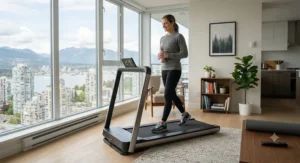
Best Treadmill for Bad Knees: Seniors and Heavier Users
Two groups deserve specific attention, because generic “best treadmill” lists often fail them.
For seniors
Balance, confidence and step-up height matter as much as cushioning. Look for full-length handrails, a low starting speed (0.8–1 km/h), a large emergency-stop key and simple controls. The Sole F63 and Horizon Fitness T101 both start at gentle speeds with straightforward consoles. Walking pads like the UREVO SpaceWalk 5L lack full handrails, so they’re a weaker choice for anyone with balance concerns.
For heavier users
The best treadmill for bad knees for a heavier body is the one with the stiffest frame and the most capacity headroom. The Sole F80 (160 kg) is the clear pick among full treadmills. The UREVO SpaceWalk 5L has a 181 kg rating but only suits slow walking. Avoid the Sunny Health & Fitness SF-T4400 and XTERRA Fitness TR150 if you’re near their 100 kg and 114 kg limits; running a treadmill at capacity strains the motor and flattens deck cushioning faster.
For taller users
Anyone above about 183 cm should favour 152 cm decks. The Sole pair is the obvious answer here.
✨ Don’t Miss These Knee-Friendly Picks! 🔍
Take your joint-friendly training to the next level with these carefully selected treadmills. Click on any highlighted model to check current pricing and availability on amazon.ca. The right deck can turn painful winter months into comfortable, consistent walks your knees will actually enjoy!
Long-Term Cost & Maintenance: The Real Price of Protecting Your Joints
Sticker price is only the opening bid. Here’s how the math looks over five years.
| Treadmill | Approx. Price Range | Cost per Session* | Warranty Risk | Best For |
|---|---|---|---|---|
| UREVO SpaceWalk 5L | C$450–C$650 | ~C$0.35–C$0.50 | Moderate | Daily desk walkers |
| XTERRA Fitness TR150 | C$550–C$750 | ~C$0.40–C$0.60 | Higher (90-day parts) | Budget starters |
| Horizon Fitness T101 | C$900–C$1,300 | ~C$0.70–C$1.00 | Low (lifetime motor) | Mid-range value |
| Sole F63 | C$1,800–C$2,200 | ~C$1.40–C$1.70 | Low (lifetime motor) | Best long-term value |
*Based on roughly 260 sessions a year for five years (five per week), excluding electricity and lubricant.
Cheaper machines win on cost per session — but only if they survive five years. A budget treadmill with 90 days of parts coverage can erase its savings with a single motor-controller repair. The Sole F63 costs more per session on paper, yet its lifetime motor coverage makes the long-term number far more predictable.
Hidden ongoing costs
- 🔧 Silicone belt lubricant: modest, usually a small bottle once or twice a year.
- 🔧 Equipment mat: a one-time purchase that protects both floor and machine.
- 🔧 Replacement belt: possible after years of heavy use on budget models.
- ⚡ Electricity: a few dollars a month for typical home use.
Compared with a physiotherapy co-pay or a winter gym membership, a well-chosen low-impact treadmill for joint pain often pays for itself within the first couple of years.
Safety & Canadian Compliance Guide
A treadmill is a motorised machine with a moving belt, so safety deserves more than a footnote.
Check recall history
Health Canada publishes consumer product recalls on its Recalls and Safety Alerts site. One relevant example: in October 2022, certain Horizon T101-05 folding treadmills sold in Canada between August 2018 and October 2022 were recalled because they could unexpectedly change speed, posing a fall risk; the remedy was a software update from Horizon. If you’re buying a used Horizon Fitness T101, check the serial number against that notice. For any model, search the recall database before buying second-hand.
Electrical and home safety
- ✅ Look for recognised Canadian electrical certification marks (such as CSA or cUL) on the machine or its documentation.
- ✅ Plug directly into a grounded wall outlet — not a power bar or extension cord — unless the manual says otherwise.
- ✅ Leave clearance behind the treadmill (manufacturers commonly specify around 2 m) so a stumble doesn’t pin you against a wall.
User safety
- ✅ Always clip the safety key to your clothing.
- ✅ Keep children and pets away; fold and lock the machine when not in use.
- ✅ Straddle the side rails before starting the belt, and start at the lowest speed.
Common Mistakes When Buying a Cushioned Treadmill for Knees
Plenty of joint-friendly purchases go sideways for predictable reasons.
Mistake 1: Trusting the word “cushioned.” Ask how it’s cushioned. A named, engineered system on the Sole F63 or Horizon Fitness T101 is a different category from a generic “shock-absorbing” label.
Mistake 2: Ignoring deck length. A 124 cm belt feels fine in the store at 3 km/h. At a brisk 6 km/h with a long stride, it can feel like walking in a phone booth.
Mistake 3: Buying for running you won’t do. Most people with joint pain will walk. Paying for 20 km/h speeds instead of a better deck is money in the wrong place.
Mistake 4: Maxing out capacity. Operating near the limit shortens motor life and compresses deck cushioning faster.
Mistake 5: Skipping the warranty fine print. Compare parts and labour terms, not just “lifetime frame” headlines.
Mistake 6: Forgetting where it will live. Measure ceiling height too — on incline, a tall user can gain several centimetres of head height.
FAQ: Low-Impact Treadmill for Joint Pain
❓ Is a cushioned treadmill worth the extra money for bad knees?
❓ What is the best treadmill for bad knees under C$1,000?
❓ Can I use a walking pad instead of a treadmill for arthritis?
❓ Do treadmill mats add extra shock absorption?
❓ How long should I walk on a treadmill with joint pain?
Conclusion: Choosing Your Low-Impact Treadmill for Joint Pain
Joint pain has a sneaky way of shrinking your world — shorter walks, skipped outings, whole winters spent on the couch. The right low-impact treadmill for joint pain pushes back on all of that by giving you a controlled, forgiving surface you can use at 6 a.m. in February without a single icy step.
If you want one machine to handle the next decade, the Sole F63 is the most balanced choice, with the Sole F80 stepping in for heavier users, taller walkers or anyone still running. The Horizon Fitness T101 and NordicTrack T 6.5 S are sensible mid-range options — one for zoned cushioning, one for switchable firmness. On a tight budget, the XTERRA Fitness TR150 and Sunny Health & Fitness SF-T4400 get lighter users moving, and the UREVO SpaceWalk 5L is a clever fix for desk-bound knees.
Whatever you choose, remember the order of priorities: deck and belt first, frame and capacity second, screens and speakers last. Pair your walks with strength work, follow your clinician’s advice, and progress slowly. Your knees don’t need you to stop moving. They just need a better floor.
✨ Ready to Walk Without the Wince? 🔍
Take your joint care to the next level with these carefully selected low-impact treadmills. Click on any highlighted model to check current pricing and availability on amazon.ca. The right machine will help you build comfortable, consistent daily walks your knees will genuinely appreciate!
Recommended for You
- Under-Desk Walking Treadmill: 7 Best Picks For Canada (2026)
- Walking Treadmill vs Under-Desk Treadmill: 7 Best Picks (2026)
- 7 Best Walking Treadmills For Canadians in 2026 (Tested Data)
Disclaimer: This article contains affiliate links. As an Amazon Associate, I earn from qualifying purchases. If you purchase products through these links, we may earn a small commission at no additional cost to you.
✨ Found this helpful? Share it with your friends! 💬🤗
