In This Article
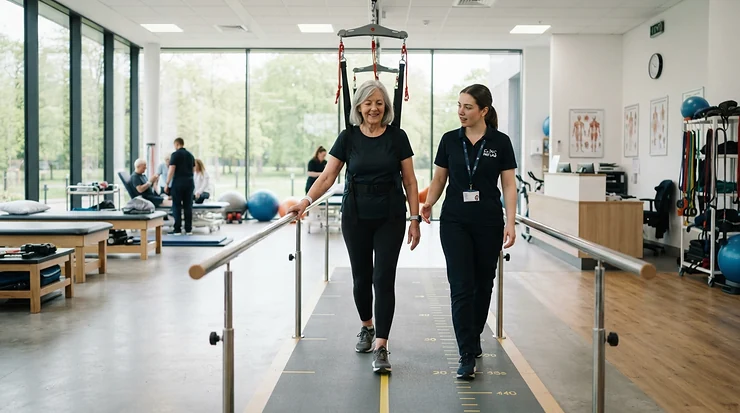
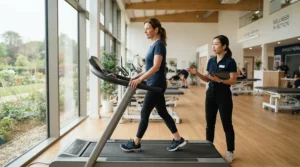
A treadmill for post-surgery rehab is a walking-first machine with a very slow starting speed, long handrails, a cushioned deck and a dependable emergency stop. It rebuilds walking tolerance at a pace your surgical team sets. Unlike a gym treadmill built for running, it favours control and stability over top speed.
Here’s the problem. Most home treadmills start at 0.8 to 1.6 km/h (0.5 to 1.0 mph). That’s fine for a healthy walker and a bit alarming when you’re ten days out from a hip replacement or bypass. Roundups of rehab models keep making the same point: early recovery often calls for speeds near 0.5 km/h, and handrails that run the full length of the deck matter more than horsepower or a big touchscreen.
Canadian health authorities already treat walking as the backbone of early recovery. Vancouver Coastal Health’s guidance on activity after cardiac surgery tells patients to begin walking daily. It also suggests avoiding the hottest and coldest parts of the day. That second tip is where a treadmill for recovery after surgery earns its keep, because a January ice sheet and a July heat dome are both off the table when your walking route is in the spare room.
This guide compares seven real models on the things that matter for rehab. It translates every spec into what it means on a Tuesday morning when you’re nervous and sore. Everything here is general information, not medical advice. Your surgeon or physiotherapist decides when you start, how long you go and how fast.
Quick Comparison: Which Treadmill for Post-Surgery Rehab Fits You?
Before the deep dive, here’s the snapshot. Speeds are shown in km/h first, with mph in brackets. Prices are rough CAD ranges based on listings at the time of research, so check current pricing on amazon.ca.
| Product | Speed Range | Max User Weight | Price Range (CAD) | Best For |
|---|---|---|---|---|
| Redliro JK06F | 0.5–8 km/h (0.3–5 mph) | 136 kg (300 lb) | C$500–C$650 | First walks, frail or nervous users |
| Redliro Long Handrails | 0.8–8 km/h (0.5–5 mph) | 136 kg (300 lb) | C$350–C$450 | Tight budgets needing full-length rails |
| Yesoul Walking Treadmill | 1.0–6.1 km/h (0.6–3.8 mph) | 136 kg (300 lb) | C$400–C$600 | Safety-feature-first shoppers |
| KEY2FUN Walking Treadmill | 1.0–8 km/h (0.6–5 mph) | 136 kg (300 lb) | C$450–C$650 | Joint cushioning and quiet homes |
| Ksports Advanced Rehab | 0.6–12.9 km/h (0.4–8 mph) | 130 kg (287 lb) | C$500–C$700 | Users who’ll outgrow handrails |
| WELLFIT Auto Incline | 1.6–16 km/h (1–10 mph) | 227 kg (500 lb) | C$1,000–C$1,300 | Heavier users, later-stage training |
| NordicTrack T Series 6.5 S | 1.6–16 km/h (1–10 mph) | 136 kg (300 lb) | C$1,000–C$1,500 | Guided programs, wide deck |
Looking at the table, the Redliro JK06F is the only model that really targets the first-steps stage. The Redliro Long Handrails delivers the most support per dollar. Anyone planning a long recovery arc, from a walker to brisk walking, should note that Ksports Advanced Rehab and WELLFIT Auto Incline cost more because they leave room to grow. Budget buyers should also notice that the cheapest model gives up the 0.3 mph start.
💬 Just one click — help others make better buying decisions too!😊
The Top 7 Picks for a Treadmill for Post-Surgery Rehab: Expert Analysis
Each pick below follows the same logic: what the spec means in practice, who it suits, what review patterns suggest and where it falls short. Review sentiment here is aggregated from published roundups and listing pages, not from any hands-on testing of mine. Several of these models are newer and carry small review pools, and I’ve flagged that where it applies.
1. Redliro JK06F — slowest start for first steps
The headline feature is the 0.3 mph (about 0.5 km/h) minimum speed. That’s the pace of a cautious shuffle, which is exactly where many people begin after major surgery.
The deck measures roughly 105 × 41 cm (41.5 × 16 in). It’s compact, so taller users with long strides may feel cramped. The 2.5-peak-horsepower motor is plenty for slow walking, and the handrails wrap the front and sides. That gives you something to hold from stepping on to stepping off.
Based on the spec sheet, this suits early-stage users, frailer users and anyone who gets anxious around moving belts. Reviewer commentary across roundups is consistently positive about the slow start and the dual rails. One recurring note is a low motor groan at precisely 0.3 mph, which is a quirk, not a defect. Listing ratings in roundups sit around the mid-4s out of 5, though I couldn’t verify amazon.ca review counts directly.
Pros:
- ✅ True 0.3 mph start for very early walking
- ✅ Front and side handrails for full support
- ✅ Foldable with auto-lubrication, less upkeep
Cons:
- ❌ Short, narrow deck for taller users
- ❌ Incline limited to three manual positions
Expect roughly C$500–C$650. For a beginner-stage buyer, the value verdict is strong: you’re paying for the one feature that’s hardest to find.
2. Redliro Long Handrails — most rail support per dollar
This one’s hook is simple: handrails that run nearly the length of the deck. Many treadmills only offer short front bars, which leave you unsupported for most of each stride.
The speed range of 0.5 to 5 mph (0.8 to 8 km/h) covers recovery walking comfortably. The 2.25-horsepower motor and 0–2% manual incline are modest, and that’s fine, because gentle rehab walking doesn’t need a hill. Wheels let you roll it between rooms without folding, which helps if lifting is off-limits after surgery.
Analytically, this is the model for someone past the very first shuffles who still wants rails along the whole belt. Roundups praise the sturdy, non-wobbly feel and the included safety key. A common limitation reported is the basic console: no Bluetooth, no app syncing. The built-in handrail pulse sensors are also described as reasonable, not precise, so pair it with a chest strap if your team wants real heart rate data.
Pros:
- ✅ Full-length rails for support throughout the stride
- ✅ Wheels allow easy repositioning
- ✅ Lowest price among rail-equipped picks
Cons:
- ❌ 0.5 mph minimum is too fast for some
- ❌ Stock availability has been reported as inconsistent
Expect around C$350–C$450. As an entry-level treadmill for post-surgery rehab, the value verdict is excellent, provided 0.8 km/h is slow enough for you.
3. Yesoul Walking Treadmill — safety features first
What sets this model apart is its safety stack: an emergency stop button, a tethered safety key, full-length handrails and an auto-stop if you step off the belt. For a nervous returner, that redundancy is the product.
The senior-oriented version starts at 0.6 mph (about 1 km/h) and tops out near 3.8 mph (6.1 km/h). The belt is about 40 × 94 cm (15.75 × 37.2 in), which is compact but adequate for short, slow strides. A multi-layer cushioned belt and remote speed control round out the package. The remote is a quiet win: you can change speed without letting go of the rails.
My read: this fits people whose biggest fear is falling, not fitness. Roundups consistently single out the handrails and emergency stop as the reasons to buy. Be aware that Yesoul sells several treadmill variants with different speed ranges, so check that the listing you click matches the specs above.
Pros:
- ✅ Emergency button plus tethered safety key
- ✅ Remote speed control keeps hands on rails
- ✅ Cushioned belt eases joint impact
Cons:
- ❌ 3.8 mph ceiling limits long-term progression
- ❌ Multiple variants cause listing confusion
Expect roughly C$400–C$600. The value verdict is good for safety-driven buyers and weaker for anyone who expects to be jogging within a year.
4. KEY2FUN Walking Treadmill — quiet cushioning for sore joints
The standout is joint protection: a shock-absorbing deck paired with a 3.0-horsepower brushless motor that runs under about 55 dB. That’s roughly conversation level, so it won’t drown out the TV or wake a sleeping household.
The 0.6–5 mph (1.0–8 km/h) range covers most recovery walking. A heart-rate-linked speed feature is claimed, where the belt can ease off if your pulse climbs past a target. Treat that as a helpful backup, not a medical monitor, especially since handrail sensors aren’t clinical-grade. There’s a flat deck only, with no incline.
For knee or hip replacement patients, the cushioning story is the relevant one. Roundups also flag a caveat honestly: the listing had only about two dozen reviews when last covered, so long-term reliability data is thin. That’s not a red flag, just a reason to buy from a seller with a straightforward return policy.
Pros:
- ✅ Cushioned deck designed for joint comfort
- ✅ Quiet brushless motor under 55 dB
- ✅ Magnetic safety key stops the belt instantly
Cons:
- ❌ Small review pool means limited reliability data
- ❌ Flat only, with no incline for later progression
Expect roughly C$450–C$650. The value verdict is solid for joint-focused buyers, tempered by the short track record.
5. Ksports Advanced Rehab — removable rails for the long game
The hook is progression. The handrails are removable, so the machine can grow from a supported walker’s tool into a regular treadmill as you regain confidence.
The 0.4–8 mph range (0.6–12.9 km/h) leaves real headroom, and the 2.25-horsepower motor handles it. The deck is about 38 × 105 cm (15 × 41.3 in), so it’s narrow, but it has a three-level manual incline and Bluetooth for apps such as Kinomap, Zwift and FitShow. Virtual scenery sounds gimmicky until you’re on week five of staring at the same wall.
This is the pick for someone whose surgeon expects a full return to activity and who wants one machine for the whole arc. The trade-offs are a lower 130 kg (287 lb) capacity and a small review pool, around twenty reviews in the roundup I found. Treat the removable-rail feature as useful only if you’ll actually stay on the rails through the early weeks.
Pros:
- ✅ Removable multi-grip rails for staged independence
- ✅ Bluetooth syncs with popular walking apps
- ✅ 0.4 mph start with a wide upper range
Cons:
- ❌ Lower 130 kg weight capacity
- ❌ Few reviews to confirm durability
Expect roughly C$500–C$700. The value verdict is good for long-arc recoveries and mediocre for anyone who needs the highest weight rating.
6. WELLFIT Auto Incline Treadmill — big deck, big capacity
This is the heavyweight: a 227 kg (500 lb) capacity, a 4.5-horsepower motor and a 51 × 140 cm (20 × 55 in) belt. Few rehab-oriented models offer that much walking room.
The auto incline runs 0–15%, which suits later-stage progression, once your team clears you for gentle hills. The deck uses a multi-layer belt with eight shock absorbers, and the motor is reported to run under 45 dB. The catch is the 1.0 mph (1.6 km/h) minimum speed. In the first weeks, that may simply be too fast, so this is a “month two and beyond” machine.
It’s also heavy at about 54 kg (120 lb), which matters for anyone who can’t lift. Roundups put the listing rating at about 4.7 out of 5, which I couldn’t independently verify on amazon.ca. Honestly, it’s an excellent treadmill that’s slightly mismatched to the earliest recovery stage.
Pros:
- ✅ 227 kg capacity suits bariatric and larger users
- ✅ Wide, long deck for natural strides
- ✅ Auto incline for staged progression
Cons:
- ❌ 1.6 km/h minimum too fast for early rehab
- ❌ Heavy and bulky to move or store
Expect roughly C$1,000–C$1,300. The value verdict is high for later-stage or larger users and poor for first-week buyers.
7. NordicTrack T Series 6.5 S — guided workouts and a roomy deck
Its hook is guided coaching. The iFIT platform offers trainer-led sessions, and SmartAdjust changes speed and incline to match the trainer’s cues. For some people, that outside voice is the difference between walking daily and skipping it.
The deck is about 51 × 140 cm (20 × 55 in), and the cushioning system is designed to soften impact. Roundups list a 2.8-horsepower motor, 0–10% auto incline and a 5-inch display. The honest limitation is that one roundup reports a 1.0 mph minimum, and full features need a paid iFIT subscription. Also remember that auto-adjusting programs shouldn’t override your surgeon’s pace limits, so switch SmartAdjust off if the program pushes harder than your plan.
This is a good fit for motivated, tech-comfortable walkers in the middle-to-late recovery stages who want structure.
Pros:
- ✅ Wide, long deck gives lateral confidence
- ✅ Guided programs help daily consistency
- ✅ Auto incline for gradual progression
Cons:
- ❌ Full features require an ongoing subscription
- ❌ 1.6 km/h minimum, with no full-length rails
Expect roughly C$1,000–C$1,500. The value verdict is good for self-motivators and steep for anyone paying mainly for a slow-start walker.
The deeper spec comparison below shows how these seven differ on the details the quick table skips.
| Product | Motor | Deck Size (cm) | Incline | Standout Trait |
|---|---|---|---|---|
| Redliro JK06F | 2.5 HP peak | ~105 × 41 | 3 manual levels | 0.3 mph start |
| Redliro Long Handrails | 2.25 HP | ~104 × 41 | 0–2% manual | Full-length rails |
| Yesoul Walking Treadmill | Not specified | ~94 × 40 | None noted | Emergency stop plus remote |
| KEY2FUN Walking Treadmill | 3.0 HP brushless | Wide deck | Flat only | Quiet cushioning |
| Ksports Advanced Rehab | 2.25 HP | ~105 × 38 | 3 manual levels | Removable rails |
| WELLFIT Auto Incline | 4.5 HP | ~140 × 51 | 0–15% auto | 227 kg capacity |
| NordicTrack T Series 6.5 S | 2.8 HP | ~140 × 51 | 0–10% auto | iFIT coaching |
The pattern is clear: the models with the slowest starts (Redliro JK06F, Ksports Advanced Rehab) have the smallest decks, while the roomy-deck models (WELLFIT Auto Incline, NordicTrack T Series 6.5 S) start faster. You’re trading early-stage control for long-term room, so match the trade to your recovery stage. Motor size matters least at walking speeds, so don’t pay extra for horsepower you won’t use.
Gradual Progression Plans: A Practical Walking Guide
Good gradual progression plans change one thing at a time. Here’s a general framework that many rehab programs echo in spirit. It’s an illustration for discussion with your care team, not a prescription.
Step 1: Set the ground rules with your team. Ask your surgeon or physiotherapist for three numbers: a starting session length, a speed ceiling and a “stop immediately” symptom list. Write them on a sticky note and stick it to the console.
Step 2: Start short and frequent. Early on, several brief sessions usually beat one long one. Hold the rails if you need to, and aim for steady, boring and pain-free.
Step 3: Change one variable per week. Add a minute or two of time, or a notch of speed, never both at once. If a new week feels worse, repeat the old one. Regression isn’t failure, it’s information.
Step 4: Move toward the national target gradually. The Canadian 24-Hour Movement Guidelines recommend at least 150 minutes of moderate-to-vigorous activity weekly for adults, including older adults. That’s a long-run destination, not a week-one assignment.
Step 5: Maintain the machine. Wipe the belt, check that the safety key clips cleanly and follow the manufacturer’s lubrication guidance. Models with auto-lubrication, like the Redliro JK06F, simplify this.
Common first-30-day mistakes: standing too far back on the belt, letting go of the rails while turning your head, ignoring stiffness after a session and skipping the warm-up. The cooldown matters too, since slow walking at the end lets your heart rate settle.
Real-World Scenarios: Treadmill for Recovery After Surgery
Specs are abstract. Here are three profiles to make the choice concrete.
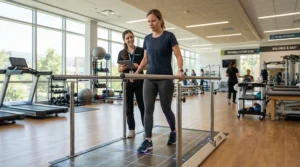
Scenario A: The cautious hip-replacement patient. She lives in an apartment, her surgeon wants short walks, and she’s wary of icy sidewalks. Budget: about C$500–C$650. The Redliro JK06F fits: the 0.3 mph start, front-and-side rails and foldable frame suit a small space and a nervous first week. A treadmill for recovery after surgery is mostly a confidence machine at this stage.
Scenario B: The cardiac-rehab graduate. He’s finished a supervised program and wants to continue at home. His team stresses heart rate zones, and he’s comfortable with apps. Budget: up to C$1,500. The NordicTrack T Series 6.5 S or Ksports Advanced Rehab fits, paired with a chest-strap monitor. This lines up with the national emphasis on exercise training: Canadian cardiac rehab recommendations describe it as a cornerstone of recovery. See the CACPR exercise training recommendations for the clinical framing.
Scenario C: The larger-bodied knee-surgery patient. Weight capacity is the first filter, and 136 kg (300 lb) models are out. The WELLFIT Auto Incline is the realistic pick at 227 kg, with the caveat that its 1.6 km/h minimum means starting with the rails and shorter sessions, or beginning outdoors until pace allows.
How to Choose a Treadmill for Post-Surgery Rehab
If you only read one section, make it this one. These steps work for any treadmill for post-surgery rehab, regardless of brand.
- Check the minimum speed first. If your team wants walking under 1 km/h, only a 0.3–0.5 mph model qualifies. A treadmill that can’t go slowly enough isn’t usable, whatever else it offers.
- Insist on full-length handrails. Rails that stop at the front leave you unsupported for most of the stride. Look for sturdy, textured grips.
- Verify the emergency stop. A magnetic safety key you clip to clothing is the minimum. A big red button within reach is better.
- Match deck size to your height and stride. Tall users need length. Anyone worried about balance benefits from width.
- Confirm the weight capacity with margin. Choose a rating well above your weight, since near-limit use strains the frame and motor.
- Think about progression. If you’ll outgrow the rails or need incline later, a pricier machine may be cheaper than buying twice.
- Plan for storage and movement. Foldability and wheels matter if lifting or bending is restricted.
Surgeon-Approved Exercise: What the Phrase Does and Doesn’t Mean
Let’s be careful here. No treadmill is surgeon-approved by default. Nobody certifies a consumer machine for your particular operation. What actually counts as surgeon-approved exercise is the plan your own team signs off on: how soon, how long, how fast and which symptoms mean stop.
Be sceptical of listings that claim medical-grade or doctor-recommended status without naming who recommended it. Marketing phrases aren’t clinical endorsements. Instead, do two things. Bring the model’s specs, especially minimum speed and rail layout, to your appointment and ask whether it matches your plan. Then ask what to monitor, such as pulse, breathlessness, pain level or wound changes.
For heart patients, the Canadian cardiac rehab literature repeatedly stresses structured, supervised exercise as a core part of recovery. A home machine supplements that, it doesn’t replace it. If your province offers a cardiac or orthopaedic rehab referral, take it. A treadmill is a tool, and your team provides the instructions.
Low-Impact Recovery Pace: Speeds, Effort and the Talk Test
A low-impact recovery pace is slow enough that your joints, incision and breathing all stay comfortable. On a treadmill, that often means somewhere between 1 and 3 km/h at first, but your team’s number overrules any rule of thumb here.
Two practical gauges help. The talk test is the simple one: you should be able to speak in full sentences while walking. If you’re gasping, ease off. Perceived effort is the second, often a “light” to “somewhat hard” scale in rehab leaflets. Chest straps give more accurate heart rate data than handrail sensors, which several roundups describe as only reasonably accurate.
There’s also the national picture. Statistics Canada reports that the Canadian 24-Hour Movement Guidelines call for 150 minutes of moderate-to-vigorous activity weekly, and for adults 65 and older, activities that challenge balance. Early-recovery slow walking won’t hit that target, and it’s not supposed to. It builds the base from which you eventually can.
Post-Op Walking Exercise Equipment: Treadmill vs Alternatives
A treadmill isn’t the only option for post-op walking exercise equipment. Here’s how it stacks up.
| Option | Joint Impact | Pace Control | Weather-Proof | Best For |
|---|---|---|---|---|
| Home treadmill | Low (cushioned deck) | Excellent | Yes | Redliro JK06F users, controlled progression |
| Outdoor walking | Higher (hard surfaces) | Variable | No | Late-stage, confident walkers |
| Stationary bike | Very low | Good | Yes | Hip or knee patients cleared for cycling |
| Mall or indoor track walking | Moderate | Self-paced | Yes | Social walkers with good balance |
| Supervised clinic treadmill | Low | Professional | Yes | WELLFIT Auto Incline graduates wanting home continuity |
The table shows that the treadmill’s real advantage isn’t impact reduction, since a bike matches or beats it. It’s pace control plus a controlled environment. For anyone who needs exact speeds, rails and a predictable surface, nothing outdoors competes. The weakness is motivation: a spare-room treadmill is easy to ignore, which is why app-connected models like Ksports Advanced Rehab and NordicTrack T Series 6.5 S can help.
Gentle Rehab Treadmill: Features That Actually Matter (And Those That Don’t)
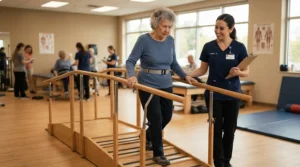
The best gentle rehab treadmill is defined by what it lets you control, not by what it can do.
Features that matter:
- Minimum speed: the single biggest filter, as covered above.
- Rail design: full-length, sturdy, easy to grip with reduced strength.
- Emergency stop: instant and within reach.
- Cushioned deck: reduces repeated impact on healing joints.
- Step-up height: a low deck makes getting on safer, though listings rarely publish it, so look at product photos.
Features that mostly don’t:
- Peak horsepower: at 2–4 km/h, any listed motor is more than enough.
- Max speed: 16 km/h sounds impressive but is irrelevant in early recovery.
- Preset programs: 12 presets are fine, but you’ll likely use one.
- Built-in speakers: nice, not necessary.
One note on app integrations: they’re useful for motivation, but treat automated speed changes cautiously. If a program pushes you faster than your plan, override it. The Yesoul Walking Treadmill‘s remote is a more modest, arguably smarter convenience, since it keeps both hands where they belong.
Cost, Value and Long-Term Ownership
A cheap treadmill that doesn’t suit your stage costs more than a pricier one that does. Here’s the tiered view.
| Tier | Typical Range (CAD) | What You Get | Pick | Best For |
|---|---|---|---|---|
| Entry | C$350–C$450 | Rails, basic console | Redliro Long Handrails | Budget-first, mild needs |
| Mid | C$450–C$700 | Slow starts, cushioning, apps | Redliro JK06F, KEY2FUN Walking Treadmill, Ksports Advanced Rehab | Most post-op users |
| Premium | C$1,000–C$1,500 | Big deck, auto incline, coaching | WELLFIT Auto Incline, NordicTrack T Series 6.5 S | Long recovery, heavier users |
Read the tiers this way: the mid-range is the sweet spot for most people because it’s where slow-start capability lives. Premium models make sense only if you’ll keep using them after recovery. Entry-tier buyers should accept the 0.8 km/h floor.
On total cost of ownership, subscriptions are the hidden line item. The NordicTrack T Series 6.5 S is fully usable without iFIT, but its best features aren’t. Auto-lubrication, found on several Redliro models, saves maintenance time. Also ask your extended health provider whether prescribed equipment is eligible for reimbursement before you buy, since policies vary widely.
Common Mistakes When Buying a Treadmill for Post-Surgery Rehab
Buying for the person you’ll be in a year. A 16 km/h top speed is pointless in week two. Buy for now, with room to grow.
Ignoring minimum speed. It’s the most common regret, and it’s invisible until delivery day.
Trusting “medical” marketing. As covered earlier, no listing replaces your team’s clearance.
Skipping the weight margin. Rated capacity isn’t a target.
Forgetting the space. A 54 kg machine like the WELLFIT Auto Incline needs a permanent home. A foldable like the Redliro JK06F doesn’t.
Overlooking the return policy. With small review pools on models like KEY2FUN Walking Treadmill and Ksports Advanced Rehab, an easy return is your insurance.
Using it too soon. The treadmill isn’t the risk, starting before clearance is.
Safety, Regulations and Standards for Canadian Buyers
Consumer treadmills are fitness equipment, and most walking-pad listings don’t claim to be licensed medical devices. Don’t assume Health Canada has reviewed a machine for rehabilitation just because the listing uses rehab language. Look instead for recognized electrical safety marks, such as CSA, cUL or ETL, on the unit or in the manual, and confirm the model sold in Canada carries them.
Practical safety habits matter more than paperwork. Use a dedicated outlet where possible. Keep the safety key clipped to your clothing every session. Clear the floor behind the machine. Position the treadmill where you can’t fall onto hard furniture. Keep a phone within reach in case you need help.
Think about the whole day too. Activity guidance for older adults, such as Eastern Health’s physical activity resource, counts slow walking and standing as light activity and encourages breaking up long periods of sitting. That framing is useful in recovery: the treadmill is one part of a day of gentle movement, not the whole thing.
FAQ
❓ How slow should a treadmill for post-surgery rehab go?
❓ Is a walking pad enough for post-op walking?
❓ When can I start treadmill walking after surgery?
❓ Are rehab treadmills covered by extended health plans in Canada?
❓ Which features make a treadmill unsafe after surgery?
Conclusion
The right treadmill for post-surgery rehab isn’t the fastest, the fanciest or the most expensive. It’s the one that matches your stage. For first steps, the Redliro JK06F is the clearest fit. For rail support on a budget, the Redliro Long Handrails earns its place. Safety-first buyers will like the Yesoul Walking Treadmill, and the KEY2FUN Walking Treadmill suits sore joints. If you expect a long arc, Ksports Advanced Rehab and the NordicTrack T Series 6.5 S have headroom, while the WELLFIT Auto Incline serves heavier users once the early weeks pass.
Whatever you choose, treat the surgeon’s plan as the boss, progress one variable at a time and keep the safety key clipped on. A good machine won’t speed up your healing. It just makes the next careful step easier to take.
✨ Ready to take that next step?
🔍 Click any highlighted product name above to check current pricing and availability on amazon.ca. The right machine can turn recovery walks into a routine you actually keep, and a routine you keep is what gets you back on your feet. 🚶♀️💪
Recommended for You
- Treadmill For Physical Therapy: 7 Safe, Smart Picks For 2026
- Gentle Exercise Treadmill For Beginners: 7 Best Picks (2026)
- Low-Impact Treadmill For Joint Pain: 7 Best Knee-Saving Picks 2026
Disclaimer: This article contains affiliate links. As an Amazon Associate, I earn from qualifying purchases. If you purchase products through these links, we may earn a small commission at no additional cost to you. This content is for general information only and is not medical advice; consult your surgeon or physiotherapist before starting any exercise program.
✨ Found this helpful? Share it with your friends! 💬🤗
