In This Article
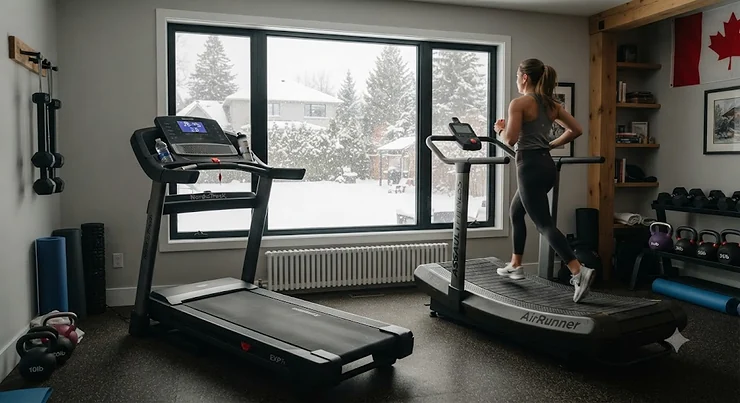
Standing in a Canadian Tire aisle or scrolling Amazon.ca at 11 p.m., the same question keeps surfacing: folding treadmill vs manual treadmill for beginners — which one actually gets used past February? A folding treadmill is a motorized machine that runs on electricity and collapses upright for storage, while a manual treadmill has no motor at all; your own steps drive the belt, usually against a fixed or adjustable incline. Neither is objectively “better” — they solve different problems, and the honest answer depends more on your space, your budget, and how self-motivated you are than on any spec sheet.
I pulled together seven real machines currently sold to Canadian shoppers — four folding, motorized treadmills and three true manual ones — ranging from a roughly C$260 non-electric walking pad to a roughly C$1,650 touchscreen folding unit. Every spec below comes from manufacturer documentation and independent testing outlets, not a rewritten Amazon listing, and every price is a range rather than a snapshot, because a fair comparison has to survive the next price update. Canada’s public health guidance on physical activity is refreshingly blunt on this point: consistent movement, at almost any intensity, beats an occasional heroic workout on a machine that’s too intimidating to turn on. That’s really the whole argument for getting this decision right the first time.
This guide walks through the mechanism differences, the real calorie burn difference between the two types, how much storage space each actually needs, and which of the seven fits which kind of beginner — so you’re not guessing at 11 p.m. anymore.
Quick Comparison Table
Here’s how the seven machines stack up before we go deep on each one, ordered roughly budget to premium within their category.
| Product | Type | Mechanism | Weight Capacity | Price Range (CAD) | Best For |
|---|---|---|---|---|---|
| Sunny Health & Fitness Manual Walking Treadmill | Manual | Fixed 13.5% incline, self-powered | 100 kg (220 lb) | C$260-C$320 | Zero-electricity, tightest budget |
| Fitness Reality TR3000 | Manual | 8-level magnetic tension, 3 incline positions | 147 kg (325 lb) | C$270-C$370 | Manual pick with real incline control |
| EFITMENT T017 | Manual | 8-level magnetic tension, arm exercisers | 100 kg (220 lb) | C$300-C$400 | Upper-body add-on while walking |
| Goplus SuperFit 2-in-1 Folding Treadmill | Folding (motorized) | 2.25 HP, desk + standalone modes | 120 kg (265 lb) | C$380-C$480 | Slides under a desk or couch |
| Horizon Fitness T101 | Folding (motorized) | 2.5 HP, motorized 0-10% incline | 136 kg (300 lb) | C$900-C$1,050 | Quietest all-around folding starter |
| ProForm Carbon T7 | Folding (motorized) | 2.6 CHP, motorized 0-10% incline, touchscreen | 136 kg (300 lb) | C$1,300-C$1,500 | Guided workouts via touchscreen |
| XTERRA Fitness TRX3500 | Folding (motorized) | 3.0 CHP, 12 motorized incline levels | 159 kg (350 lb) | C$1,400-C$1,650 | Widest deck, most incline range |
A pattern jumps out immediately: the three manual treadmills all sit under C$400, while the four folding, motorized machines start around C$380 and climb past C$1,600. That’s not a coincidence — removing the motor removes the single most expensive component on the bill of materials, which is exactly why manual treadmills dominate the true entry-level price tier. But price isn’t the only variable that matters, and the table above doesn’t capture calorie burn, noise, or how each one actually feels underfoot — which is where the rest of this guide comes in.
💬 Just one click — help others make better buying decisions too!😊
Top 7 Folding and Manual Treadmills for Beginners: Expert Analysis
The first four picks below are folding, motorized treadmills; the last three are true manual machines with no motor at all. Every product name stays bolded on every mention so you can scan for the one you’re weighing.
1. Horizon Fitness T101 — quietest folding pick for daily beginners
What makes the Horizon Fitness T101 stand out among folding treadmills is that independent testers specifically describe it as “fairly quiet” during use — a genuine plus for folding and unfolding it daily in a shared living room.
A 2.5 HP motor covers 0.8-16 km/h (0.5-10 mph) across a 140 cm x 51 cm (55 in x 20 in) deck, and the console adjusts incline automatically from 0-10% during programmed workouts. Horizon backs it with a lifetime warranty on the frame and motor, and the hydraulic one-step fold with built-in transport wheels means one person can fold and roll it away solo.
Based on the spec sheet and Horizon’s broader lineup reputation, this reads as the safest first folding treadmill for someone who’s never owned a motorized machine before — nothing about it is flashy, and that’s the point. Aggregated reviewer sentiment leans positive on reliability and quiet operation, with the main recurring critique being a basic 3-LED display that skips the app or touchscreen extras found on pricier models.
Pros:
- ✅ Independently tested as fairly quiet, good for shared-wall homes
- ✅ Motorized incline adjusts automatically during workouts
- ✅ Lifetime frame and motor warranty is exceptional at this price
Cons:
- ❌ Basic 3-LED display with no app or touchscreen integration
- ❌ Some testers report noticeable vibration above 10 km/h (6 mph)
At the time of research, the Horizon Fitness T101 runs in the C$900-C$1,050 range — a reasonable middle ground for a beginner who wants real motorized incline without paying for a screen they might not use.
2. XTERRA Fitness TRX3500 — widest deck with the most incline range
The XTERRA Fitness TRX3500 distinguishes itself with 12 motorized incline levels and a genuinely wide 51 cm x 152 cm (20 in x 60 in) deck — more running room than any other folding treadmill on this list.
A 3.0 continuous horsepower motor covers 0-19 km/h (0-12 mph), and quick-access incline and speed buttons make interval-style walking or light jogging easier to structure than on a manual-incline machine. The gas-shock fold lowers the deck gently instead of dropping it, and a lifetime warranty covers both frame and motor.
Independent testers praised the 159 kg (350 lb) weight capacity, which exceeds most machines in its price bracket, and the 30 built-in programs give real structure beyond flat walking. Honestly, though, reviewers consistently flag motor noise, a fairly high 20 cm (7.75 in) step-up height that may challenge shorter or older users, and assembly several testers call difficult solo.
Pros:
- ✅ Widest deck on this list at 51 cm x 152 cm (20 in x 60 in)
- ✅ 12 motorized incline levels for genuine hill training
- ✅ Highest weight capacity among the folding models at 159 kg
Cons:
- ❌ Reviewers consistently report noticeable motor noise
- ❌ High step-up height and difficult assembly reported by testers
The XTERRA Fitness TRX3500 generally runs in the C$1,400-C$1,650 range in Canada, positioning it as the premium pick for a beginner who already knows they’ll want incline variety and running headroom, not just walking.
3. Goplus SuperFit 2-in-1 Folding Treadmill — slides under a desk or couch
The defining feature of the Goplus SuperFit 2-in-1 Folding Treadmill is its dual-mode design: a low-profile walking pad for desk use at 0-4 km/h (0-2.5 mph), and a standalone treadmill with handlebars for faster walking up to 12 km/h (7.5 mph).
At 32 kg (69.5 lb) and folding to 140 cm x 74 cm x 13 cm (55 in x 29 in x 5 in), this is the most space-efficient motorized option here — testers noted it can slide “under the couch” between uses, thanks to the narrow 41 cm x 100 cm (16 in x 39.3 in) deck and modest 2.25 HP motor.
What most buyers overlook about this category is that the compact footprint comes with a genuinely modest ceiling: there’s no incline function, and independent reviewers rated it a middling score overall, noting the deck “might not provide enough surface to run at higher speeds” and that it “isn’t best for moderate to heavy use.” For a few thousand extra steps during work calls rather than structured cardio, that’s an honest fit, not a flaw.
Pros:
- ✅ Folds flat enough to store under a couch or desk
- ✅ Dual-mode design works for desk walking and standalone use
- ✅ Lightest folding motorized treadmill on this list at 32 kg
Cons:
- ❌ No incline function whatsoever
- ❌ Narrow deck limits it to walking, not running
At the time of research, the Goplus SuperFit 2-in-1 Folding Treadmill typically lists in the C$380-C$480 range, making it the most accessible folding, motorized entry point on this list by a wide margin.
4. ProForm Carbon T7 — touchscreen-guided folding treadmill for structured beginners
The ProForm Carbon T7 is the outlier here, built around a 7-inch smart HD touchscreen and iFit compatibility rather than physical buttons — a shift from “set it and walk” to “follow the trainer on screen.”
A 2.6 CHP motor drives a 0-16 km/h (0-10 mph) belt across a 140 cm x 51 cm (55 in x 20 in) deck with motorized 0-10% incline, and the gas-shock fold is noticeably safer than unassisted-drop designs on cheaper competitors. iFit comes with a 30-day free trial before rolling into a paid subscription, roughly C$20-C$55 a month, which belongs in your total budget, not just the machine’s price tag.
Based on the spec comparison, this machine is aimed squarely at beginners who need external accountability — someone following an on-screen coach is less likely to quietly stop showing up. Independent testers found the touchscreen itself “subpar” for its price bracket, small and occasionally slow to load, and reported the machine running surprisingly loud in manual mode without an iFit program guiding pace and incline together.
Pros:
- ✅ 7-inch touchscreen and iFit unlock studio-style guided workouts
- ✅ Gas-shock folding is noticeably safer than budget competitors
- ✅ ISO Flex cushioning adds genuine comfort for daily walkers
Cons:
- ❌ Touchscreen tested as small and occasionally slow to respond
- ❌ Runs surprisingly loud in manual mode without an iFit program
The ProForm Carbon T7 generally sells in the C$1,300-C$1,500 range before factoring in an ongoing iFit subscription — worth it specifically for beginners who want screen-guided coaching from week one, less so for anyone who prefers to zone out to their own playlist.
5. Sunny Health & Fitness Manual Walking Treadmill — zero electricity, lightest fold in this lineup
What makes the Sunny Health & Fitness Manual Walking Treadmill stand out is that it needs no outlet at all — your own footfall drives the belt, and a fixed 13.5% incline supplies the resistance a motor would otherwise provide.
The 107 cm x 33 cm (42 in x 13 in) belt and 100 kg (220 lb) weight capacity are modest, and the digital monitor tracks time, distance, speed, and calories off the belt’s own rotation. Because the incline can’t be lowered, every session is effectively an incline walk, which burns noticeably more calories per minute than flat walking but also demands more from your calves and hip flexors than a beginner might expect.
This is a machine built for genuinely tight budgets and apartments — it folds to roughly 51 cm x 58 cm x 127 cm (20 in x 23 in x 50 in) and weighs under 21 kg (47 lb), light enough to lean against a closet wall. Verified customer-review data specific to this exact SKU was limited during research, so treat the fixed-incline trade-off as the deciding factor rather than a star rating.
Pros:
- ✅ No motor to fail, no outlet required, ever
- ✅ Folds to the smallest footprint of any product on this list
- ✅ Fixed incline burns more calories than flat walking automatically
Cons:
- ❌ Incline can’t be reduced, so there’s no easy-day setting
- ❌ Narrow 33 cm (13 in) belt rules out anyone with a wide stride
At the time of research, the Sunny Health & Fitness Manual Walking Treadmill runs in the C$260-C$320 range, making it less a scaled-down motorized treadmill and more a genuinely different category of machine — check current price, since stock rotates periodically.
6. Fitness Reality TR3000 — manual pick with real incline positions
Unlike most budget manual treadmills, the Fitness Reality TR3000 offers three actual incline positions — 8, 10, and 13 degrees — set by hand rather than the single fixed grade found on simpler manual machines.
Twin flywheels combined with an 8-level magnetic tension system give it a smoother, quieter feel than a plain belt-and-roller design, and the 41 cm x 114 cm (16 in x 45 in) deck plus 147 kg (325 lb) tested weight capacity make it noticeably more accommodating than the Sunny model above. An LCD console tracks heart rate, time, and calories, and “Pacer Control” gives beginners a target rhythm to walk against.
What most buyers overlook about a manual treadmill like this one is that adjustable resistance plus adjustable incline lets you genuinely scale the workout as fitness improves, rather than being stuck at one intensity forever. Aggregated reviewer sentiment highlights pre-assembly convenience, foldability, and quiet twin-flywheel operation as consistent praise points, with occasional notes that the contact-based heart rate reading can be inconsistent under strain — a common trait of this feature generally, not unique to this model.
Pros:
- ✅ Three real incline positions, not just one fixed grade
- ✅ 147 kg (325 lb) weight capacity, highest among the manual picks
- ✅ Twin flywheels keep operation quieter than basic manual designs
Cons:
- ❌ Contact-based heart rate reading can be inconsistent under strain
- ❌ Narrower deck than motorized options limits stride length
The Fitness Reality TR3000 typically lists in the C$270-C$370 range, positioning it as the strongest all-around manual pick on this list for a beginner who wants adjustable difficulty without paying for a motor.
7. EFITMENT T017 — manual treadmill that adds an arm workout
The EFITMENT T017 pairs a standard manual walking belt with dual moving handlebars for arm exercises, turning a simple walk into a light upper-body session too — a genuinely different approach from the other six machines here.
An 8-level magnetic resistance system and three manual incline positions (7%, 8%, and 9%) sit beneath a 34 cm x 106 cm (13.4 in x 41.7 in) deck rated to 100 kg (220 lb), and fixed handlebars with built-in pulse sensors let you check heart rate without a chest strap, though contact-based readings are a rough estimate at best. The folding frame reduces its footprint by roughly 65% for storage.
This is a genuinely niche pick: ideal for a beginner who wants to combine light cardio with arm toning in one compact machine, less ideal for anyone who just wants to walk without extra moving parts. Independent reviewers describe it as “excellent for light to medium-intensity workouts” and one of the more affordable manual treadmills with adjustable incline, while noting the fixed deck angle and lack of built-in workout programs as its clearest limitations.
Pros:
- ✅ Dual handlebars add a genuine upper-body element while walking
- ✅ Three manual incline positions plus 8-level resistance
- ✅ Folds down by roughly 65% of its assembled length
Cons:
- ❌ No built-in workout programs of any kind
- ❌ Deck angle is fixed and can’t be adjusted independently
At the time of research, the EFITMENT T017 generally sells in the C$300-C$400 range, a fair price for the added arm-exerciser feature if that’s genuinely something you’ll use rather than ignore after week two.
Top 7 at a Glance
| Product | Motor/Mechanism | Speed Range | Incline | Best For |
|---|---|---|---|---|
| Sunny Health & Fitness Manual Walking Treadmill | None (self-powered) | Self-paced | Fixed 13.5% | Renters wanting zero cost, zero motor |
| Fitness Reality TR3000 | 8-level magnetic tension | Self-paced | 3 positions (8°, 10°, 13°) | Beginners wanting adjustable manual difficulty |
| EFITMENT T017 | 8-level magnetic tension | Self-paced | 3 positions (7-9%) | Combined cardio and arm workout |
| Goplus SuperFit 2-in-1 | 2.25 HP | 0-4 km/h desk, 0-12 km/h standalone | None | Desk walkers, tightest storage space |
| Horizon Fitness T101 | 2.5 HP | 0.8-16 km/h | Motorized 0-10% | Quiet, reliable folding starter |
| ProForm Carbon T7 | 2.6 CHP | 0-16 km/h | Motorized 0-10% | Screen-guided workouts |
| XTERRA Fitness TRX3500 | 3.0 CHP | 0-19 km/h | Motorized, 12 levels | Widest deck, most incline range |
Reading this table alongside the pricing one above, the split is clean: the three manual machines trade speed range and motorized incline for a genuinely lower price and simpler mechanics, while the folding, motorized machines add automatic incline, wider decks, and higher top speeds at a proportionally higher cost. Neither column is universally “better” — the Fitness Reality TR3000‘s adjustable manual incline covers a real gap that a fixed-incline model like the Sunny can’t, while the XTERRA Fitness TRX3500‘s 12 motorized incline levels simply aren’t replicable by hand at all.
✨ Comparing a folding treadmill against a manual one for your own space? Click through to check today’s Amazon.ca listing on any of the seven above — prices and stock shift often enough that waiting a week can change the comparison.
Getting Started: Your First 30 Days
Getting any of these seven machines from delivery box to reliable daily habit comes down to a handful of practical steps that product manuals tend to gloss over, and the steps differ meaningfully between the two treadmill types.
For the folding, motorized picks — the Horizon Fitness T101, XTERRA Fitness TRX3500, Goplus SuperFit 2-in-1 Folding Treadmill, and ProForm Carbon T7 — assembly runs 20 to 45 minutes with included tools, and it’s worth resisting the urge to skip levelling the frame using the adjustable feet, since an unlevel deck accelerates uneven belt wear. Run the belt at a low, steady speed for 10-15 minutes daily for the first two weeks; this break-in period lets the belt and deck surface seat properly, something several manufacturers note explicitly in their setup documentation. Check belt tension in week one and then monthly after — a belt that’s too loose slips under load and strains the motor, while one that’s too tight strains it from the opposite direction.
For the manual picks — the Sunny Health & Fitness Manual Walking Treadmill, Fitness Reality TR3000, and EFITMENT T017 — there’s no motor to break in, but there is a genuine adjustment period for your own body. Manual belts require a deliberate push-off with each step rather than the passive foot placement a motorized belt allows, and most beginners find their first few sessions noticeably more tiring than expected relative to the displayed speed. Start with 8-10 minutes rather than a full 30, and expect the movement to feel natural within a week or two as your calves and glutes adapt to actively driving the belt.
Across both types, place the unit on a proper mat rather than bare flooring from day one — it protects your floor, cuts vibration noise for anyone below or beside you, and on motorized models keeps dust out of the motor housing.
Real-World Scenarios: Matching a Treadmill Type to Your Life
Concrete situations clarify this decision faster than specs alone, so here are three common Canadian scenarios mapped onto the seven machines above.
If you’re a downtown condo renter in Toronto or Vancouver with genuinely no storage closet and a budget under C$350, the Sunny Health & Fitness Manual Walking Treadmill solves the actual problem — no outlet needed, the smallest folded footprint on this list, and a price that doesn’t strain a student or early-career budget. If you’re working from home and want to sneak in walking minutes during calls without dedicating floor space to a full treadmill, the Goplus SuperFit 2-in-1 Folding Treadmill‘s under-desk profile and dual-mode design fit that exact use case better than any manual option could. And if you’re rebuilding a fitness habit after time off and want structure rather than guesswork — someone telling you when to speed up, when to climb, when to rest — the ProForm Carbon T7‘s touchscreen and iFit programming, or the XTERRA Fitness TRX3500‘s 12 incline levels and 30 built-in programs, genuinely earn their higher price by removing the “how hard should today’s walk be” question entirely.
A fourth scenario worth naming honestly: if your primary goal is calorie burn per minute rather than convenience, the Fitness Reality TR3000‘s combination of adjustable resistance and incline gives a manual machine genuine workout variety without the higher price tag or electricity draw of the folding options.
Folding or Manual? A Simple Decision Framework
Rather than weighing every spec simultaneously, this framework narrows the folding treadmill vs manual treadmill for beginners decision down to three questions, in order.
First: do you have a dedicated electrical outlet within reach of where the treadmill will live, and is C$900 or more genuinely available in your budget? If either answer is no, skip straight to the manual picks — the Sunny Health & Fitness Manual Walking Treadmill, Fitness Reality TR3000, or EFITMENT T017 — since none of the folding motorized options on this list meaningfully undercut C$380. Second: do you want speeds above roughly 8 km/h (5 mph) for jogging, or motorized incline you can adjust mid-workout? If yes, a manual treadmill will frustrate you quickly — none of the three manual picks here comfortably support sustained jogging, and none offer incline that changes without stopping to reset it by hand. Third: how much genuine storage space do you have, in centimetres, not vibes? A manual treadmill or the Goplus SuperFit 2-in-1 both fold to roughly 13-15 cm thick, while the Horizon Fitness T101, ProForm Carbon T7, and XTERRA Fitness TRX3500 need meaningfully more clearance even when folded upright.
Answering those three questions in order gets most beginners to the right category before they’ve even opened a single product page — the remaining choice, within whichever category you land in, comes down mostly to budget and the specific features covered above.
Folding Treadmill vs Manual Treadmill: Beginner Mechanism Comparison
Understanding how each machine actually works underneath the marketing copy makes the rest of this comparison click into place, so here’s a straightforward beginner treadmill mechanism comparison before we get into outcomes like calorie burn and cost. Boiled down, motorized vs non-motorized is really a question of who — or what — is supplying the belt’s momentum.
How Folding, Motorized Treadmills Work
A motorized folding treadmill uses an electric motor, typically rated between 2.25 and 3.0 horsepower on the machines in this list, to spin a front roller that drives the belt at a speed you set independently of your own effort. Because the motor does the work of maintaining pace, you can walk, jog, or stand still mid-session without the belt slowing down — a genuine safety consideration, since a sudden stumble on a motorized belt still moving at speed is a real fall risk that every unit addresses with a magnetic safety clip attached to your clothing. Motorized incline, where present, works through a second small motor that tilts the deck automatically, which is what makes structured interval training practical on the Horizon Fitness T101, ProForm Carbon T7, and XTERRA Fitness TRX3500.
How Manual, Non-Motorized Treadmills Work
A manual treadmill has no motor anywhere in the mechanism. The belt sits on a set of rollers, often paired with a flywheel for smoother rotation as seen on the Fitness Reality TR3000, and moves only because your foot pushes it backward with each step. Incline on a manual machine is either fixed, as on the Sunny Health & Fitness Manual Walking Treadmill, or adjustable through a small number of manual positions you set by hand before starting, as on the Fitness Reality TR3000 and EFITMENT T017. Critically, the belt stops the instant you stop walking — there’s no momentum to fight and nothing to switch off in an emergency, which is a genuine, if underrated, safety advantage for a first-time treadmill owner nervous about the machine “running away” from them.
Pros and Cons of Manual Treadmills
Weighing the pros and cons of manual treadmills honestly, against motorized alternatives, comes down to a short but meaningful list. On the plus side: no electricity cost, no motor to eventually fail or need servicing, genuinely lighter and easier for one person to move, and a belt that inherently matches your own pace rather than forcing you to keep up with a preset speed. On the downside: sustained jogging or running is uncomfortable to impossible on a flat-belt manual design, the learning curve for a smooth, natural stride takes longer than stepping onto a motorized belt, and the fixed or limited incline options mean less long-term workout variety than a motorized machine with automatic incline changes.
| Feature | Folding (Motorized) Treadmill | Manual (Non-Motorized) Treadmill |
|---|---|---|
| Power source | Electricity required | None |
| Speed control | Precise, set independently of effort | Directly tied to your own pace |
| Incline | Motorized on premium models, automatic | Fixed or manually set positions |
| Typical price (CAD) | C$380-C$1,650 | C$260-C$400 |
| Best For | Jogging, structured interval training | Walking, budget-conscious beginners |
The takeaway from this table lines up with what the research on non-motorized treadmill mechanics generally shows: a 2017 study in Frontiers in Physiology found non-motorized treadmill exercise associated with meaningfully higher cardiometabolic demand than either overground or motorized treadmill exercise at a matched pace, largely because you’re generating the belt’s momentum yourself rather than letting a motor do it. That’s a genuine point in favour of manual treadmills for calorie-conscious beginners, provided the trade-offs above — no jogging headroom, less incline variety — are ones you can live with.
Storage Space and Footprint: Which Type Actually Saves Room?
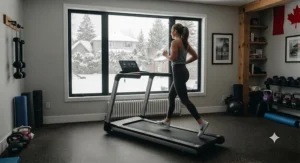
Storage space is usually the deciding factor for apartment and condo dwellers, and it’s worth being precise about what “folds down small” actually means across these seven machines rather than trusting product photos alone.
Among the manual options, the Sunny Health & Fitness Manual Walking Treadmill folds to roughly 51 cm x 58 cm x 127 cm (20 in x 23 in x 50 in) and weighs under 21 kg, genuinely light enough to lean in a closet corner. The Fitness Reality TR3000 folds vertically to about 89 cm x 74 cm x 155 cm (35 in x 29 in x 61 in), noticeably taller once folded because of its box-style hinge, while the EFITMENT T017 reduces its length by roughly 65%, landing between the two. Among the folding motorized machines, the Goplus SuperFit 2-in-1 Folding Treadmill is the clear standout for a genuinely space-saving folding treadmill — it collapses to just 13 cm (5 in) thick and, per independent testers, slides under a couch or low-clearance furniture. The Horizon Fitness T101 folds upright on built-in transport wheels for easy rolling into a closet, while the XTERRA Fitness TRX3500 and ProForm Carbon T7, with their wider 51 cm decks, both fold upright but occupy noticeably more floor footprint once folded than any manual model on this list.
The honest pattern: manual treadmills and the Goplus SuperFit 2-in-1 win decisively on true storage space, folding flatter and lighter than any wide-deck motorized machine can manage, while the Horizon Fitness T101, ProForm Carbon T7, and XTERRA Fitness TRX3500 trade some of that compactness for the wider running surface and motorized incline that make jogging and structured workouts realistic.
Calorie Burn Difference: Does Powering the Belt Yourself Burn More?
The calorie burn difference between manual and motorized treadmills is one of the most searched — and most oversimplified — questions in this category, so it’s worth separating the genuine physiology from the marketing claims.
Because a manual treadmill requires you to generate the belt’s momentum with every step, walking at a given displayed speed on a manual machine typically demands more energy than the same displayed speed on a motorized belt, where the motor is doing part of the propulsive work for you. The Frontiers research cited above backs this up specifically for non-motorized treadmill exercise, and several equipment manufacturers’ own technical documentation echoes the same general pattern for curved and manual decks. That said, “burns more calories” doesn’t mean “burns dramatically more” — the difference is most pronounced at higher intensities and largely disappears if you slow your manual-treadmill pace to compensate for the extra effort, which most beginners do instinctively within the first few sessions.
| Activity (30 minutes, moderate effort) | Motorized Treadmill (approx.) | Manual Treadmill (approx.) |
|---|---|---|
| Flat walking, 5 km/h | 120-150 kcal | 150-190 kcal |
| Incline walking, 5 km/h, 10-13% grade | 180-230 kcal | 210-260 kcal |
| Light jogging, 8 km/h | 220-280 kcal | Not comfortably sustainable |
These ranges are broad estimates based on general exercise-physiology data for a mid-weight adult, not lab results specific to any product on this list, and individual calorie burn varies substantially with body weight, effort, and fitness level. The practical takeaway for a beginner: if calorie burn per minute genuinely matters more to you than jogging capability or motorized incline, a manual treadmill like the Fitness Reality TR3000 or the fixed-incline Sunny Health & Fitness Manual Walking Treadmill delivers a real, physiologically grounded advantage at walking pace — just don’t expect it to replace the higher absolute output a motorized machine allows once you’re fit enough to jog.
How to Choose Between a Folding Treadmill and a Manual Treadmill
Working through these seven machines surfaced a fairly clear decision process. Here’s how to apply it to your own shortlist.
- Set your real budget ceiling first, including accessories. A C$50-C$100 mat and, for the ProForm Carbon T7, an ongoing iFit subscription both belong in the total cost, not just the machine’s sticker price.
- Decide whether jogging is a realistic near-term goal. If yes, the manual picks won’t serve you well long-term — go straight to the Horizon Fitness T101, XTERRA Fitness TRX3500, or ProForm Carbon T7.
- Measure your actual storage space in centimetres, both folded and unfolded, rather than assuming “compact” on a listing means what you need it to mean — a genuinely space-saving folding treadmill like the Goplus SuperFit 2-in-1 can still surprise you with its assembled footprint.
- Match weight capacity to your body weight with real headroom, not the bare minimum — the Fitness Reality TR3000‘s 147 kg rating and the XTERRA Fitness TRX3500‘s 159 kg rating suit heavier users better than the 100 kg ceiling on the two lightest models.
- Weigh noise level against your living situation honestly — a shared-wall condo makes the Horizon Fitness T101‘s tested quietness, or a fully manual machine’s total silence, a genuine priority rather than a nice-to-have.
- Check whether incline needs to change mid-workout. If you want structured interval training, only motorized incline on the Horizon Fitness T101, ProForm Carbon T7, or XTERRA Fitness TRX3500 genuinely delivers that — a distinction that matters more than raw speed when you’re weighing motorized vs non-motorized options side by side.
- Read the warranty terms before assuming they’re similar. The Horizon Fitness T101‘s and XTERRA Fitness TRX3500‘s lifetime frame-and-motor coverage is unusually strong and worth factoring into the value calculation.
Common Mistakes When Buying a Beginner Treadmill
The clearest mistake showing up across reviews and forum threads is assuming a manual treadmill will feel just like a motorized one at the same displayed speed. It won’t — you’re driving the belt yourself, and most first-time manual treadmill users need a week or two to find a natural rhythm before the higher perceived effort stops feeling discouraging. Skimming past the pros and cons of manual treadmills before buying is how most of these disappointed first impressions happen in the first place.
A second common mistake is buying a folding motorized treadmill based on top speed alone. A 19 km/h rating on the XTERRA Fitness TRX3500 means little if you’re a beginner who’ll spend most sessions at 5-6 km/h — that headroom matters only if your fitness goals genuinely grow into it. A third mistake is ignoring belt or deck length relative to your height; anyone over roughly 178 cm (5’10”) will likely feel cramped on the narrower manual decks or the Goplus SuperFit 2-in-1‘s 100 cm belt, where the longer 152 cm deck on the XTERRA Fitness TRX3500 exists specifically for taller users.
Finally, plenty of buyers treat weight capacity as a hard ceiling for a single moment rather than a sustained-use rating — shopping right at the limit on a 100 kg-rated machine when your weight fluctuates seasonally is a recipe for premature wear, motor or otherwise.
Long-Term Cost & Maintenance
Sticker price is only part of the ownership picture for either treadmill type, so it’s worth running the honest numbers before committing to any of these seven.
The three manual treadmills carry essentially no ongoing cost — no electricity draw, no motor to service, just occasional belt lubrication on the Fitness Reality TR3000 and EFITMENT T017‘s roller systems every few months, a roughly C$10-C$15 bottle of silicone treadmill lubricant. The folding motorized machines add real ongoing costs: modest electricity draw for all four, and for the ProForm Carbon T7 specifically, an iFit subscription running C$20-C$55 a month that can add C$240-C$660 a year on top of the machine’s own price. Belt lubrication matters for the motorized machines too, and skipping it is the single most common cause of premature motor strain reported across owner reviews for this entire category.
Reliability-wise, the Horizon Fitness T101 and XTERRA Fitness TRX3500‘s lifetime frame-and-motor warranties mean a structural failure is genuinely covered, which meaningfully lowers the real long-term risk of the higher upfront price — something worth weighing against the manual machines’ inherently lower failure-point count in the first place.
Safety, Certification & Regulations for Home Treadmills in Canada
Every treadmill sold in Canada, folding or manual, falls under general consumer product safety rules, and it’s worth knowing what that actually covers before buying from a smaller or third-party seller.
Health Canada’s consumer product safety resources outline the basics every home-fitness buyer should check: a verified electrical certification mark on any motorized unit, an emergency safety clip on motorized models, and weight-capacity labelling that manufacturers are expected to state accurately. Look for a CSA, cULus, or ETL mark on the rating plate of any of the four folding, motorized machines before buying from a listing that seems unusually cheap relative to its stated specs — that’s often the first sign of an uncertified import rather than a genuine deal. The three manual treadmills, having no electrical components, sidestep electrical certification concerns entirely, though basic structural safety — a stable frame, non-slip belt surface, and clear weight rating — still applies. Wikipedia’s overview of the treadmill’s mechanical development is a useful primer on how far the modern design, motorized and manual alike, has come from its industrial-era origins.
Beyond certification, basic household habits matter more than most buyers expect: keeping the safety clip attached during every motorized session, positioning any of these seven machines away from walls and furniture with clearance behind it, and supervising children and pets around a folded-but-not-collapsed unit are all genuinely preventable-injury measures rather than overcautious advice.
FAQ
❓ Is a folding treadmill or a manual treadmill better for beginners?
❓ Do manual treadmills really burn more calories than motorized ones?
❓ How much storage space does a folding treadmill actually need?
❓ Can beginners jog on a manual treadmill?
❓ Are manual treadmills cheaper to own long-term than folding motorized ones?
Conclusion
Seven machines, one shared starting point: getting a body moving consistently without needing a gym membership, perfect weather, or a machine too intimidating to actually use. If there’s a single takeaway from lining these up side by side, it’s that folding treadmill vs manual treadmill for beginners isn’t really a contest with a universal winner — it’s a question of which trade-offs fit your actual apartment, actual budget, and actual fitness goals. The Sunny Health & Fitness Manual Walking Treadmill, Fitness Reality TR3000, and EFITMENT T017 cover genuinely tight budgets and genuinely tight storage space with zero electricity cost, while the Goplus SuperFit 2-in-1 Folding Treadmill, Horizon Fitness T101, ProForm Carbon T7, and XTERRA Fitness TRX3500 trade some of that compactness for motorized incline, higher speeds, and — for two of them — genuinely guided coaching.
Whichever category you land in, the honest advice holds across all seven: measure your real storage space in centimetres before you buy, start slower than you think you need to in week one, and check the current listed price on Amazon.ca before ordering, since these listings shift more often than the spec sheets suggest.
✨ Don’t miss the current pricing on these picks! 🔍
Click through to any of the seven treadmills above to check today’s availability and price on Amazon.ca — a few minutes of comparison now can save you a headache once the box arrives.
Recommended for You
- Top Starter Treadmills: 7 Best Picks for Beginners (2026)
- Treadmill for First-Time Buyers: 7 Smart Picks for 2026
- Best Beginner Treadmill 2026: 7 Top Picks for Canadians
Disclaimer: This article contains affiliate links. As an Amazon Associate, I earn from qualifying purchases. If you purchase products through these links, we may earn a small commission at no additional cost to you.
✨ Found this helpful? Share it with your friends! 💬🤗
