In This Article
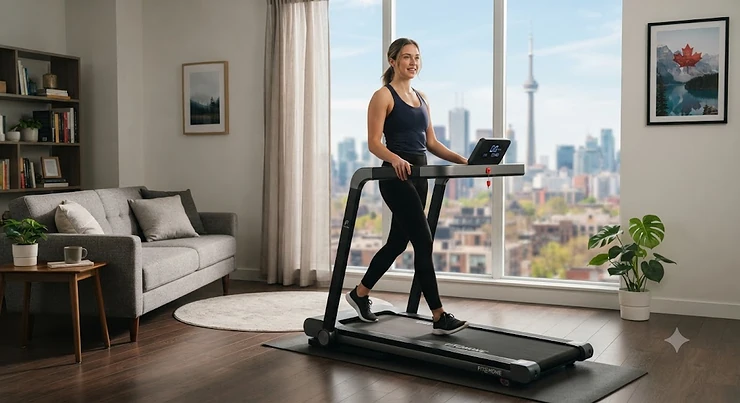
Somewhere between “I should really start exercising” and actually doing it sits a treadmill nobody wants to fight with. That’s the whole appeal of a simple treadmill for home: no touchscreen demanding a software update, no subscription nagging you mid-stride, just a belt, a couple of buttons, and enough room to walk off a bad day. A simple treadmill for home is, in plain terms, a compact motorized or manual walking machine built around straightforward controls, a basic LCD display, and a handful of preset programs rather than streaming classes or app-locked features — the goal is movement, not a second screen to manage. Canadians buy a lot of them, and for good reason: our winters are long, our commutes eat daylight, and a treadmill you can start with one button beats a fancy one you’re too intimidated to use.
This guide walks through seven real, currently available models spanning budget, mid-range, and premium territory, plus the practical stuff nobody tells you upfront — assembly time, what those preset programs actually do, and how to avoid buying more treadmill than your apartment (or your patience) can handle. Health Canada and the Public Health Agency of Canada point to 150 minutes of moderate-to-vigorous activity per week as the baseline for adults, and a treadmill sitting in your living room is one of the more reliable ways to actually hit that number when the sidewalks are glazed with ice.
Quick Comparison Table: 7 Simple Treadmills for Home at a Glance
| # | Treadmill | Best For | Preset Programs | Price Range (CAD) |
|---|---|---|---|---|
| 1 | XTERRA Fitness TR150 | Budget walkers and light joggers | 12 | Under C$650 |
| 2 | Goplus 1 HP Electric Walking Treadmill | Fastest setup, under-desk use | 12 | C$300-C$400 |
| 3 | Egofit Walker Pro M1 | Tiny apartments, WFH walking | Speed/incline presets via remote | C$450-C$600 |
| 4 | Sunny Health & Fitness SF-T7515 | Auto-incline on a budget | 12 | C$650-C$850 |
| 5 | Horizon Fitness T101 | First-time treadmill owners | Around 30 | C$900-C$1,100 |
| 6 | NordicTrack T 6.5 S | Small footprint, no subscription pressure | Console basics + optional iFIT | C$1,050-C$1,300 |
| 7 | Sole F63 | Long-term durability, low upkeep | 10 | C$1,400-C$1,700 |
Looking at the spread above, the XTERRA Fitness TR150 and Goplus 1 HP Electric Walking Treadmill cover the “I just want to walk more” crowd without asking much of your wallet, while the Sole F63 sits at the other end for buyers who’d rather pay once and stop thinking about it. The middle three — Egofit Walker Pro M1, Sunny Health & Fitness SF-T7515, and Horizon Fitness T101 — split the difference between space constraints and feature count. Note that every price above is a range only; retailers adjust pricing constantly, so always check current price before assuming a figure is locked in.
💬 Just one click — help others make better buying decisions too!😊
Top 7 Simple Treadmills for Home: Expert Analysis
Coverage below spans real, currently sold models — budget, mid-range, and premium — plus two compact formats (an under-desk walker and a walking pad) for anyone whose square footage is the real deciding factor, not the price tag.
1. XTERRA Fitness TR150 — best all-around budget pick
The standout here isn’t a single spec, it’s the whole package staying under the price of a decent stand mixer while still folding up and rolling out of the way. The 2.25 HP motor runs a 16-by-50-inch deck across a 0.5-10 mph (0.8-16 km/h) range, which is plenty for walking and comfortable jogging but not built for marathon-pace intervals — that’s the trade-off at this price. Incline is manual, adjusted with a pop-pin at the rear of the deck rather than motorized buttons, so you’ll step off briefly to change it, a detail that matters more to hill-training runners than to everyday walkers.
Based on the spec sheet, this is squarely a beginner-to-intermediate walking machine, not a serious runner’s tool — and that’s exactly who should buy it. Reviewers consistently note that the 5-inch LCD display is basic but genuinely easy to read, and several long-term owners on retailer review pages mention the lifetime frame warranty as reassuring given the low price. A recurring complaint in user reviews is that the running surface feels tight for taller users over about 6 feet.
Pros:
- ✅ Lifetime frame warranty rare at this price point
- ✅ 12 preset programs add real workout variety
- ✅ Folds compactly with an easy-pull release knob
Cons:
- ❌ Manual incline requires stepping off to adjust
- ❌ Deck feels short for taller runners
At under C$650, this is one of the least expensive genuinely reliable simple treadmill for home options on the market — a fair value verdict for anyone whose main goal is consistent daily walking rather than training for a 10K.
2. Goplus 1 HP Electric Walking Treadmill — fastest treadmill assembly time in this lineup
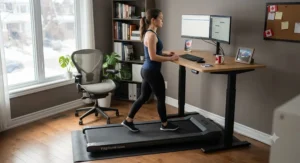
What sells this one before you even plug it in is that it ships pre-assembled — no bolts, no Allen key, no ninety minutes on the living room floor swearing at an instruction manual. The 1 HP motor and slim under-desk profile mean this isn’t a running machine; it’s a walking pad meant to slide under a standing desk or beside a couch. Twelve built-in programs and an LED display cover the basics: time, speed, distance, calories.
What most buyers overlook about compact walking treadmills like this one is that the 220-pound (100 kg) weight capacity and modest top speed are deliberate design choices, not corner-cutting — the whole unit is built slim enough to disappear under furniture, and that footprint has to come from somewhere. Reviewers frequently flag the noise level as louder than expected for a “quiet” walking pad, and a few mention the remote control feeling flimsy, though the LED screen itself works fine as a backup if the remote ever gives out.
Pros:
- ✅ Arrives pre-assembled, easy to use within minutes
- ✅ Slim profile fits under most desks
- ✅ 12 preset programs for a walking-only machine
Cons:
- ❌ Louder in operation than its size suggests
- ❌ 220 lb weight limit rules out heavier users
Priced in the C$300-C$400 range, the Goplus 1 HP Electric Walking Treadmill is the pick for someone who wants to add steps during a workday without renovating their office.
3. Egofit Walker Pro M1 — smallest footprint for tiny apartments
Marketed, fairly accurately, as one of the smallest under-desk treadmills available, the standout here is a fixed 5% incline built directly into the frame rather than offered as an optional setting. That incline means you’re burning more per kilometre walked without needing to push the speed higher — useful in a studio apartment where a loud, fast belt would annoy the neighbours below. Speed tops out modestly (independent testers have clocked it slightly above the stated 3.1 mph figure, closer to 3.6 mph), which keeps this firmly in walking-pad territory rather than jogging territory.
Here’s what to weigh: the fixed incline is either a clever fitness boost or a limitation, depending on whether you ever want a flat surface for stretching or light yoga alongside your walks. Aggregated reviewer sentiment is largely positive on portability and the companion remote, with recurring praise for how easily it tucks under a bed or couch when not in use; a smaller number of reviewers note the 220-243 lb (100-110 kg) weight capacity as limiting for larger households.
Pros:
- ✅ Genuinely tiny footprint, fits under most furniture
- ✅ Fixed incline adds intensity without extra noise
- ✅ Simple remote and LCD display, no learning curve
Cons:
- ❌ Fixed incline can’t be turned off for flat walking
- ❌ Top speed too low for jogging
Expect to pay in the C$450-C$600 range — a fair premium over the Goplus given the incline feature and smaller physical footprint.
4. Sunny Health & Fitness SF-T7515 — best auto-incline value under C$850
The headline feature is motorized incline — 12 levels from 0 to 12% — controlled by quick buttons rather than a manual pop-pin, which is a meaningfully different workout experience than treadmill #1 on this list despite a similar price bracket. The 1-8 mph (1.6-13 km/h) speed range keeps this walking-and-light-jogging territory, powered by a modest but adequate motor.
On paper this means you get gym-style incline training without gym-style pricing, and reviewers seem to agree — the auto-incline feature shows up repeatedly as the single most-praised element across independent reviews, often described as punching above its price class. Twelve preset interval programs manipulate speed and incline together, and a built-in BMI calculator adds a small but genuinely useful reference point for tracking progress over months. A common thread in user feedback is that the handlebar grip space feels narrow for larger hands, and the frame is best suited to users under about 250 lb (113 kg) rather than heavier athletes.
Pros:
- ✅ Motorized incline rare at this price bracket
- ✅ Bluetooth speakers and BMI tracking included
- ✅ Soft-drop folding deck for easy storage
Cons:
- ❌ Narrow handlebar grips for larger hands
- ❌ 250 lb weight capacity limits heavier users
At roughly C$650-C$850, this is the treadmill to pick if incline variety matters more to you than top speed.
5. Horizon Fitness T101 — easiest console for total beginners
Independent testers keep landing on the same word for this model: easy. The standout feature is genuinely how little there is to learn — four simple LED windows display time, speed, incline, calories, distance, and heart rate, with dial-based speed and incline controls that don’t require a manual to figure out. A 2.5 CHP motor covers 0.5-10 mph (0.8-16 km/h) and up to 10% incline, respectable numbers for a treadmill priced under C$1,100.
What most buyers overlook about the T101 is the three-zone variable deck cushioning, which softens impact more at the front of the stride and firms up toward push-off — a detail that shows up in day-to-day comfort more than in any spec sheet number. Reviewers, including certified personal trainers who’ve tested it hands-on, consistently praise how quickly it can be assembled solo and how comfortable the handlebar positioning feels for taller users. A recurring critique is that there’s no rear safety bar to catch the belt, something households with young kids or pets should factor in.
Pros:
- ✅ Genuinely simple console, no learning curve
- ✅ Lifetime frame and motor warranty
- ✅ Around 30 preset programs for the price
Cons:
- ❌ No rear safety catch bar
- ❌ 2.5 CHP motor underpowered for serious running
Priced around C$900-C$1,100, the Horizon Fitness T101 is the treadmill most likely to still feel approachable six months in, once the New Year’s resolution energy has worn off.
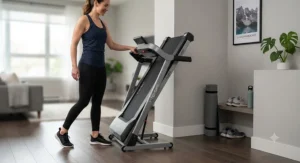
6. NordicTrack T 6.5 S — best small-screen option without a subscription trap
Unlike NordicTrack’s larger touchscreen models, the T 6.5 S ships with a smaller 5- to 7-inch screen and a genuinely usable manual mode, so you’re not locked out of a workout the moment your iFIT trial expires. The 20-by-55-inch belt handles walking, jogging, and hiking-style workouts comfortably, with incline up to roughly 10% and speeds into double digits.
Reviewers consistently note that NordicTrack pushes its iFIT subscription hard on the console, but the honest read here is that the base console programs and manual controls remain fully functional without ever entering a credit card — you simply lose the automatic trainer adjustment and streaming class library. Here’s what to weigh: if you want the NordicTrack brand’s build quality and 20-inch belt width without ongoing costs, this smaller-screen model delivers that better than its larger, screen-forward siblings. A common complaint across owner reviews is that the smaller rollers (under 2 inches) may shorten belt lifespan compared with commercial-style machines.
Pros:
- ✅ Full-width 20-inch belt, comfortable for most strides
- ✅ Works fully in manual mode, no forced subscription
- ✅ 10-year frame warranty standard
Cons:
- ❌ Smaller rollers may wear faster long-term
- ❌ Console still nudges toward iFIT upsells
In the C$1,050-C$1,300 range, this sits at the upper edge of “simple” but earns its spot for buyers who want NordicTrack reliability minus the monthly bill.
7. Sole F63 — best premium pick for low-maintenance durability
The 2026 refresh brings a 3.0 CHP motor, a spacious 20-by-60-inch deck, and incline up to 15% — genuinely commercial-adjacent numbers wrapped in a foldable home unit. Ten preset programs cover cardio, fat-burn, hill, and interval formats, displayed on a 6.5-inch backlit LCD that, notably, doesn’t try to be a touchscreen and is arguably easier to read mid-stride because of it.
What the spec sheet won’t tell you, but reviewers note, is how much the Cushion Flex Whisper Deck actually reduces joint impact during longer sessions — testers have measured it noticeably softer than pavement, which matters if knee comfort is part of why you’re avoiding outdoor running. Based on the spec comparison with the rest of this list, the F63 is the only model here built to handle years of near-daily use without the motor or deck becoming the weak link; its lifetime frame-and-motor warranty backs that up. Aggregated reviewer sentiment is strongly positive on build quality and value relative to price, with the most common criticism being that a full touchscreen isn’t included at this tier — a deliberate simplicity trade-off, not an oversight.
Pros:
- ✅ 3.0 CHP motor handles daily use for years
- ✅ Lifetime warranty on frame and motor
- ✅ Cushioned deck noticeably reduces joint impact
Cons:
- ❌ No touchscreen at this price point
- ❌ Heavier unit, harder to relocate solo
Expect to pay in the C$1,400-C$1,700 range — a genuine investment, but one reviewers repeatedly frame as the treadmill you buy once instead of replacing twice.
Setting Up and Getting the Most From Your Simple Treadmill for Home
Treadmill assembly time varies more than people expect, and it’s rarely about the box being heavy — it’s about small parts going in the wrong order. Fully assembled walking pads like the Goplus 1 HP Electric Walking Treadmill need essentially zero setup time beyond unboxing and plugging in, while a full folding frame like the Sole F63 or NordicTrack T 6.5 S realistically takes sixty to ninety minutes with two people, mostly spent attaching the upright console arms and running the display cable through the frame.
A few things make the first thirty days go smoother. First, place the treadmill on a hard, level surface — carpet padding underneath can throw off incline calibration on motorized models like the Sunny Health & Fitness SF-T7515. Second, resist the urge to skip the safety key clip test; treadmills stop instantly when it’s pulled, and it’s better to learn that on purpose than mid-stride. Third, lubricate the belt on schedule (most manufacturers recommend every three months of regular use) using a silicone-based lubricant — petroleum products like WD-40 will degrade the belt material rather than protect it. Finally, keep the console area dry; sweat dripping into button gaps is the single most common cause of unresponsive controls on budget consoles.
Who Actually Buys a Simple Treadmill for Home?
Picture three different households, because the “right” pick genuinely depends on who’s stepping on it. First: a downtown condo-dweller working from home, wanting to break up long stretches of sitting without adding noise complaints. That person is better served by the Egofit Walker Pro M1 or Goplus 1 HP Electric Walking Treadmill — compact, quiet enough for shared walls, and easy to tuck away before guests arrive.
Second: a suburban family in a basement rec room, where two or three people of different fitness levels will use the same machine. Here, something like the Horizon Fitness T101 or Sunny Health & Fitness SF-T7515 makes more sense — sturdier weight capacity, motorized or wider incline range, and a console simple enough that a teenager and a grandparent can both use it without a tutorial. Third: someone who’s tried treadmills before, knows they’ll use it consistently, and wants to stop shopping for years. That’s the Sole F63 buyer — paying more upfront in exchange for a motor and deck built to outlast a half-decade of daily walks.
How to Choose a Simple Treadmill for Home
- Measure your space twice — folded and unfolded dimensions both matter, especially in condos and smaller homes common across Canadian cities.
- Match motor size to your actual use — 2.0-2.5 HP suits walking and light jogging; save 3.0 CHP and above for regular running.
- Decide how much incline you actually want — manual pop-pin incline works fine for occasional variety, but motorized incline changes the workout more meaningfully.
- Check the weight capacity against every household member, not just yourself, if more than one person will use the machine.
- Confirm whether preset programs require an app or subscription, since some “smart” features quietly lock behind a paywall after a free trial period.
- Read the warranty terms on the frame and motor specifically — lifetime motor coverage is a strong signal of manufacturer confidence.
- Factor in delivery and treadmill assembly time honestly, particularly if you’ll be setting it up alone.
Common Mistakes When Buying a Simple Treadmill for Home
The single most common misstep is buying based on top speed alone. Reviewers and certified trainers alike point out that most home users rarely exceed 6-7 mph (10-11 km/h), yet shoppers fixate on 12 mph specs they’ll never use while ignoring belt length, which affects comfort on every single walk. A second mistake is underestimating noise — apartment dwellers especially should look for stated decibel ranges or motor type before assuming “quiet” marketing copy holds up in a shared building.
Third, buyers often skip measuring doorways and stairwells, only to discover the boxed unit won’t make it around a tight hallway corner. Fourth, some shoppers assume every LCD display shows the same information; in practice, some consoles cycle through metrics one at a time while others show everything simultaneously, and that difference matters mid-workout. Finally, treat “12 preset programs” as a number worth verifying rather than taking at face value — a program that only varies speed is a different experience than one that varies speed and incline together.
Simple Treadmill vs Smart Connected Treadmill
| Factor | Simple Treadmill | Smart Connected Treadmill |
|---|---|---|
| Upfront cost | Lower, generally under C$1,700 | Often C$1,800-C$4,500+ |
| Ongoing cost | None | Monthly subscription common (C$40-C$60) |
| Learning curve | Minimal, buttons and dials | Moderate, app pairing and account setup |
| Workout variety | Preset programs, self-directed | Streaming classes, auto-adjusting terrain |
| Best For | Consistent, low-friction daily movement | Guided training, variety-seekers |
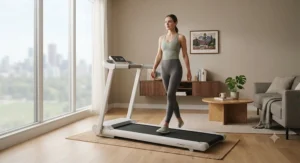
The gap here isn’t really about quality, it’s about what keeps you coming back. A simple treadmill for home wins on friction — there’s no login screen between you and a walk — while a smart connected model wins on engagement for people who genuinely enjoy structured classes. Based on the spec comparison, anyone who has previously abandoned a gym membership because “getting there” felt like the hard part should lean simple, since the same psychology applies to logging into an app before every session.
Long-Term Cost & Maintenance
A low-maintenance treadmill isn’t really about the sticker price — it’s about what you’re not paying for later. Belt replacement, motor brush wear, and console button failure are the three most common repair categories across budget-to-mid-range machines, and all three are heavily influenced by upkeep habits rather than luck. Regular silicone lubrication (roughly every three months for daily use) is the single cheapest way to extend belt life, often costing under C$20 per year in supplies.
Total cost of ownership also depends on warranty structure. The Sole F63 and Horizon Fitness T101 both carry lifetime frame-and-motor coverage, which meaningfully changes the five-year math compared with machines offering only one or two years on major components. A treadmill priced C$300 cheaper upfront but requiring a motor replacement in year three isn’t actually the better value — it just moved the cost to a less convenient moment. For a low-maintenance treadmill in the truest sense, prioritize models with sealed or low-friction bearing systems and avoid placing any unit in a damp basement without a dehumidifier nearby, since moisture is a leading cause of premature electrical failure in home fitness equipment.
Features That Actually Matter (And Those That Don’t)
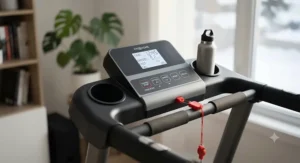
An LCD display genuinely matters, but bigger isn’t automatically better. What matters is legibility mid-stride — high-contrast numbers you can read while your head bounces slightly from footfall beat a cluttered screen crammed with metrics you’ll check twice a year. Preset programs matter more than their marketing suggests, too, but only the ones that vary both speed and incline together; a “12 programs” claim built entirely on speed changes alone is a thinner feature than it sounds.
On the other hand, Bluetooth speakers, phone charging ports, and tablet holders are genuinely nice-to-haves rather than essentials — pleasant additions that rarely factor into whether you actually use the machine six months from now. Treadmill with basic controls setups — simple up/down buttons plus a handful of speed presets — consistently outperform button-heavy consoles in real-world satisfaction surveys, largely because fewer options means less hesitation before starting a workout. The takeaway: prioritize display clarity and program depth over flash, and treat extras as tie-breakers, not deciding factors.
Safety, Regulations, and Compliance Guide
Every electrical treadmill sold in Canada that plugs into a wall outlet needs to carry a recognized certification mark — CSA, cUL, or cETL — confirming it meets Canadian national safety standards, a requirement Health Canada outlines clearly for electrical products. It’s worth checking for that mark on the product listing or the unit itself before completing a purchase, particularly with lesser-known imported brands. Beyond certification, a few practical safety habits matter for any easy to use home treadmill: always clip the safety key to clothing during use, keep pets and small children away from the moving belt and rear roller area, and unplug the unit fully — not just power it off — before any cleaning or belt lubrication.
Positioning also plays a safety role. Leave at least the manufacturer-recommended clearance behind the unit (commonly around 1.5 to 2 metres) in case of a stumble, and avoid running the power cord under rugs where it could fray unnoticed over time. None of this is complicated, but it’s the kind of groundwork that turns a simple treadmill for home into a genuinely low-risk piece of equipment rather than a hazard waiting for a distracted morning.
FAQ: Simple Treadmill for Home
❓ What is a simple treadmill for home?
❓ Is a simple treadmill for home good for beginners?
❓ How much does a simple treadmill for home cost in Canada?
❓ Do simple treadmills for home need Wi-Fi or a subscription?
❓ How long does treadmill assembly time usually take?
Conclusion
A simple treadmill for home doesn’t need to impress anyone — it needs to be there, ready, on the mornings when the driveway’s iced over or the gym feels like too much effort. Whether that’s the budget-friendly XTERRA Fitness TR150, the zero-assembly Goplus 1 HP Electric Walking Treadmill, or the built-to-last Sole F63, the honest throughline across every option here is the same: fewer barriers between you and pressing start tend to matter more than any spec sheet. Match the motor and footprint to how you’ll actually use it, keep the belt lubricated on schedule, and the machine will quietly do its job for years without asking much in return.
Recommended for You
- Folding Treadmill vs Manual Treadmill for Beginners—7 Real Picks 2026
- Top Starter Treadmills: 7 Best Picks for Beginners (2026)
- Treadmill for First-Time Buyers: 7 Smart Picks for 2026
Disclaimer: This article contains affiliate links. As an Amazon Associate, I earn from qualifying purchases. If you purchase products through these links, we may earn a small commission at no additional cost to you.
✨ Found this helpful? Share it with a friend who’s still thinking about it! 💬🤗
