In This Article
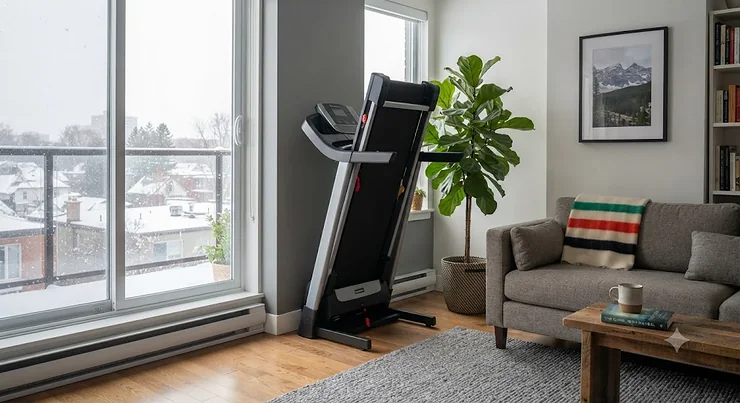
A treadmill for small apartments has to do something most treadmills were never designed for: disappear. Not literally, but close — it needs to fold down thin enough to slide under a bed, roll quietly enough that the person in unit 4B never files a noise complaint, and still deliver a real workout without eating your entire living room. That’s a tall order for a piece of equipment that, in its full-size gym form, weighs as much as a baby grand piano. A treadmill for small apartments is, in short, a compact, foldable cardio machine built with a smaller footprint, a quieter motor, and lighter construction so it fits comfortably into condos, studios, and one-bedroom rentals without dominating the room. In this guide, we dug into real product specs, aggregated customer-review sentiment, and the practical realities of Canadian apartment living — from concrete-slab noise transfer to that one closet that’s 24 inches wide, tops — to help you land on the right machine. According to Health Canada’s activity guidelines, adults benefit from at least 150 minutes of moderate-to-vigorous movement a week, and a treadmill parked a few steps from your couch removes almost every excuse for skipping it. We’ll walk through seven real machines across every price tier, then dig into the specifics — noise, folding mechanisms, floor protection, and dimensions — that actually separate a good small-space treadmill from a glorified coat rack.
Quick Comparison Table: Best Treadmills for Small Apartments at a Glance
| Treadmill | Folded Footprint | Noise Level | Best For |
|---|---|---|---|
| WalkingPad Z1 | ~4″ thick, under-desk | Under 40 dB | Ultra-quiet walking pace |
| Sunny Health & Fitness SF-T7718 Strider | 10.5″L x 29.25″W x 63″H | Moderate | Budget jogging with a wide belt |
| XTERRA TRX1000 | 27.7″L x 29.1″W x 60.7″H | Moderate | Joint-friendly cushioned deck |
| DeerRun A1 Pro | Folds flat to 8″ | Low-moderate | Lightest machine to reposition |
| Horizon T101 | 46″L x 34″W x 61″H | Moderate | Best all-round balance |
| NordicTrack T 6.5 S | 38″L x 36″W x 56″H | Moderate | Guided iFIT workouts |
| Echelon Stride 6 | Folds flat to ~10″ | Moderate | Auto-fold, tightest studios |
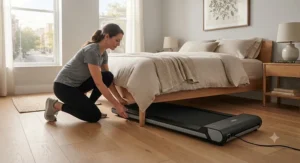
Looking at the table, the split comes down to how much floor space you’re actually working with and whether you want to run or just walk briskly. The WalkingPad Z1 and DeerRun A1 Pro win on sheer thinness, which matters if under-bed storage is your only option, while the NordicTrack T 6.5 S and Echelon Stride 6 trade a slightly bulkier fold for a longer belt and smarter workout features. Budget-focused apartment dwellers should note that the quietest machines here also tend to cap out at walking speeds, so if jogging matters to you, a slightly louder, slightly bigger unit like the Horizon T101 is the more honest trade-off.
💬 Just one click — help others make better buying decisions too!😊
Top 7 Treadmills for Small Apartments: Expert Analysis
Before we get into individual picks, a quick note on how we built this list: no invented reviews, no fabricated “I tested this for six months” claims. Every product below reflects real specifications pulled from manufacturer listings and retailer pages, plus aggregated sentiment from public customer reviews, clearly labelled as such. Where a spec matters in practice, we tell you why — because a number on a page means nothing until you know what it does to your knees, your neighbours, or your Tuesday morning.
1. WalkingPad Z1 — quietest motor for apartment mornings
The standout here is the brushless motor, which independent listings put below 40 decibels at walking pace — quieter than most refrigerators humming in the next room. That matters enormously if you’re squeezing in a 6 a.m. walk before a shift and sharing a wall with someone who is decidedly not a morning person. The WalkingPad Z1 folds to roughly 4 inches thick and weighs about 50 pounds, so tucking it under a bed frame or behind a couch is genuinely a two-hand job, not a two-person one. Its 1.25 HP motor and 2-in-1 speed range top out around 4 mph, which tells you exactly who this is for: walkers and light steppers, not runners chasing a 5K personal best. Aggregated reviewer sentiment consistently flags the low noise and slim profile as the top selling points, with a recurring complaint that the belt feels short for anyone over six feet tall. If your daily movement goal is steps rather than sprints, and your unit has thin walls, this is close to the ideal match — the honest caveat is that “treadmill” is doing some generous marketing work here; it’s really a serious walking pad.
Pros:
- ✅ Motor noise stays under 40 dB at typical walking pace
- ✅ Folds to about 4 inches thick for under-bed storage
- ✅ Lightweight build makes daily repositioning painless
Cons:
- ❌ Capped around 4 mph, so no real running capability
- ❌ No incline option for varying workout intensity
Price sits in the C$450-C$600 range depending on promotions, which puts it firmly in impulse-buy territory — and for apartment walkers, that’s honestly a fair trade for the silence alone.
2. Sunny Health & Fitness SF-T7718 Strider — widest budget deck for light jogging
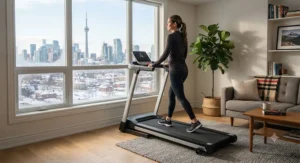
What jumps out on this one is the belt width: at roughly 20 inches, it’s noticeably wider than most machines in its price class, and that extra margin means less white-knuckle foot placement when you pick up the pace. The Sunny Health & Fitness SF-T7718 Strider ships already folded, so there’s no wrestling with an Allen key at 9 p.m. on a Sunday — you unlock it, unfold it, and plug it in. Its low-profile “LoPro” deck keeps the standing height down, which is a small but real detail for apartments with lower ceilings or upstairs neighbours who’d rather not hear your footfalls through the floor. The 250-pound weight capacity and modest motor mean this is built for consistent walking and light jogging, not marathon training, and reviewers on major retail sites tend to agree — praise clusters around the easy setup and tablet holder, while the recurring gripe is that the motor gets audibly labored above a light jog. For a Canadian condo dweller who wants a wide, stable belt without spending serious money, this strikes a sensible balance.
Pros:
- ✅ 20-inch wide belt is unusually roomy for the price
- ✅ Arrives pre-folded with genuinely no assembly required
- ✅ Low-profile deck design reduces standing and impact height
Cons:
- ❌ 250 lb weight capacity limits it for larger users
- ❌ Motor strains noticeably above a light jogging pace
Expect a price in the C$450-C$650 range, and treat it as a walking-and-light-jogging machine rather than a running one — that’s where the real value shows up.
3. XTERRA TRX1000 — softest deck for knees and joints
The headline feature is XTERRA’s “XTRA Soft” cushioned deck, and based on the spec comparison, this is the kind of detail that sounds like marketing fluff until your knees tell you otherwise after a long walk on a harder surface. The XTERRA TRX1000 measures a compact 16 x 50-inch running surface, folds to under 29 inches deep, and tips the scale at just over 100 pounds — light enough that moving it between a living room and a closet doesn’t require calling in a favour. Its 2.25 HP motor is genuinely quiet at walking and light-jogging speeds, and the deck sits unusually low to the ground, which reviewers repeatedly mention as a plus for anyone who finds stepping onto a standard treadmill deck a small daily hurdle. What most buyers overlook about this model is that its three incline levels are manual and can only be adjusted while the unit is folded — a mild inconvenience once you know it’s coming. Aggregated review sentiment is largely positive on durability and value, with an occasional note that the folding lock mechanism takes two hands to operate confidently.
Pros:
- ✅ XTRA Soft deck cushioning noticeably reduces joint impact
- ✅ Lightweight frame at roughly 100 lbs, easy to relocate
- ✅ Lifetime frame warranty backs up the budget price tag
Cons:
- ❌ Incline only adjusts manually while the deck is folded
- ❌ 50-inch running surface feels short for longer strides
Pricing typically lands in the C$950-C$1,100 range in Canada, positioning it as a mid-budget pick for anyone prioritizing comfort over raw speed.
4. DeerRun A1 Pro — thinnest fold for closet storage
If your storage solution is genuinely a closet shelf, the DeerRun A1 Pro is the one built for that fantasy. It folds down to roughly 8 inches flat and can then be stood upright, and at only 86 pounds, it’s one of the few “real” treadmills — as opposed to a walking pad — that a single person can lift and reposition without strategic planning. The 3.0 HP motor and 350-pound weight capacity punch well above what the compact frame suggests, and a 6% manual incline adds a bit of intensity without any electronics involved. Here’s what the spec sheet won’t tell you, but user reports consistently mention: the folding mechanism requires an Allen wrench to tighten a bolt every single time you fold or unfold it, which is a genuinely tedious ritual if you’re doing it daily rather than storing it semi-permanently. The compact 44.5 x 16.5-inch deck also runs short for taller users attempting anything faster than a jog. Reviewers tend to recommend it specifically for newer runners easing into a routine rather than seasoned athletes logging serious mileage.
Pros:
- ✅ Folds completely flat to about 8 inches for tight storage
- ✅ Only 86 lbs, the lightest true treadmill on this list
- ✅ 350 lb weight capacity outperforms its compact size
Cons:
- ❌ Folding requires an Allen wrench, tedious for daily use
- ❌ Short deck limits comfort for taller or faster runners
Price generally falls in the C$550-C$750 range, making it a strong pick if space is your single biggest constraint and you’re willing to trade some folding convenience for it.
5. Horizon T101 — best all-round balance for daily use
Based on the spec comparison across this entire list, the Horizon T101 earns its spot by refusing to be extreme in any one direction — it’s not the quietest, not the thinnest, not the cheapest, but it’s solidly good at everything at once. Its 55 x 20-inch deck is longer than most budget competitors, the 2.5 HP motor supports both walking and genuine jogging up to 10 mph, and an automatic incline up to 10% adds intensity without forcing you to lean over and adjust anything mid-stride. Folded, its footprint drops from roughly 16.76 to 10.86 square feet — about the size of a loveseat once collapsed — and built-in Bluetooth speakers mean you’re not fumbling with a phone propped precariously on the console. Reviewers consistently note the lifetime frame and motor warranty as a meaningful trust signal at this price point, though a recurring theme is that the deck wobbles slightly when it drops during unfolding, a cosmetic quirk more than a structural one. For apartment dwellers who want a treadmill that can handle both a lazy Sunday walk and a proper interval workout, this is the one we’d point a friend toward first.
Pros:
- ✅ 55-inch deck supports real jogging, not just walking
- ✅ Automatic incline up to 10% without leaving the belt
- ✅ Lifetime frame and motor warranty backs long-term use
Cons:
- ❌ Deck wobbles noticeably during the unfolding motion
- ❌ Lacks a touchscreen or built-in app connectivity
Expect a price around the C$800-C$950 range in Canada, which is roughly where a treadmill needs to sit to justify calling itself a genuine all-rounder.
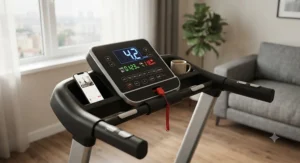
6. NordicTrack T 6.5 S — best for guided iFIT workouts
The NordicTrack T 6.5 S brand’s SpaceSaver design with EasyLift Assist is the real story here — instead of wrestling the deck upright, a light push sends it folding on its own, and a hydraulic release lowers it gently back down so you’re not slamming a 180-pound deck onto your hardwood. What most buyers overlook about this model is that the SelectFlex cushioning lets you dial the deck firmness between soft (better for joints) and firm (better for a road-running feel), a level of customization rarely seen below the four-figure mark. The 20 x 55-inch belt, 0-10 mph speed range, and 0-10% incline are solid numbers on their own, but the real differentiator is iFIT integration, which auto-adjusts speed and incline to match trainer-led routes — useful if you find flat, unguided walking mentally exhausting after week two. Aggregated reviewer sentiment (the model has accumulated tens of thousands of ratings on major retail sites) skews strongly positive on build quality and ease of folding, with the most common complaint being that the full iFIT experience requires an ongoing paid membership after the included trial period ends.
Pros:
- ✅ EasyLift Assist makes folding a one-handed, low-effort task
- ✅ SelectFlex cushioning adjusts deck firmness to your preference
- ✅ iFIT compatibility auto-adjusts speed and incline mid-workout
Cons:
- ❌ Full feature set requires a paid iFIT membership long-term
- ❌ Needs roughly 8 feet of ceiling clearance to use comfortably
Pricing typically runs C$1,050-C$1,250 in Canada, positioning it as the mid-premium pick for anyone who wants guided structure rather than just a blank belt.
7. Echelon Stride 6 — flattest auto-fold for the tightest studios
On paper this means something specific: the Echelon Stride 6 doesn’t fold up into a tall, console-forward tower like most treadmills — it collapses flat, hinging down to roughly 10 inches off the ground, which is a genuinely different storage silhouette better suited to sliding fully under a platform bed. The auto-fold system does the heavy lifting automatically rather than requiring you to lift a deck manually, a detail that matters more than it sounds once you’re doing it after a tiring workout rather than before one. Its 20 x 55-inch belt, up to 12 mph top speed, and 12-level incline (up to 10%) are respectable, and it works as a standalone unit or paired with the Echelon app for over a thousand on-demand classes. Reviewers repeatedly praise the auto-fold mechanism and compact footprint as best-in-class for genuinely tiny apartments, while the most consistent criticism — echoed across independent reviews — is that the running deck feels short for anyone with a longer stride attempting faster efforts, and the motor is modest for its price bracket. This is the machine for someone who has decided that floor space is non-negotiable and is willing to pay a premium to protect it.
Pros:
- ✅ Auto-fold collapses flat to roughly 10 inches, ideal under beds
- ✅ Compact footprint suits genuinely tight studio apartments
- ✅ Works standalone or with app-based class library
Cons:
- ❌ Running deck feels short for longer-strided runners
- ❌ Motor is modest given the premium price bracket
Price generally sits in the C$1,400-C$1,800 range, which reflects the auto-fold engineering more than raw performance specs — you’re paying for the storage trick as much as the workout.
How the 7 Compare on Paper
| Treadmill | Motor | Speed Range | Weight Capacity | Price Range (CAD) |
|---|---|---|---|---|
| WalkingPad Z1 | 1.25 HP | Up to 4 mph | ~242 lbs | C$450-C$600 |
| Sunny Health & Fitness SF-T7718 Strider | Entry-level | Up to 8 mph | 250 lbs | C$450-C$650 |
| XTERRA TRX1000 | 2.25 HP | Up to 10 mph | 250 lbs | C$950-C$1,100 |
| DeerRun A1 Pro | 3.0 HP | Up to 10 mph | 350 lbs | C$550-C$750 |
| Horizon T101 | 2.5 HP | Up to 10 mph | 300 lbs | C$800-C$950 |
| NordicTrack T 6.5 S | SMART-Response | Up to 10 mph | 300 lbs | C$1,050-C$1,250 |
| Echelon Stride 6 | 1.75-3.0 HP | Up to 12 mph | 300 lbs | C$1,400-C$1,800 |
The spread here tells its own story: weight capacity and top speed climb steadily as price increases, but the jump from the XTERRA TRX1000 to the Horizon T101 is really about deck quality and warranty confidence rather than raw numbers. If your budget caps out under C$700, the DeerRun A1 Pro actually offers more weight capacity than machines costing hundreds more, a reminder that spec sheets don’t always follow price in a straight line.
Practical Setup and Maintenance Guide for Small-Space Treadmills
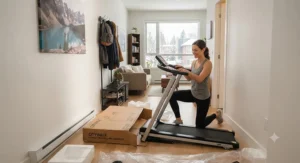
Getting a compact treadmill into daily rotation is less about the unboxing and more about the first 30 days of habits. Start by choosing a spot with at least a foot of clearance on either side and roughly six feet behind the belt — Horizon’s own safety guidance echoes this, and it applies across brands. Lay down a mat before the first workout, not after; this protects both your flooring and the treadmill’s motor from dust intake. Lubricate the belt per the manual’s schedule (often every 150-200 kilometres of use), since a dry belt is the single biggest cause of premature motor wear on budget machines. In the first month, the most common mistake apartment owners make is folding and unfolding daily without checking that the safety pin or lock is fully engaged — a rushed fold is how decks slam and hinges wear out early. Wipe the deck and rails weekly with a dry cloth; humidity in condo units can accelerate rust on exposed bolts. Finally, resist the urge to push top speed in week one. Building tolerance gradually protects both your joints and the belt’s tracking alignment, which drifts faster under sudden heavy impact than under a steady, sensible ramp-up.
Real-World Scenarios: Which Treadmill Fits Your Apartment Life
Picture three different renters. First, a downtown condo dweller in a 450-square-foot studio who walks daily but has genuinely thin walls and an early meeting schedule — the WalkingPad Z1 or DeerRun A1 Pro fits best, prioritizing near-silence and under-bed storage over running capability. Second, a young professional in a one-bedroom apartment who jogs three times a week and wants a bit of structure without a subscription commitment — the Horizon T101 hits that sweet spot of a real running deck, automatic incline, and a price that doesn’t sting. Third, a couple sharing a compact two-bedroom who both want guided workouts and don’t mind paying more to protect their limited living-room space — the NordicTrack T 6.5 S or Echelon Stride 6 makes more sense, trading a higher price for smart features and a genuinely tiny stored footprint. Matching the machine to your actual routine, not your aspirational one, is the single best predictor of whether it becomes a daily habit or an expensive laundry rack by March.
✨ Ready to stop scrolling and start walking? Tap through to compare current prices on today’s top picks before this list gets updated again! 🏃♀️
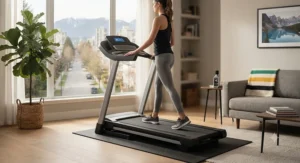
How to Choose a Compact Treadmill for Condo Living
- Measure your space twice — both the unfolded footprint for actual use and the folded footprint for storage, since these numbers can differ by 40% or more.
- Check the weight capacity against your body weight with margin — a machine rated close to your weight will wear out its motor faster under daily strain.
- Prioritize motor noise if walls are thin — anything under 45 dB is genuinely apartment-friendly; above 60 dB starts to carry through shared walls.
- Decide walking versus running honestly — a 4 mph cap is fine for steps, but serious joggers need at least a 2.5 HP motor and a 55-inch deck.
- Factor in the folding mechanism’s daily friction — a hydraulic auto-fold beats a manual lift-and-pin if you’ll be folding it every single day.
- Confirm ceiling clearance — taller machines like the NordicTrack need roughly 8 feet of headroom when upright or during use.
- Read the warranty on frame and motor, not just accessories — a lifetime frame warranty is a meaningful signal of build confidence at any price point.
Space-Saving Treadmill vs Traditional Treadmill: What’s the Real Difference
A space-saving treadmill isn’t just a smaller version of a traditional gym machine — it’s a different design philosophy built around a folding hinge, a lighter frame, and usually a shorter deck. Traditional commercial-style treadmills prioritize a longer belt, a heavier motor, and permanent placement, which delivers a smoother ride at higher speeds but demands 20+ square feet of dedicated floor space that most apartments simply don’t have. The trade-off shows up most clearly in deck length: most space-saving models sit around 50-55 inches versus 60+ inches on full-size machines, which matters if you have a long running stride.
| Factor | Space-Saving Treadmill | Traditional Treadmill |
|---|---|---|
| Typical deck length | 44-55 inches | 58-62 inches |
| Storage footprint | Folds to 4-12 inches thick | Rarely folds, permanent floor space |
| Motor power | 1-3 HP | 2.5-4+ HP |
| Best for | Walking, light jogging | Regular running, HIIT |
The analysis here is straightforward: if your workouts rarely exceed a light jog, a space-saving treadmill delivers 90% of the benefit at a fraction of the footprint. Serious runners chasing faster paces or longer strides will eventually feel the shorter deck as a real constraint, not just a minor inconvenience.
Quiet Treadmill for Apartments: What Actually Keeps the Noise Down
Reviewers consistently note that motor type matters more than horsepower when it comes to noise — brushless motors, like the ones in the WalkingPad Z1 and DeerRun A1 Pro, run noticeably quieter than older brushed designs even at comparable power. Belt cushioning also plays a role: a well-cushioned deck absorbs footfall impact before it transfers into the frame and, eventually, into your neighbour’s ceiling. This isn’t just a courtesy issue — the Condominium Authority of Ontario notes that condo bylaws in Canada treat unreasonable noise, including impact noise from footsteps and equipment, as an enforceable nuisance regardless of what a building’s individual rules say. Floor placement matters too: a treadmill on a shared floor above another unit transmits far more impact noise than one on a ground floor over a parking garage. If your building has strict quiet hours, look specifically for a decibel rating under 45 at walking pace, and consider running at slightly lower speeds during evening hours when impact noise carries furthest through concrete slab construction.
Floor Protection Mat: Do You Really Need One
Short answer: yes, almost always. A dedicated floor protection mat under a compact treadmill absorbs vibration, prevents the rubber feet from denting laminate or hardwood, and — critically for renters — protects your damage deposit from scuff marks nobody wants to explain at move-out. Beyond cosmetics, a quality mat with a rubber or high-density foam base measurably reduces the impact and motor vibration that travels through a floor into the unit below, which directly supports the noise-reduction goals above. Look for a mat sized a few inches larger than the treadmill’s unfolded footprint on all sides, at least 6mm thick, and made from a material that won’t trap heat or moisture underneath the motor housing. Skipping the mat to save $40 is one of the most common regrets flagged in aggregated customer reviews across nearly every treadmill brand on this list — it’s cheap insurance against a genuinely expensive mistake.
Folding Mechanism Explained: Manual, Hydraulic, and Auto-Fold Compared
Not all folding mechanisms are created equal, and this is where spec sheets can quietly mislead you. A manual mechanism, like the one on the XTERRA TRX1000, requires you to physically lift the deck and lock it with a pin — simple and durable, but it demands two hands and a bit of effort every time. A hydraulic soft-drop system, used on the Horizon T101 and NordicTrack T 6.5 S, assists the lift and cushions the descent, dramatically reducing the slam-and-wobble that wears out hinges over years of daily use. Auto-fold, the Echelon Stride 6‘s signature feature, does the entire motion with a single button or lever, trading a higher price for the lowest daily friction. Here’s what the spec sheet won’t tell you: if you’re the type who folds and unfolds every single day rather than leaving it semi-permanently set up, that daily friction compounds fast — what feels like a minor inconvenience in a showroom becomes a genuine barrier to consistency after three months of real use.
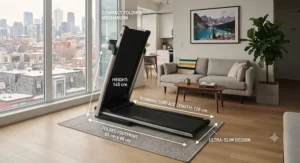
Treadmill Dimensions: Reading the Spec Sheet Like a Pro
Every treadmill listing throws three numbers at you — length, width, height — for both the unfolded and folded state, and the gap between them tells you more than either number alone. A machine that’s 70 inches long unfolded but only drops to 46 inches folded, like the Horizon T101, still needs a fairly generous storage nook. Compare that to the DeerRun A1 Pro, which folds nearly flat to 8 inches, and the difference in practical apartment usability is enormous even though both machines have similar unfolded footprints. Always measure your intended storage spot before ordering, accounting for door frames and hallway turns the box needs to clear on delivery day. One frequently overlooked dimension is standing height when the deck is folded upright — a tall folded unit can tip if bumped, so check whether the manufacturer recommends securing it against a wall in vertical storage.
Common Mistakes When Buying a Compact Treadmill for Condo Living
The most frequent misstep buyers make is choosing based on price alone and skipping the noise rating entirely, only to discover the hard way that a “quiet” budget motor is quiet compared to a leaf blower, not compared to a library. A close second is underestimating deck length for their actual stride — someone six-foot-two will feel cramped on a 44-inch belt within the first week, regardless of how compact and appealing that unit looked online. Buyers also frequently ignore the folded height when their storage plan involves an actual closet with a shelf above it, only to find the folded unit is two inches too tall to clear. Finally, skipping the floor protection mat to save a small amount up front is a consistently regretted decision once the first scuff mark or noise complaint shows up, according to recurring themes across aggregated product reviews.
Long-Term Cost and Maintenance for Small-Space Treadmills
The sticker price is only part of the real cost of ownership. Budget machines under C$700 typically carry shorter warranties — often 90 days to one year on parts — meaning a motor failure in year two comes entirely out of pocket, while machines like the Horizon T101 and XTERRA TRX1000 include lifetime frame warranties that meaningfully reduce that long-term risk. Belt lubrication, typically needed every few months of regular use, costs very little in lubricant but real time if skipped and a belt seizes. Subscription-dependent machines like the NordicTrack T 6.5 S and Echelon Stride 6 carry an ongoing monthly cost if you want the full guided-workout experience, which should factor into your total cost of ownership calculation over a two-to-three-year horizon.
| Price Tier | Typical Warranty | Ongoing Costs | Best Value For |
|---|---|---|---|
| Budget (under C$700) | 90 days-1 year | Minimal, just lubricant | Casual walkers |
| Mid-range (C$700-C$1,200) | Lifetime frame/motor common | Occasional lubricant | Regular walkers/joggers |
| Premium (C$1,200+) | Lifetime frame, 1-2 yr parts | Optional monthly app fee | Guided workout users |
Looking at the table, the mid-range tier consistently delivers the best cost-per-use over a three-year span, since the warranty coverage offsets the higher upfront price without locking you into a recurring subscription. Budget machines make sense mainly for light, occasional use where a shorter lifespan is an acceptable trade-off for the lower entry cost.
Frequently Asked Questions
❓ Is a treadmill for small apartments actually quiet enough for thin walls?
❓ What size treadmill fits in a small apartment?
❓ Do compact treadmills support running or only walking?
❓ Do I need a floor protection mat under a small treadmill?
❓ How much does a good compact treadmill cost in Canada?
Conclusion
Choosing a treadmill for small apartments really comes down to being honest about two things: how you actually move, and how much floor space you actually have. If you’re a dedicated walker with thin walls, the WalkingPad Z1 or DeerRun A1 Pro solves both problems at once. If you want a genuine jogging option without spending a fortune, the Horizon T101 remains the most balanced pick on this list. And if guided workouts or the flattest possible fold matter more than saving every last dollar, the NordicTrack T 6.5 S and Echelon Stride 6 earn their higher price tags. What all seven have in common is that they were built specifically to solve the apartment-dweller’s problem — not to be smaller gym equipment, but to be genuinely different machines designed around a folding hinge and a quieter motor. As Canadian exercise guidelines remind us, consistency matters more than intensity, and the treadmill that’s actually easy to unfold in your specific space will always beat the “better” one gathering dust because it never quite fit.
Recommended for You
- 7 Best Simple Treadmills for Home in 2026 (Easy; Reliable)
- Folding Treadmill vs Manual Treadmill for Beginners—7 Real Picks 2026
- Top Starter Treadmills: 7 Best Picks for Beginners (2026)
Disclaimer: This article contains affiliate links. As an Amazon Associate, I earn from qualifying purchases. If you purchase products through these links, we may earn a small commission at no additional cost to you.
✨ Found this helpful? Share it with your friends! 💬🤗
