In This Article
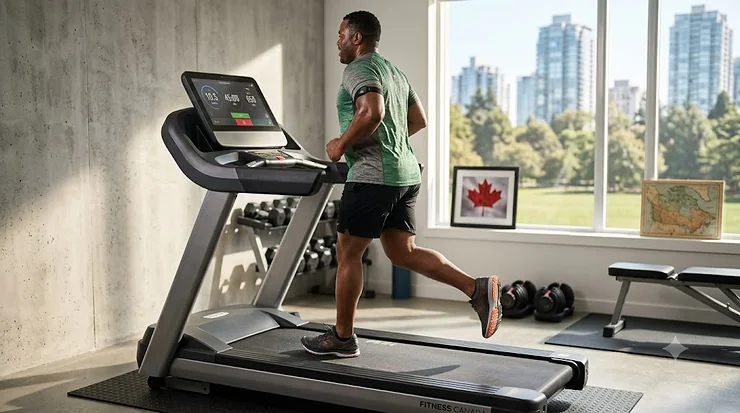
Here’s a truth nobody prints on the box: most treadmills are built for a 160-pound jogger who runs three times a week and never breaks 6 mph. If that’s not you, you already know the feeling — the deck that flexes a little too much underfoot, the motor that whines on an incline, the vague worry that today might be the day something snaps. A genuinely capable treadmill for heavy runners isn’t a luxury upgrade. It’s the difference between a machine that disappears beneath your stride and one that reminds you, every single step, that it’s working overtime just to keep up.
This guide skips the fluff and gets into the mechanics that actually matter for bigger, stronger, faster runners: continuous-duty motor horsepower, true weight capacity (not the optimistic number on the marketing page), deck size, frame construction, and long-term cost. We’ve researched seven real machines sold in Canada, spanning budget-conscious folding units to commercial-grade steel frames that don’t fold at all. Every product below carries a genuine weight rating of 350 lbs or higher and a motor built to run — not just walk — for the long haul. Prices are shown as ranges in Canadian dollars, since exact pricing shifts constantly and this article isn’t the place to pin down today’s number.
Quick affiliate disclosure up front, as required by the Amazon.ca Associates Program: this article contains affiliate links, and purchases made through them may earn a small commission at no extra cost to you. Now, let’s get into which machines can actually take a pounding.
What Is a Treadmill for Heavy Runners?
A treadmill for heavy runners is a motorized running machine engineered with a reinforced frame, a continuous-duty motor of roughly 3.0 to 4.0 HP, and a user weight capacity of 350 lbs or more — well above the 250 to 300 lb ceiling common on entry-level treadmills. These machines use thicker decking, sturdier rollers, and often a wider, longer belt to handle the higher impact forces that come with a heavier stride, especially during running rather than walking.
The mechanical reality is straightforward: when you run, your body doesn’t gently press down on the belt — it slams into it. Impact forces during running commonly reach two to three times body weight at footstrike. A 220-lb runner isn’t loading the deck at 220 lbs; momentarily, it’s closer to 440 to 660 lbs. That’s why weight capacity for running should never be treated as a number you’re simply “under.” It’s a buffer against real forces, not a suggestion.
Quick Comparison Table
| Product | Motor | Weight Capacity | Best For |
|---|---|---|---|
| 3G Cardio Pro Runner X | 3.0 HP continuous-duty | 350 lbs | Budget-friendly folding pick |
| Sole F80 | 3.5 HP | 350 lbs | Best all-around value |
| Horizon 7.8 AT | 4.0 HP | 375 lbs | Mid-range interval training |
| Matrix T75 | 3.0 HP AC continuous-duty | 400 lbs | Commercial-grade daily mileage |
| NordicTrack Commercial 2450 | 4.0 CHP | 400 lbs | Marathon-pace speed and tech |
| Bowflex Treadmill 22 | 4.0 CHP | 400 lbs | Large-format stability |
| Sole TT8 | 4.0 HP | 400 lbs | Premium light-commercial build |
Looking at this lineup, there’s a clear pattern: every serious contender for heavy runners clusters around 3.0 to 4.0 HP and 350 to 400 lbs of rated capacity, and the jump from “good” to “great” usually comes down to whether the motor is AC (like the Matrix T75) or DC, and whether the frame folds at all. Folding convenience almost always costs you a little rigidity, which matters more the heavier and faster you run. If your household has more than one serious runner, or you’re logging 30-plus km a week, leaning toward the 400-lb-capacity end of this table is the safer bet.
💬 Just one click — help others make better buying decisions too!😊
Top 7 Treadmills for Heavy Runners: Full Reviews
1. 3G Cardio Pro Runner X — smallest footprint that still handles serious mileage
The 3G Cardio Pro Runner X proves that “folding” and “flimsy” aren’t synonyms. Folded down to a 40″ x 35″ footprint, it’s one of the more apartment-friendly options here, yet it still carries a 3.0 HP continuous-duty motor and a genuine 350-lb user weight rating.
Under the hood, the 3.0 HP motor drives a 20.5″ x 58″ orthopedic belt across 2-inch rollers, and 3G Cardio backs the drive motor with a lifetime residential warranty. What that means in practice: the belt accelerates from 0 to 12 mph in roughly 18 seconds, which is snappy enough for interval work, and the low 6.5-inch step-up height makes mounting easier for taller or heavier runners who don’t want to lunge up onto a deck.
Based on the spec comparison, this is the pick for someone who needs serious build quality but genuinely lacks space for a non-folding commercial frame. It skips a built-in touchscreen entirely, relying instead on FTMS Bluetooth so you can run apps like Zwift or Kinomap from your own tablet — a deliberate trade that keeps the price down and avoids a screen that becomes outdated in three years.
Reviewers consistently describe the frame as unexpectedly rigid for its folding design, with the welded steel construction feeling closer to a fixed-frame commercial unit than a typical fold-up. A recurring theme in owner feedback is appreciation for the lack of subscription requirements, since many competing brands gate basic workout data behind a monthly fee.
Pros:
- ✅ Genuinely compact when folded for small spaces
- ✅ Lifetime motor and frame warranty included
- ✅ No mandatory subscription for basic functionality
Cons:
- ❌ No built-in touchscreen console
- ❌ Belt is narrower than some 22-inch-deck rivals
Expect to pay in the C$2,900-C$3,200 range at the time of research, positioning it as one of the more affordable machines here that still clears the 350-lb bar — solid value for a runner who prioritizes storage over screen size.
2. Sole F80 — best all-around value for serious home runners
The Sole F80 has built a reputation as the treadmill people recommend when they’re tired of researching treadmills, and the spec sheet backs that up. A 3.5 HP motor, a spacious 22″ x 60″ running deck, and a 350-lb weight capacity combine into a machine that doesn’t feel like it’s compromising anywhere obvious.
The CushionFlex Whisper Deck is worth calling out specifically: Sole claims up to a 40% impact reduction versus asphalt, and independent reviewers have generally found the deck firm enough to still feel like real running rather than trampoline-bouncy, which matters if you’re training for outdoor races and don’t want your gait to feel foreign on pavement. The 10.1-inch touchscreen runs Netflix, YouTube, and Prime Video with no subscription required — a genuinely different business model from iFIT-locked competitors.
What most buyers overlook about the F80 is the belt acceleration. Independent lab testing has clocked it as notably slow to ramp from 2 to 8 mph — over 20 seconds in one test — which makes it a poor fit for rapid-fire interval sprints even though it’s an excellent fit for steady-state endurance runs, tempo work, and long, comfortable mileage.
Aggregated review sentiment is unusually consistent for a treadmill at this price: owners over 250 lbs repeatedly describe the deck as “rock solid” at speed, and Sole’s lifetime frame-and-motor warranty, paired with reportedly responsive customer service on belt replacements, comes up again and again as a reason buyers feel comfortable with the investment.
Pros:
- ✅ Spacious 22″ x 60″ deck fits longer strides
- ✅ Lifetime warranty on frame and motor
- ✅ No subscription needed for streaming apps
Cons:
- ❌ Slow belt acceleration hampers interval training
- ❌ Cooling fans are weak per multiple reviewers
Priced in the C$2,700-C$3,000 range depending on promotions, the F80 delivers a lot of commercial-feeling machine for the money — arguably the strongest value-for-capability ratio in this entire roundup.
3. Horizon 7.8 AT — best for varied training styles on a mid-range budget
The Horizon 7.8 AT carries a 4.0 HP motor and a 22″ x 60″ deck with three-zone cushioning — softer near the front for landing, firmer toward the back for a stable push-off. That’s a deliberately engineered detail, not marketing copy: it’s designed to mimic how your foot actually loads through a stride.
QuickDial controls let you spin between speed and incline settings rapidly rather than tapping through digital increments, which becomes genuinely useful mid-interval when you don’t want to fumble with buttons while breathing hard. The moderate 8.75-inch step-up height sits in a comfortable middle ground — not as low as the 3G Cardio’s 6.5 inches, but not an awkward climb either.
Here’s what the spec sheet won’t tell you, but training-focused reviewers note: the 7.8 AT’s willingness to work with third-party apps like Peloton and iFIT (rather than locking you into one ecosystem) makes it a flexible pick for runners who like variety in their training content without committing to a single platform’s subscription for years.
For heavier runners specifically, the 4.0 HP motor is genuinely reassuring — it’s the same horsepower class as the premium NordicTrack and Bowflex units below, just attached to a lower list price. Reviewers frequently position it as the value leader among 4.0 HP machines, without shortchanging build quality to get there.
Pros:
- ✅ 4.0 HP motor at a mid-range price point
- ✅ Three-zone cushioning tuned to landing and push-off
- ✅ QuickDial controls speed up interval adjustments
Cons:
- ❌ Console feels basic next to touchscreen rivals
- ❌ Fewer built-in programs than premium competitors
Expect a price range of roughly C$2,800-C$3,300 CAD, which puts real 4.0 HP power within reach of runners who aren’t ready to spend commercial-grade money.
4. Matrix T75 — best commercial-grade build for daily high mileage
If you’ve ever run at a proper gym and wondered why the treadmill there feels so different from the one at home, the answer is usually the motor type. The Matrix T75 is one of the only residential-adjacent treadmills in this list running an industrial-grade AC motor rather than the DC motors found in nearly every other home unit — a meaningfully different drive technology that runs cooler and more consistently under sustained load.
It doesn’t fold. That single design choice explains almost everything else about the T75: a welded steel frame, a 375-lb machine weight, and a 400-lb user weight capacity that multiple independent testers have described as matching the Sole TT8 and Life Fitness Run CX in class. The 22″ x 60″ deck and aluminum side rails round out a build that reads as genuinely club-grade rather than home-gym-grade with better marketing.
Based on the spec comparison, this is the treadmill for a runner who trains daily, shares the machine across an active household, or simply refuses to compromise on stability at speed. What most buyers overlook is the electrical requirement — Matrix recommends a dedicated 20-amp circuit for the AC motor to perform at its peak, which is a real installation consideration most folding treadmills never require.
A recurring theme in owner feedback is relief at eliminating the “wobble” that plagues cheaper decks during sprints or high-incline intervals, alongside consistent praise for the lifetime warranty on frame, motor, and cushioning — backed by 7 years on parts.
Pros:
- ✅ Industrial AC motor built for continuous daily use
- ✅ 400-lb capacity with a non-folding steel frame
- ✅ Lifetime frame, motor and cushioning warranty
Cons:
- ❌ Doesn’t fold — needs a dedicated permanent space
- ❌ Heavy at 375 lbs, difficult to reposition
Pricing typically lands in the C$3,400-C$3,900 range depending on console choice, making it a serious but justifiable step up for anyone who wants gym-grade durability at home.
5. NordicTrack Commercial 2450 — fastest option for marathon-pace training
The NordicTrack Commercial 2450 is built around speed. With a top belt speed of 14 mph and a 4.0 continuous-horsepower motor, NordicTrack markets it explicitly around sub-2-hour marathon pace training — a 4:17-minute-mile ceiling that few home treadmills even attempt to offer.
The 400-lb weight capacity and 12% incline to -3% decline range give it genuine versatility for hill simulation and downhill running practice, which is a rarer feature even among premium machines. RunFlex cushioning and a pivoting 24-inch touchscreen round out a package clearly designed for a runner who wants both raw performance and training content in one machine.
Here’s the honest trade-off: nearly every meaningful feature beyond basic speed and incline control — live-adjusting workouts, global run routes, ActivePulse heart-rate-based auto-adjustment — requires an iFIT subscription sold separately. Without it, you’re paying premium-machine money for a treadmill that behaves like a much simpler one. That’s a legitimate consideration for a heavy runner on a budget, since the hardware cost is only part of the long-term investment.
What the spec sheet won’t tell you, but reviewers note repeatedly, is that the decline function is genuinely useful for runners rehabbing from injury or specifically training downhill running technique for trail races — a feature almost no competitor in this price bracket offers at all.
Pros:
- ✅ 14 mph top speed suits serious marathon pacing
- ✅ Rare incline-to-decline range for hill and downhill work
- ✅ 400-lb capacity with RunFlex cushioning
Cons:
- ❌ Full feature set requires a paid iFIT subscription
- ❌ Console and screen add real cost versus simpler rivals
Price ranges typically fall between C$4,000 and C$4,800 CAD before any bundled membership offers, positioning it firmly as a premium buy for runners chasing performance metrics as much as durability.
6. Bowflex Treadmill 22 — best for stability during high-speed sprints
The Bowflex Treadmill 22 takes a maximalist approach to frame design. Its triangulated upright structure is explicitly built to reinforce stability, creating a console area that stays notably steady even during aggressive sprint work — a common complaint on lighter machines is console shake at higher speeds, and Bowflex’s design directly targets that failure point.
With a 400-lb user weight capacity and a 22″ x 60″ deck, it’s built for the same class of runner as the Matrix T75 and NordicTrack 2450, but its firmer, more shock-absorbing deck feel is frequently described as a deliberate middle ground between plush cushioning and true road-like firmness — useful preparation if you’re using the treadmill to supplement, rather than replace, outdoor training.
The JRNY subscription platform powers most of the smart features, similar in structure to NordicTrack’s iFIT model — meaning the base hardware cost doesn’t tell the whole ownership story. On paper, this means buyers should budget for the subscription as a near-mandatory add-on if they want adaptive workout programming rather than manual control alone.
Reviewers frequently note that the sheer physical footprint of the Treadmill 22 is a genuine space consideration — this is not a machine you tuck into a closet between sessions, and it rewards buyers who have a dedicated, permanent home gym area.
Pros:
- ✅ Triangulated frame minimizes console shake at speed
- ✅ 400-lb capacity with a spacious 22″ x 60″ deck
- ✅ Deck feel bridges cushioned comfort and road firmness
Cons:
- ❌ Large footprint demands a permanent dedicated space
- ❌ Full smart features depend on a JRNY subscription
Expect a price range in the C$3,900-C$4,500 CAD bracket, comparable to other premium 400-lb-capacity machines in this guide.
7. Sole TT8 — best premium pick for serious, long-term runners
The Sole TT8 sits at the top of Sole’s lineup, and the upgrade over the F80 is substantial rather than cosmetic: a 4.0 HP motor, a 400-lb weight capacity, and light-commercial-grade construction, plus a rare 6-level decline feature that almost nothing at this price point offers.
The larger 15.6-inch touchscreen and the same subscription-free CushionFlex Whisper Deck technology carry over from the F80, but the TT8 is explicitly positioned by Sole itself as the choice for training households with multiple serious runners or anyone specifically chasing race-terrain variety through decline simulation.
Based on the spec comparison, the extra roughly C$1,000 over the F80 buys real functional upside: 50 additional pounds of rated capacity, a full additional horsepower of continuous-duty motor strength, and true downhill training capability that directly benefits trail and marathon runners preparing for varied terrain. For a genuinely heavy or high-mileage runner, that’s not a luxury tax — it’s a durability and versatility upgrade with a clear mechanical justification.
What most buyers overlook is the light-commercial warranty language Sole applies specifically to the TT8, distinct from the F80’s standard home-use lifetime warranty — a signal from the manufacturer itself that this unit is engineered to a higher continuous-use standard.
Pros:
- ✅ 400-lb capacity with a full 4.0 HP motor
- ✅ Rare 6-level decline for varied terrain training
- ✅ Light-commercial-grade construction and warranty
Cons:
- ❌ Roughly C$1,000 pricier than the F80
- ❌ Overkill for lighter, casual walkers
Pricing generally sits in the C$3,900-C$4,300 CAD range, making it the clear premium pick for a heavy, dedicated runner who wants headroom to grow rather than a machine they’ll outgrow in two years.
Full Spec Comparison: Top 7 Treadmills Side-by-Side
| Product | Deck Size | Motor | Capacity | Notable Feature |
|---|---|---|---|---|
| 3G Cardio Pro Runner X | 20.5″ x 58″ | 3.0 HP | 350 lbs | Compact fold, no subscription |
| Sole F80 | 22″ x 60″ | 3.5 HP | 350 lbs | CushionFlex deck, streaming apps |
| Horizon 7.8 AT | 22″ x 60″ | 4.0 HP | 375 lbs | Three-zone cushioning |
| Matrix T75 | 22″ x 60″ | 3.0 HP AC | 400 lbs | Industrial AC motor, non-folding |
| NordicTrack Commercial 2450 | 22″ x 60″ (approx.) | 4.0 CHP | 400 lbs | 14 mph top speed, incline/decline |
| Bowflex Treadmill 22 | 22″ x 60″ | 4.0 CHP | 400 lbs | Triangulated stability frame |
| Sole TT8 | 22″ x 60″ | 4.0 HP | 400 lbs | 6-level decline, light-commercial |
Side by side, the pattern holds: nearly every 400-lb-capacity machine on this list also runs a 4.0 HP-class motor, while the 350-lb machines cluster around 3.0 to 3.5 HP — the two specs tend to scale together because a frame engineered to handle more mass also needs a motor engineered to move that mass without strain. If your training includes regular hill work or you’re above 250 lbs and running rather than walking, the Matrix T75, NordicTrack Commercial 2450, Bowflex Treadmill 22, or Sole TT8 are the four machines built with the largest margin for error.
Heavy-Duty Treadmills vs Standard Home Treadmills
| Factor | Standard Treadmill | Heavy-Duty Treadmill |
|---|---|---|
| Typical Motor | 2.0-2.75 HP | 3.0-4.0 HP continuous-duty |
| Weight Capacity | 250-300 lbs | 350-400+ lbs |
| Frame Construction | Lighter steel, folding | Reinforced steel, often non-folding |
| Best For | Walking, light jogging | Sustained running, higher body weight |
The gap here isn’t marketing spin — it’s mechanical reality. A standard 2.0 HP motor can power walking and light jogging without overheating, but it will struggle and often fail within 18 to 24 months if it’s regularly pushed by a heavier runner or sustained running pace. Heavy-duty models compensate with continuous-duty motors rated to run at their stated horsepower indefinitely, not just in short bursts, plus frames engineered around the higher impact forces of running rather than walking.
For context on why this matters physiologically, Health Canada and Canadian public health guidance around physical activity note that consistent, sustained aerobic activity — not just any movement — is what drives cardiovascular benefit, which is exactly the kind of use a standard treadmill’s motor isn’t built to survive over years of daily service.
3.0 HP vs 3.5 HP vs 4.0 HP: Treadmill Motor Power for Marathon Training
Motor horsepower numbers get thrown around loosely in treadmill marketing, so here’s what they actually mean in practice for a heavy runner training toward distance goals.
A 3.0 HP continuous-duty motor, like the one in the 3G Cardio Pro Runner X or Matrix T75, comfortably handles walking, jogging, and moderate running for most users, including heavier runners, as long as the “continuous-duty” rating is genuine rather than a peak/burst figure. The distinction matters: a motor rated 3.0 HP continuous-duty is built to sustain that output for the length of a full run, while a “3.0 HP peak” motor might only briefly touch that number before throttling back.
A 3.5 HP motor, as found in the Sole F80, adds meaningful headroom for longer runs at higher speeds and inclines without the motor working at its absolute ceiling — which translates to less heat buildup and, generally, a longer motor lifespan under heavy or daily use.
A 4.0 HP motor, used in the Horizon 7.8 AT, NordicTrack Commercial 2450, Bowflex Treadmill 22, and Sole TT8, is where marathon-specific training starts to make real sense. Sustained speeds above 8-9 mph, combined with incline work, ask more of a motor than most runners realize, and a 4.0 HP unit has enough reserve capacity to maintain speed consistency rather than surging and lagging — the kind of inconsistency that can throw off pacing during structured tempo or threshold sessions. Runners following structured marathon buildups, the kind detailed by outlets like Canadian Running Magazine, typically spend significant weekly volume at goal race pace, which is precisely the sustained-load scenario where motor headroom pays off.
Here’s what most buyers overlook: horsepower alone doesn’t guarantee a smooth ride if torque is poor, which is why AC motors — as used in the Matrix T75 — are often described by serious runners as feeling smoother under load than a higher-horsepower DC motor, even at a lower HP rating on paper.
How to Choose a Treadmill for Heavy Runners
- Confirm true running capacity, not just walking capacity. Some brands quote a single weight limit that assumes walking use; ask specifically whether the rating accounts for running impact forces, which run two to three times higher than static body weight.
- Prioritize continuous-duty horsepower over peak horsepower. A 3.0 HP continuous-duty motor will outlast a 3.5 HP peak-rated motor under sustained daily running.
- Measure your actual space, including clearance. Non-folding commercial-style frames like the Matrix T75 need a permanent footprint plus safety clearance behind and around the deck.
- Check the deck size against your stride. A 60-inch belt length comfortably suits most runners over 5’10”, while shorter belts can force an unnaturally clipped stride at speed.
- Factor in subscription costs over the machine’s lifespan. iFIT- or JRNY-dependent machines like the NordicTrack Commercial 2450 and Bowflex Treadmill 22 can add hundreds of dollars annually if you want the full feature set.
- Review the warranty structure carefully. Lifetime frame-and-motor coverage, common among the machines in this guide, matters more for heavier users because component stress is genuinely higher.
- Weigh electrical requirements for high-HP AC motors. Machines like the Matrix T75 may recommend a dedicated circuit — a detail easy to miss until installation day.
Common Mistakes When Buying a High Weight Capacity Treadmill
Even careful shoppers trip over a handful of recurring errors. The most common: buying right at the weight limit rather than well under it. If you weigh 220 lbs, a treadmill rated for 230 lbs is not “enough” — running impact routinely pushes momentary loads to 400 to 600 lbs on that same frame, so experts generally recommend leaving at least 100 lbs of buffer above your body weight if running is the primary use.
Another frequent misstep is treating horsepower as a single, comparable number across brands without checking whether it’s a continuous-duty or peak rating — the two aren’t interchangeable, and a “3.5 HP peak” motor can underperform a genuine “3.0 HP continuous-duty” motor during a real run.
Buyers also commonly underestimate delivery and assembly logistics. Commercial-grade, non-folding units like the Matrix T75 can weigh 350-375 lbs before you even step on them, arriving via freight rather than standard parcel delivery — a detail that catches people off guard when they assume a couch-sized box will show up at the door.
Finally, many shoppers overlook total cost of ownership by comparing sticker prices alone, without factoring in optional but functionally necessary subscriptions like iFIT or JRNY, which can add C$20-C$40 monthly and meaningfully change which machine offers the better long-term value.
Treadmill Weight Capacity Explained: What the Numbers Really Mean
Weight capacity isn’t a simple pass/fail line — it’s a proxy for frame strength, motor torque, and deck durability all at once. A treadmill rated for exactly your body weight is under-engineered for running use, because impact loading during a run routinely reaches two to three times static body weight at footstrike.
That’s the reasoning behind the general guidance to look for at least 50 lbs of buffer above your weight for walking, and 100-plus lbs of buffer for jogging or running. A 220-lb runner, for example, is generally better served by a treadmill rated for at least 320-350 lbs, which is exactly why every machine featured in this guide clears that threshold.
It’s also worth understanding that weight capacity numbers aren’t purely marketing claims — they typically reflect engineering choices like roller diameter, frame gauge, and motor torque rating working together. The Matrix T75‘s 400-lb rating, for instance, is backed by a 375-lb machine weight and welded steel construction, while lighter folding units achieve their lower ratings partly because a folding hinge mechanism inherently introduces a structural compromise that a fixed frame doesn’t have.
Practically, this means a heavier runner shouldn’t just scan for the biggest number on a spec sheet — it’s worth checking whether that capacity is paired with a continuous-duty motor and a frame description that mentions reinforced steel, welded joints, or commercial-grade components, since those details indicate the rating reflects genuine engineering rather than an aspirational marketing figure.
Practical Usage Guide: Setting Up and Maintaining Your Treadmill
Getting a heavy-duty treadmill running well — and keeping it that way — starts before your first run. During initial setup, resist the urge to rush assembly on machines like the Sole F80 or Matrix T75; these ship in genuinely heavy boxes (285 lbs for the F80 alone), and having a second person on hand for lifting isn’t optional advice, it’s a practical necessity.
Once assembled, most manufacturers recommend a short break-in period — often the first 10-20 hours of use at moderate speeds — to let the belt and deck settle before pushing into high-intensity sessions. Skipping this on a brand-new motor can contribute to premature wear, since components haven’t yet seated properly.
For ongoing maintenance, belt lubrication is the single most impactful habit for extending motor life, particularly for heavier runners generating more friction and heat at the belt-deck interface. Most manufacturers recommend lubricating every three to six months, or more frequently under heavy daily use — owners of the Sole F80 who log multiple 30-minute sessions weekly often report lubricating closer to every two months to keep the deck friction-free.
A common first-30-days mistake is neglecting to check and re-center the belt after the initial settling period; belts can drift slightly off-center as components break in, and an off-center belt increases wear on one side of the deck disproportionately. Dust and pet hair buildup around the motor housing is another frequently overlooked issue — a quick monthly vacuum around the motor hood prevents debris from restricting airflow and causing the motor to run hotter than it should.
Real-World Scenarios: Which Treadmill Fits Your Training Life
The marathon-in-training commuter: A 230-lb runner training for a spring marathon, squeezing in 5 km runs on weekday mornings before work and a longer 20+ km session on weekends, benefits most from a machine with genuine speed range and incline-decline versatility. The NordicTrack Commercial 2450‘s 14 mph ceiling and true decline function directly support both tempo work and downhill-simulation training that many home treadmills simply can’t offer.
The multi-runner household on a budget: A family of two or three regular runners, combined weights ranging from 180 to 280 lbs, sharing one machine daily, needs durability over flash. The Matrix T75‘s AC motor and 400-lb capacity are specifically built for exactly this kind of sustained, shared, high-frequency use — the non-folding frame is a worthwhile trade-off when the machine effectively never gets a rest day.
The apartment-dwelling steady-state runner: A 260-lb runner in a condo, running three to four times weekly at a comfortable, consistent pace rather than chasing speed records, is well served by the 3G Cardio Pro Runner X or Sole F80 — both fold compactly, both carry genuine 350-lb ratings, and neither demands the dedicated floor space that a non-folding commercial frame requires.
Problem → Solution: Common Issues for Heavy Runners and Fixes
Problem: The belt feels like it’s slipping or lagging during sprints. This is often a torque issue rather than a raw horsepower issue — an AC motor like the one in the Matrix T75 typically delivers steadier torque under sudden load than a comparably rated DC motor, so if slippage persists after proper belt tensioning, the motor type itself may be the underlying mismatch.
Problem: The console shakes noticeably at higher speeds. Frame rigidity is the usual culprit. The Bowflex Treadmill 22‘s triangulated upright design was specifically engineered to address this failure point, so runners experiencing shake on a lighter folding frame may simply need a sturdier, non-folding or reinforced-frame machine.
Problem: Joint discomfort after longer runs. Deck cushioning quality varies enormously between machines. The Sole F80 and Sole TT8‘s CushionFlex Whisper Deck technology is engineered specifically to reduce impact, and pairing a cushioned deck with proper running shoes can meaningfully reduce joint strain versus a firmer, more road-like deck.
Problem: Overheating or unusual motor noise during extended sessions. This often traces back to inadequate belt lubrication or restricted motor airflow from dust buildup — both fixable through the maintenance habits outlined above, though persistent noise after proper maintenance may indicate the motor is being run beyond its continuous-duty rating.
Problem: Interval training feels sluggish or unresponsive. Not every treadmill accelerates quickly, even at a high top speed. The Sole F80, for instance, is excellent for steady endurance work but has been independently clocked as notably slow to ramp speed — runners focused on HIIT or interval sessions may find the Horizon 7.8 AT‘s QuickDial controls or a higher-HP motor a better functional fit.
High Performance Running Machines for Serious Runners: Long-Term Cost & Maintenance
The sticker price is only the opening bid in a treadmill’s total cost of ownership. Subscription-dependent machines like the NordicTrack Commercial 2450 and Bowflex Treadmill 22 carry ongoing iFIT or JRNY fees that, over a three-year span, can add well over C$1,000 to the true cost — a detail easy to overlook when comparing hardware prices alone.
By contrast, subscription-free machines like the Sole F80, Sole TT8, and 3G Cardio Pro Runner X front-load their cost into the hardware itself, with no recurring fees required to access built-in programming, streaming apps, or workout tracking. For a serious runner planning to keep a machine for five-plus years, that structural difference can meaningfully shift which machine actually costs less over its useful life, even if the sticker price looks higher upfront.
Maintenance costs also scale with usage intensity. A high-performance running machine used daily by a heavier runner will need belt lubrication, deck inspection, and occasional roller or belt replacement more frequently than a lightly used walking treadmill — budgeting roughly C$50-C$100 annually for lubricant, a treadmill mat, and the occasional replacement part is a realistic expectation for serious, sustained use.
Warranty coverage functions as a hedge against these costs. Lifetime frame-and-motor warranties, offered on the Sole F80, Sole TT8, and Matrix T75, transfer meaningful risk away from the buyer, particularly since motor replacement is typically the single most expensive treadmill repair a heavy, frequent runner is likely to eventually face.
Safety, Weight Ratings & Canadian Standards
For Canadian buyers, electrical safety certification is worth checking before purchase — look for CSA (Canadian Standards Association) certification or an equivalent recognized mark on any treadmill’s electrical components, particularly on higher-HP AC-motor machines like the Matrix T75, which draw more current and specifically recommend a dedicated circuit. The CSA Group publishes safety standards that reputable fitness equipment manufacturers test against before bringing products to the Canadian market.
Beyond electrical certification, practical safety for heavy runners comes down to a few consistent factors: adequate clearance behind the treadmill (manufacturers commonly recommend at least 1.2 to 2 metres of clear space behind the deck), a functioning safety clip or key that stops the belt immediately if you fall back, and floor stability, since even a well-built frame can feel less secure on thick carpet without a rated treadmill mat underneath.
Weight-rated capacity itself functions as a safety feature, not just a durability one — running on a treadmill near or above its rated limit increases the risk of belt slippage, frame flex, or, in worst cases, structural failure at speed. This is precisely why every machine featured in this guide was selected specifically for its genuine, engineering-backed capacity rating rather than an optimistic marketing number.
FAQ
❓ What HP motor is best for a heavy runner?
❓ How much weight capacity buffer do I need for running?
❓ Do heavy-duty treadmills need a dedicated electrical circuit?
❓ Are non-folding treadmills better for heavier runners?
❓ Is a 3.5 HP motor enough for marathon training?
Conclusion
There’s no single “best” treadmill for heavy runners — there’s a best match for your body weight, your training goals, and how much floor space and budget you’re realistically working with. If you want the strongest all-around value, the Sole F80 earns that spot through its spacious deck, lifetime warranty, and subscription-free streaming. If daily mileage and a shared household are the priority, the Matrix T75‘s industrial AC motor is hard to beat. And if marathon pace and hill-and-decline training matter most, the NordicTrack Commercial 2450 offers a genuinely rare combination of top speed and terrain versatility.
What ties every recommendation in this guide together is a refusal to cut corners on the two specs that matter most for a heavier runner: continuous-duty motor strength and a weight capacity rating with real engineering behind it, not just an optimistic number on a box. Whichever machine you land on, giving yourself that buffer — in horsepower and in pounds — is what turns a treadmill from a source of quiet anxiety into a training partner you can actually trust at full speed.
✨ Don’t Miss These Exclusive Deals!
🔍 Ready to find your match? Click through to check current pricing and availability on any of the seven treadmills above. A machine built for your weight and your training goals is the difference between a home gym that gets used and one that becomes an expensive coat rack.
Recommended for You
- 7 Best DC Motor Treadmill for Walking Picks in 2026
- AC Motor Treadmill: 7 Best Picks for Canadian Home Gyms (2026)
- Best Electric Treadmill 2026: 7 Top Picks Ranked for Canadians
Disclaimer: This article contains affiliate links. As an Amazon Associate, I earn from qualifying purchases. If you purchase products through these links, we may earn a small commission at no additional cost to you.
✨ Found this helpful? Share it with your friends! 💬🤗
