In This Article
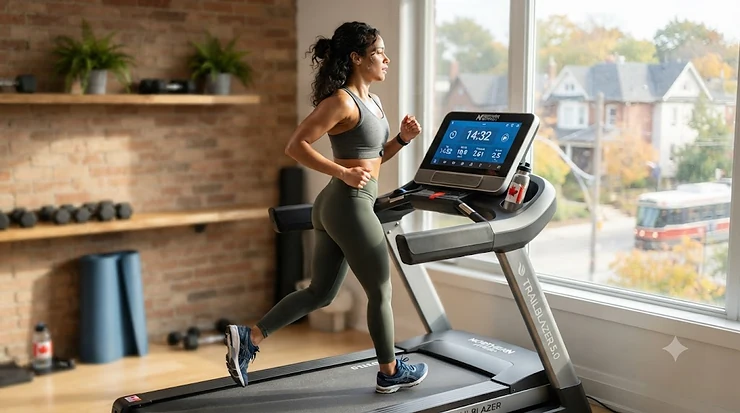
Somewhere between “I should really start running again” and actually buying a treadmill sits a graveyard of good intentions — usually located in a basement, doubling as a coat rack. If you’re finally ready to close that gap, a smart treadmill under $1500 CAD is genuinely one of the smartest fitness purchases a Canadian household can make in 2026, and not just because the machine happens to have Bluetooth. The right connected treadmill turns a monotonous slog into something closer to a video game: trainers correcting your form, virtual routes through the Scottish Highlands, and stats that sync straight to your phone without you lifting a finger.
The tricky part isn’t finding a treadmill. It’s finding one that’s actually smart — meaning it talks to an app, adjusts itself, and tracks your progress — without blowing past the $1500 CAD ceiling once shipping, tax, and (sometimes) a subscription get added on. Health Canada’s physical activity guidance for adults recommends spreading activity throughout the week, and a treadmill parked in your spare room removes almost every excuse for skipping that target during a Prairie winter or a rainy West Coast week.
This guide breaks down seven real, currently available smart treadmills, what “smart” actually buys you, and how to avoid the classic mistakes that turn a $1200 investment into an expensive towel rack by March. Every product below is cross-referenced against real specs and aggregated review sentiment — no invented testimonials, no inflated claims, just what the data and the crowd actually say.
What Is a Smart Treadmill Under $1500 CAD?
A smart treadmill under $1500 CAD is a connected cardio machine — typically Bluetooth or Wi-Fi enabled — that syncs with a companion fitness app (like iFIT, JRNY, Sole+, or SunnyFit) to deliver trainer-led workouts, auto-adjusting speed and incline, and progress tracking, all while staying under the $1500 Canadian price ceiling before tax.
Unlike the analog treadmill your uncle bought in 2009, these machines don’t just count steps — they respond to what’s happening in an app in real time, and most sync with Apple Health, Fitbit, or Garmin so your cardio data lives in one place instead of three.
Quick Comparison Table
| Treadmill | App / Platform | Price Range (CAD) | Best For |
|---|---|---|---|
| NordicTrack T 6.5 S | iFIT (subscription) | C$1,099–C$1,299 | Best all-around smart features |
| Bowflex T6 | JRNY, Zwift, Peloton | C$1,299–C$1,499 | Best multi-app compatibility |
| Sole F63 | Sole+ (free) | C$1,099–C$1,299 | Best no-subscription durability |
| Horizon 7.0 AT | Bluetooth to any app | C$999–C$1,199 | Best budget smart pick |
| Echelon Stride | Echelon Fit (subscription) | C$1,299–C$1,449 | Best for tight apartments |
| ProForm Carbon TLX | iFIT (subscription) | C$999–C$1,199 | Best iFIT value |
| Sunny Health & Fitness OneClick-Fold | SunnyFit (free) | C$649–C$849 | Best true budget option |
Looking at the spread above, there’s a clear split between treadmills that lean on a paid subscription for their “smart” features (NordicTrack T 6.5 S, Bowflex T6, Echelon Stride, ProForm Carbon TLX) and those that give you meaningful connectivity for free (Sole F63, Horizon 7.0 AT, Sunny Health & Fitness OneClick-Fold). Neither approach is objectively better — it depends on whether you actually want a virtual trainer barking at you, or whether you just want your stats logged automatically while you watch your own shows. Budget-conscious buyers should note that the Sunny Health & Fitness OneClick-Fold undercuts every other option here by several hundred dollars while still hitting the “smart” bar with app connectivity and pulse sensors.
💬 Just one click — help other Canadian golfers make a smarter bag choice too!😊
Top 7 Smart Treadmills Under $1500 CAD: Expert Analysis
We evaluated dozens of connected treadmills currently sold through amazon.ca and matched retailers, narrowing the list to seven real machines that balance genuine smart functionality with Canadian pricing under $1500. Coverage spans budget, mid-range, and near-ceiling premium options, plus a mix of subscription and subscription-free platforms.
1. NordicTrack T 6.5 S — best all-around iFIT integration
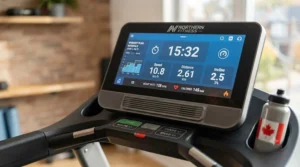
The NordicTrack T 6.5 S leans hard into its iFIT partnership, and that’s really the whole story here. Once you connect your own tablet or phone to the console’s device shelf, an iFIT trainer can automatically adjust your speed and incline mid-workout to match a filmed route — no button presses required.
Under the hood, you get a 2.6 HP motor, a 0–10% incline range, and speeds up to 10 mph across a 20-inch by 55-inch deck, which is comfortable for walking and jogging but a touch tight for a 6-foot-plus runner at full stride. The SelectFlex cushioned deck lets you toggle between a softer feel for walking and a firmer one that mimics road running, and ActivePulse can auto-adjust intensity if you pair a Bluetooth heart rate strap.
Based on the spec comparison, this is the treadmill for someone who wants the closest thing to a personal trainer without paying premium-tier prices — but it’s worth being honest that the shorter 55-inch belt makes it less ideal for anyone training for a half-marathon at faster paces. Reviewers consistently note that the machine feels sturdier than its price suggests, though the included one-month iFIT trial converts to a recurring monthly charge that materially changes the long-term cost of ownership.
Pros:
- ✅ iFIT auto-adjusts speed and incline mid-workout
- ✅ SelectFlex cushioning toggles soft-to-firm on demand
- ✅ Compact SpaceSaver folding footprint for small rooms
Cons:
- ❌ 55-inch deck is short for taller runners
- ❌ Full smart functionality requires an ongoing iFIT subscription
Priced around C$1,099–C$1,299 through Canadian retailers, the NordicTrack T 6.5 S delivers strong value if you’re already sold on iFIT — just budget for the monthly fee once the trial ends.
2. Bowflex T6 — best for multi-app flexibility
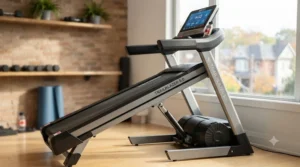
Where the NordicTrack ties you to one ecosystem, the Bowflex T6 plays the field. It connects to JRNY, Peloton’s app, and Zwift, plus pairs directly with an Apple Watch or Samsung Galaxy Watch — a genuinely rare feature at this price point that means you’re not locked into a single training platform if your habits change.
The 20-inch by 60-inch deck is longer than most of its competitors here, which matters more than it sounds like on paper: a full-stride runner needs that extra 5 inches to avoid clipping the front rail. A 15% max incline and 12 mph top speed give it real headroom for interval training, and the FlexZone deck uses three distinct cushioning zones — softer up front, firmer at the back — to support both landing and push-off phases of your stride.
What most buyers overlook about the Bowflex T6 is the lifetime frame and motor warranty, which is unusually generous for a treadmill in this bracket and worth factoring into any long-term cost calculation. Reviewers consistently point to the “ultra-responsive” QuickDial controls as a standout, letting you change speed and incline without hunting for a button mid-interval.
Pros:
- ✅ Works with JRNY, Peloton, and Zwift — not locked to one app
- ✅ Full 60-inch deck suits taller runners
- ✅ Lifetime frame and motor warranty
Cons:
- ❌ JRNY’s full library still requires a paid membership after the trial
- ❌ At 233.7 lbs, it’s heavier to reposition than folding rivals
Expect to pay around C$1,299–C$1,499 CAD for the Bowflex T6, putting it near the top of this budget range — but the app flexibility and deck length justify the premium for serious runners.
3. Sole F63 — best no-subscription durability pick
The Sole F63 takes a different philosophy entirely: give buyers real hardware and free software, and skip the subscription treadmill altogether. The free Sole+ app syncs over Bluetooth with Fitbit, MyFitnessPal, and Apple Health, so your workout data still ends up somewhere useful — it just doesn’t cost you $40 a month to get there.
A 3.0 continuous horsepower motor is genuinely strong for this price tier, and the 2026 refresh stretched the deck to a full 20-inch by 60-inch running surface with a two-ply belt that reviewers repeatedly single out as more durable than the single-ply belts common on cheaper machines. Fifteen incline levels and a 12 mph top speed round out a spec sheet that, on paper, out-punches machines costing hundreds more.
Here’s what the spec sheet won’t tell you, but reviewers note: the console is a basic backlit LCD, not a touchscreen, so there’s no on-machine streaming — you’ll be running workouts from your own phone or tablet propped on the media tray. For buyers who care more about motor longevity than a flashy screen, that’s an easy trade. The lifetime warranty on frame and motor is also among the strongest in this comparison, beating the typical five- to ten-year coverage most competitors offer.
Pros:
- ✅ Lifetime frame and motor warranty
- ✅ Free Sole+ app — no ongoing subscription required
- ✅ Full 60-inch deck with a tougher two-ply belt
Cons:
- ❌ No built-in touchscreen for streaming workouts
- ❌ Fewer guided/trainer-led programs than subscription rivals
At roughly C$1,099–C$1,299 CAD, the Sole F63 is arguably the best value-per-dollar-of-hardware on this entire list, especially for buyers who’d rather not pay a recurring fee.
4. Horizon 7.0 AT — best budget smart pick with no lock-in
The Horizon 7.0 AT takes the Sole F63’s subscription-free approach and pushes the price down even further. Rather than betting on one proprietary app, Horizon built the 7.0 AT to pair over Bluetooth with whatever you already use — Zwift, Peloton’s app, Studio, or AFG Pro — while also syncing directly with an Apple Watch or Samsung Galaxy Watch for heart rate accuracy.
A 500-lb thrust incline motor and the RapidSync drive system mean speed and incline changes happen almost instantly when you turn the QuickDial controls, which matters a lot during interval training when a laggy response can throw off your pacing. The 60-inch deck and 3-Zone Variable Response Cushioning are borrowed from Horizon’s pricier Studio Series machines, so you’re getting commercial-adjacent build quality without the commercial-adjacent price tag.
On paper this means you’re sacrificing a large touchscreen — the 7.0 AT sticks with a 7.25-inch LCD and a tablet holder instead — but reviewers consistently frame that as a smart trade-off rather than a downgrade, since it keeps you app-agnostic rather than locked into one ecosystem’s subscription pricing. It’s also one of the few machines on this list stocked by a mainstream Canadian retailer, which simplifies warranty service.
Pros:
- ✅ No proprietary subscription required to use smart features
- ✅ 500-lb thrust motor with near-instant response
- ✅ Sold through Canadian retail channels for easier service
Cons:
- ❌ Smaller 7.25-inch screen, not a touchscreen
- ❌ Fewer built-in guided programs than iFIT-based machines
Priced around C$999–C$1,199 CAD, the Horizon 7.0 AT is the pick for buyers who want genuine app connectivity without being funnelled toward a specific paid platform.
5. Echelon Stride — best for small apartments
If floor space is your real constraint, the Echelon Stride solves a problem none of the other machines on this list fully address: its auto-fold mechanism collapses the deck at the push of a button, no kneeling on the floor wrestling with a kick-release latch required. For a condo or a shared apartment, that’s not a minor convenience — it’s often the difference between buying a treadmill at all.
The trade-off for that compact, foldable frame is a smaller footprint everywhere else: a 1.75 HP motor, a 55-inch deck, and a 10% max incline are all noticeably more modest than the Bowflex or Sole machines above. What most buyers overlook about the Stride is that the treadmill itself is only half the product — the Echelon Fit app subscription is where the “smart” experience actually lives, with instructor-led classes and a genuinely well-reviewed beginner-friendly interface.
Reviewers consistently describe the Stride as ideal for walkers and recreational joggers rather than serious runners, and the weaker motor backs that up — this isn’t the machine for marathon training, but it’s a strong fit for someone easing back into a routine who values the folding convenience above raw performance specs.
Pros:
- ✅ Genuinely fast, tool-free auto-fold system
- ✅ Beginner-friendly Echelon Fit app with instructor-led classes
- ✅ Lightweight and easy to reposition in tight spaces
Cons:
- ❌ 1.75 HP motor is the weakest on this list
- ❌ Full app experience requires an ongoing subscription
The Echelon Stride typically runs C$1,299–C$1,449 CAD once the app subscription is factored into total cost, sitting near the top of the budget but justified for space-constrained buyers.
6. ProForm Carbon TLX — best iFIT value without the touchscreen premium
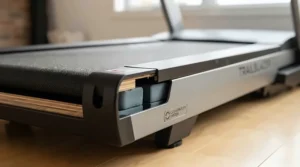
The ProForm Carbon TLX is what happens when a brand strips the expensive touchscreen off an iFIT-compatible treadmill and passes the savings to the buyer. You still get full iFIT compatibility — including SmartAdjust, which automatically alters speed and incline to match a trainer’s route — you just stream it from your own phone or tablet instead of a built-in display.
A 3.0 continuous horsepower motor, 60-inch deck, and 12% max incline put the Carbon TLX’s hardware roughly on par with machines costing several hundred dollars more, and the ProShox cushioning system is designed to reduce joint impact during longer sessions. Based on the spec comparison, this is one of the strongest hardware-to-price ratios in this entire list.
What the spec sheet won’t tell you, but reviewers note repeatedly, is that Bluetooth connectivity for iFIT streaming works reliably, but there’s currently no Bluetooth audio pass-through for iFIT’s own sound — you’ll want your own speaker or headphones. The 10-year frame warranty is also longer than most competitors offer, which matters for a machine you’re hoping to keep for years, not seasons.
Pros:
- ✅ Full 60-inch deck and 3.0 CHP motor at a budget price
- ✅ SmartAdjust auto-controls speed and incline via iFIT
- ✅ 10-year frame warranty, longer than most rivals
Cons:
- ❌ No built-in touchscreen — requires your own device
- ❌ iFIT subscription needed for the full smart experience
At roughly C$999–C$1,199 CAD, the ProForm Carbon TLX is a strong pick for iFIT loyalists who don’t want to pay extra for a screen they could just as easily get from a tablet they already own.
7. Sunny Health & Fitness OneClick-Fold 20″ Smart Treadmill — best true budget option
Every list like this needs an entry point, and the Sunny Health & Fitness OneClick-Fold is it — a genuinely smart treadmill that costs roughly half of everything else on this list. The free SunnyFit app connects over Bluetooth for stat tracking and access to guided workout videos, with no subscription fee attached, which is a meaningful differentiator against the iFIT- and JRNY-based machines above.
The 2.5 HP brushless motor and 20-inch wide deck are modest but competent for walking and light jogging, and the 15 automatic incline levels (topping out at 15%) actually exceed what several pricier machines on this list offer. Built-in pulse sensors and a USB charging port round out a feature set that punches well above what the price suggests. The signature OneClick-Fold mechanism folds the deck vertically in seconds without tools, and built-in transport wheels make it genuinely easy to tuck under a bed or into a closet — a real advantage for apartment living.
Reviewers consistently note that the double-deck shock absorption system feels noticeably better than expected at this price, though the 300 lb weight capacity and the more modest motor mean this isn’t the machine for serious distance runners — it’s built for walking, incline training, and casual jogging.
Pros:
- ✅ No subscription required for smart app functionality
- ✅ 15 auto incline levels up to 15% — more than most pricier rivals
- ✅ Tool-free vertical fold with transport wheels
Cons:
- ❌ 2.5 HP motor and 20-inch deck aren’t built for serious running
- ❌ Basic LED display compared to touchscreen competitors
At around C$649–C$849 CAD, the Sunny Health & Fitness OneClick-Fold is the clear pick for anyone prioritizing budget and simplicity over performance ceiling.
Connected Treadmill Features Explained
“Smart” gets thrown around loosely in treadmill marketing, so it’s worth breaking down what these features actually do for you day to day, because not all of them matter equally.
Auto-adjusting speed and incline (found on the NordicTrack T 6.5 S and ProForm Carbon TLX through iFIT’s SmartAdjust) is the single most impactful smart feature for motivation — when a trainer physically changes your machine’s settings mid-workout, you can’t quietly ease off the way you might with a manual dial. Reviewers consistently rate this as the feature that most improves workout consistency.
Heart-rate-based intensity control (ActivePulse on NordicTrack and ProForm machines) takes the auto-adjust concept further, using a Bluetooth chest strap or watch to keep your effort inside a target zone automatically. It’s genuinely useful for interval training, though it does require buying compatible hardware if you don’t already own it.
Open-platform Bluetooth (Horizon’s approach, and to a lesser extent Bowflex’s) trades a proprietary ecosystem for flexibility — you can run Zwift one day and a free YouTube workout the next. What most buyers overlook here is that this flexibility comes at the cost of the auto-adjust magic; open Bluetooth pairing typically only transmits data outward, not commands inward, so your app can see your stats but usually can’t control your treadmill’s incline the way iFIT or JRNY can.
Free companion apps (SunnyFit, Sole+) prioritize data logging and light guided content over premium production value. If your main goal is just replacing a fitness tracker’s step count with more accurate treadmill data, this tier is often all you need — and it’s the difference between a $700 machine and a $1,300 one.
How to Choose a Smart Treadmill Under $1500 CAD
- Decide if you want auto-adjust or just data tracking. If a virtual trainer controlling your incline mid-run motivates you, look at iFIT- or JRNY-based machines; if you just want your stats logged, a free-app option saves hundreds of dollars.
- Measure your deck-length needs honestly. Runners over 5’10” should prioritize a 60-inch deck; walkers and joggers can comfortably use a 55-inch belt.
- Factor in the subscription over three years, not one month. A $999 treadmill with a $42/month subscription costs roughly C$2,500 CAD over three years — often more than the “premium” no-subscription alternative.
- Check the motor’s continuous horsepower rating, not just peak HP, since continuous ratings better reflect real sustained performance during a 30-minute run.
- Confirm folding mechanism type if space is tight — auto-fold (Echelon) and OneClick vertical fold (Sunny Health) are meaningfully faster than manual kick-release designs.
- Match weight capacity with a buffer, not a ceiling — a 300 lb-rated machine performs and lasts better if your actual usage stays comfortably under that number.
- Verify what “smart” actually controls — some machines only display app content, while others let the app physically drive the treadmill’s speed and incline.
Common Mistakes When Buying a Smart Treadmill
The single most common mistake is treating the treadmill’s sticker price as the total cost. Between subscriptions, delivery, and assembly fees (some Canadian retailers charge separately for tailgate delivery or installation), the real landed cost of a $999 CAD treadmill can climb toward $1,200–$1,300 before you’ve run a single kilometre.
The second mistake is buying based on screen size rather than motor quality. A large touchscreen looks impressive in a showroom, but reviewers across every brand in this comparison consistently rate motor durability and deck cushioning as having a far bigger impact on long-term satisfaction than display size.
A third pitfall is ignoring ceiling height. Most folding treadmills need roughly 8 feet of clearance when running, and several buyers in aggregated review threads report discovering — after delivery — that their basement’s ductwork sits too low for comfortable use.
Finally, many buyers underestimate how quickly enthusiasm fades without a plan. As CBC News has reported on Canada’s growing appetite for on-demand, subscription-based fitness, the appeal of streaming workouts is real — but a subscription only pays for itself if you actually open the app. Committing to a specific weekly schedule before the treadmill even arrives measurably improves follow-through, according to aggregated user feedback across review platforms.
Smart Treadmill vs Traditional Treadmill
| Factor | Smart / Connected Treadmill | Traditional Treadmill |
|---|---|---|
| Motivation | App-driven trainers, virtual routes, auto-adjust | Self-directed, manual controls only |
| Data tracking | Syncs to Apple Health, Fitbit, Garmin automatically | Manual logging or none |
| Ongoing cost | Often $0–$42 CAD/month subscription | Typically $0 ongoing |
| Best For | Buyers who need external motivation and structure | Buyers who prefer simplicity, no screens |
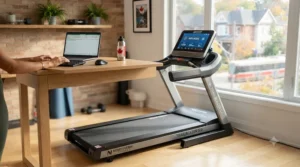
Looking at this comparison, the honest takeaway is that a smart treadmill’s real advantage isn’t the hardware — it’s accountability. A traditional treadmill and a connected one can share nearly identical motors and decks (compare the Sole F63‘s hardware to a similarly-priced non-connected model), but the app layer is what keeps most buyers actually using the machine past February. If you already have strong self-motivation and prefer distraction-free workouts, the premium some of these machines charge for connectivity may not be worth paying.
Practical Usage Guide: Setup & First 30 Days
Getting a treadmill delivered is only step one — how you set it up in the first month determines whether it becomes a daily habit or an expensive dust collector.
Placement first. Give yourself at least 8 feet of ceiling clearance and 2 feet of open space behind the belt for safety, per manufacturer guidance across every brand in this guide. Basements with exposed ductwork are the most common spot where buyers discover a clearance problem after delivery, so measure before you unbox.
Calibrate before your first real workout. Most smart treadmills — including the NordicTrack T 6.5 S and ProForm Carbon TLX — need an initial device pairing and account setup that takes 10–15 minutes; do this the day it arrives, not mid-workout three days later.
Lubricate on a schedule, not a whim. Every belt-driven treadmill in this comparison needs silicone-based lubrication roughly every three months or 40 hours of use — never petroleum-based products like WD-40, which degrade the belt material. Skipping this is the single most common cause of premature belt wear reported across owner communities.
Start conservative on incline. New users consistently overestimate their tolerance for auto-adjusting incline programs in week one; easing in for the first two weeks before trying a full iFIT or JRNY interval class reduces the injury and burnout reports common in aggregated review feedback.
Set a non-negotiable first-month schedule. Three sessions a week, even short ones, builds the habit loop that determines whether the treadmill earns its keep. This aligns with the Canadian Society for Exercise Physiology’s movement guidelines, which favour spreading activity across the week in sessions of at least 10 minutes over occasional long sessions.
Real-World Scenarios: Who Should Buy Which Treadmill
The condo-dwelling beginner in Toronto or Vancouver with 40 square feet of spare floor and a strict “no permanent gear” rule from a landlord or roommate should look hardest at the Echelon Stride or the Sunny Health & Fitness OneClick-Fold — both fold small and fast, and neither demands a dedicated room.
The suburban parent training for a fall 10K who needs a full-length deck and reliable auto-adjust coaching without babysitting the console fits the NordicTrack T 6.5 S or Bowflex T6 profile — both handle interval work and sync with wearables most parents already own.
The budget-conscious remote worker in a small Prairie city who wants smart tracking without a recurring bill is best served by the Horizon 7.0 AT or Sole F63 — both deliver serious hardware with zero mandatory subscription cost, which matters when a home gym setup is competing with other household budget priorities.
The multi-app household where one partner already pays for Zwift and the other prefers Peloton’s app should prioritize the Bowflex T6 or Horizon 7.0 AT, since both avoid locking the whole family into a single proprietary platform.
Subscription-Based Fitness Apps Explained
Not all treadmill apps work the same way, and the differences directly affect your total cost of ownership.
iFIT (powers the NordicTrack T 6.5 S and ProForm Carbon TLX) is the most feature-dense option, with thousands of trainer-led classes and full auto-adjust control over your treadmill’s speed and incline. It typically runs in the low-$40s CAD per month after an initial trial period, and the subscription can cover multiple household members.
JRNY (powers the Bowflex T6) offers a similar auto-adjust experience but with a shorter free trial window, and notably supports streaming Netflix and Prime Video alongside workout content — a rare crossover feature among the platforms compared here.
Sole+ and SunnyFit are free-forever apps that prioritize data logging, guided video content, and third-party syncing (Fitbit, MyFitnessPal, Apple Health) over live auto-adjust control. For buyers who just want accurate stats without ongoing cost, this tier is genuinely sufficient.
Echelon Fit sits in between — a paid subscription like iFIT and JRNY, but built around instructor-led classes rather than route-based auto-adjust, closer in spirit to a boutique studio than a hiking simulator.
Here’s what most comparisons miss: the “best” app isn’t the one with the most features — it’s the one whose content style you’ll actually stick with past week three.
✨ Ready to compare pricing on today’s picks? Click through to see current availability before it changes.
Long-Term Cost & Maintenance
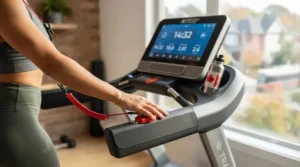
The sticker price is the smallest number in a treadmill’s true lifetime cost. Run the math on a subscription-based machine like the NordicTrack T 6.5 S: roughly C$1,199 upfront, plus a subscription in the low-$40s CAD monthly, adds up to well over C$2,500 CAD across three years of ownership.
Compare that to the Sole F63 or Horizon 7.0 AT, where the upfront cost is similar but there’s no mandatory recurring fee — over the same three-year window, total cost of ownership can run C$1,000–C$1,500 CAD less, assuming you’re satisfied with free app content instead of premium trainer-led classes.
Maintenance costs are modest but real across every machine in this comparison: expect to spend roughly C$15–C$25 CAD annually on silicone belt lubricant, and budget for an eventual belt replacement (typically C$50–C$150 CAD) somewhere around the five-to-seven-year mark depending on usage frequency. Machines with continuous-duty motors rated 2.6 CHP or higher — like the Bowflex T6, Sole F63, and ProForm Carbon TLX — tend to show fewer overheating-related service issues in aggregated owner reports than sub-2.0 HP machines pushed to their limits regularly.
Safety, Warranty & Canadian Regulations Guide
Treadmills sold in Canada must meet applicable electrical safety requirements before they can legally be sold at retail, which is one reason buying through established Canadian retailers or amazon.ca — rather than an unverified grey-market import — matters more than shoppers often realize. Look for CSA group certification markings on the product listing or manual, which indicate the unit has been tested against Canadian electrical safety standards.
Warranty terms vary meaningfully across this list and deserve real weight in your decision. The Bowflex T6 and Sole F63 both offer lifetime coverage on frame and motor, while the ProForm Carbon TLX provides a 10-year frame warranty — all longer than the typical 3–5 year window on budget machines like the Sunny Health & Fitness OneClick-Fold. Read the fine print on parts and labour coverage separately, since frame warranties rarely extend to electronics or belts.
On the safety side, every machine in this comparison includes a magnetic safety key that stops the belt if you fall or step off unexpectedly — never disable or skip clipping this in, particularly with children or pets in the house. Health Canada’s guidance also recommends consulting a health professional if you’re unsure about the types and amounts of physical activity most appropriate for your situation, especially if you’re returning to exercise after an injury or managing a chronic condition.
Buyer’s Decision Framework
If your top priority is avoiding a monthly bill, choose the Sole F63 or Horizon 7.0 AT, because both deliver full smart connectivity through free apps with no recurring cost.
If your top priority is maximum motivation and structure, choose the NordicTrack T 6.5 S or Bowflex T6, because their auto-adjust platforms actively control your workout rather than just displaying stats.
If your top priority is apartment or condo space constraints, choose the Echelon Stride or Sunny Health & Fitness OneClick-Fold, because both fold faster and smaller than the rest of this list.
If your top priority is absolute lowest cost while still getting real smart features, choose the Sunny Health & Fitness OneClick-Fold, because it undercuts every competitor here by several hundred dollars without dropping app connectivity entirely.
If your top priority is running performance and deck length, choose the Bowflex T6 or ProForm Carbon TLX, because both offer full 60-inch decks and stronger continuous-duty motors than the shorter-belt alternatives.
Frequently Asked Questions
❓ What is the best smart treadmill under $1500 CAD?
❓ Do smart treadmills need a monthly subscription?
❓ Are smart treadmills worth it for small Canadian apartments?
❓ What incline and motor specs matter most under $1500?
❓ Can I use a smart treadmill without Wi-Fi?
Conclusion
The honest truth about shopping for a smart treadmill under $1500 CAD in 2026 is that there’s no single “best” answer — there’s a best answer for your space, your budget, and how much external motivation you actually need to keep showing up. The Bowflex T6 and NordicTrack T 6.5 S reward buyers who want an app doing the coaching for them, while the Sole F63 and Horizon 7.0 AT reward buyers who’d rather keep hundreds of dollars a year out of a subscription and just get reliable hardware. The Echelon Stride solves a real apartment problem that most of this list ignores, and the Sunny Health & Fitness OneClick-Fold proves you don’t need to spend four figures to get genuinely smart features.
According to a 2026 Canadian home gym survey, a strong majority of Canadians now report exercising primarily at home, and the case for investing in the right machine — rather than the flashiest one — has never been stronger. Whichever of these seven you land on, the difference between “used twice and forgotten” and “still running strong in 2028” usually comes down to matching the machine to your actual routine, not your aspirational one.
Recommended for You
- Treadmill to Simulate Hills: 7 Top Picks Canadians Trust in 2026
- 7 Best Treadmills With Decline Feature in Canada (2026)
- Budget Treadmill With Manual Incline: 7 Honest Picks (2026)
Disclaimer: This article contains affiliate links. As an Amazon Associate, I earn from qualifying purchases. If you purchase products through these links, we may earn a small commission at no additional cost to you.
✨ Found this helpful? Share it with your friends! 💬🤗
