In This Article
Picture this: it’s minus 20°C outside, the sidewalks are a skating rink, and your running plans have officially been cancelled by Mother Nature. This is the exact moment an iFit compatible treadmill review actually earns its keep, because for half the country, “just go for a run outside” simply isn’t an option from November through March. That’s precisely why so many Canadian households are pricing out a treadmill that does more than just spin a belt — one that hands you a trainer, a mountain trail, and a training plan without you ever touching a thermostat.
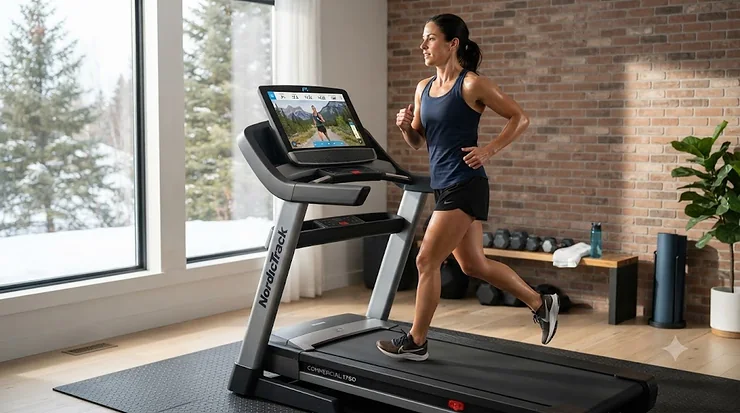
This iFit compatible treadmill review looks at seven real, currently available machines — from NordicTrack’s budget-friendly T Series right up through its incline-obsessed Commercial X22i — and breaks down what each one actually does once you’re standing on it. We’ll get into iFit subscription cost, because that recurring bill matters just as much as the machine’s price tag. We’ll unpack the auto-incline feature that makes these treadmills feel less like exercise equipment and more like a hiking trail that comes to you. And we’ll be upfront about where the real value is, and where you’re just paying for a bigger screen.
One quick note before we dive in: nobody here has personally logged 500 km on each of these decks. What follows is built from manufacturer specifications, aggregated reviewer testing, and real owner feedback — clearly labelled as such — because an honest comparison beats a fabricated one every single time.
What Is an iFit Compatible Treadmill?
An iFit compatible treadmill is a home treadmill built with a touchscreen console, Wi-Fi, and Bluetooth sensors that connect to the iFit training platform. Instead of manually setting speed and incline, the machine automatically adjusts both to match a trainer-led workout, syncing your effort to on-screen terrain in real time.
Most of these machines come from NordicTrack or ProForm, both owned by the same parent company as iFit itself, which is why compatibility runs so deep across their lineups — a point that lines up with Canada’s public health research on integrated movement behaviour, which frames daily activity as a whole-day habit rather than an isolated gym session — exactly the mindset iFit’s programming is built to reinforce.
Quick Comparison: 7 iFit Compatible Treadmills at a Glance
Before we get into the weeds, here’s the 30-second version for anyone who just wants the shortlist.
| Model | Screen | Motor | Incline / Decline | Best For | Price Range (CAD) |
|---|---|---|---|---|---|
| NordicTrack T 6.5 S | 5″ | Entry-level | Basic incline only | Absolute beginners | Under C$1,150 |
| NordicTrack EXP 7i | 7″ HD | 2.6 CHP | Up to 12% incline | Compact apartments | C$1,400–C$1,700 |
| NordicTrack EXP 10i | 10″ HD | 2.75 CHP | Up to 12% incline | Small-space upgraders | C$1,650–C$1,950 |
| NordicTrack Commercial 1750 | 16″ HD | ~4.25 CHP | 12% incline / -3% decline | Most households | C$2,700–C$3,400 |
| ProForm Pro 9000 | 22″ HD | 3.6 CHP | 12% incline / -3% decline | Multi-user homes | C$2,700–C$3,500 |
| NordicTrack Commercial 2450 | 24″ HD | ~4.25 CHP | 12% incline / -3% decline | Serious runners | C$4,000–C$4,800 |
| NordicTrack Commercial X22i | 22″ HD | Heavy-duty | Up to 40% incline | Hill and hike training | C$5,300 and up |
Looking at this lineup, the split is pretty clear: the NordicTrack T 6.5 S and NordicTrack EXP 7i exist to get skeptics through the door cheaply, the NordicTrack Commercial 1750 and ProForm Pro 9000 are where most Canadian living rooms will actually land, and the NordicTrack Commercial 2450 and NordicTrack Commercial X22i are for people who’ve already decided iFit is part of their routine and now just want the best hardware to run it on. Notice that screen size and motor strength climb together — that’s not a coincidence, since NordicTrack builds its pricier decks around sustained, high-speed use rather than the odd 20-minute walk.
💬 Just one click — help others make better buying decisions too!😊
Top 7 iFit Compatible Treadmills: Expert Analysis
1. NordicTrack T 6.5 S — cheapest true entry point into iFit
If your goal is simply to find out whether you’ll actually use a treadmill before spending real money, the NordicTrack T 6.5 S is the low-risk way to test that theory. It comes with a compact 5-inch screen, an AutoBreeze fan, and built-in handlebar sensors that keep the price refreshingly low.
At this tier you’re not getting a huge incline range or a blazing top speed — this is a walk-and-jog machine, not a marathon simulator. The NordicTrack T 6.5 S ships with a 30-day iFit trial and works fine in manual mode afterward, so you’re never locked into the subscription just to use the belt.
Reviewers consistently note that it feels like a sensible stepping stone rather than a compromise: people who buy it specifically because they’re unsure about paying for iFit long-term. A common thread in aggregated feedback is that the 5-inch screen feels genuinely small once you’ve tried a bigger one at a friend’s house, which is worth knowing before you buy.
Pros:
- ✅ Lowest cost way to try real iFit workouts
- ✅ Handlebar sensors included at this price point
- ✅ Works fully in manual mode without a subscription
Cons:
- ❌ 5-inch screen feels cramped for streaming workouts
- ❌ Limited incline range compared to pricier NordicTrack models
At under C$1,150, the NordicTrack T 6.5 S is the value pick for someone testing the waters, not the pick for someone chasing a 10K personal best.
2. NordicTrack EXP 7i — smallest footprint with a real touchscreen
Apartment dwellers, meet your match. The NordicTrack EXP 7i is the entry point into NordicTrack’s newer EXP line, and its main selling point is squeezing a genuine 7-inch HD touchscreen into a frame that won’t swallow your whole condo.
Spec-wise, expect a motor in the 2.6 CHP range, speeds up to roughly 10–12 mph (16–19 km/h) depending on the exact configuration, and incline that tops out around 12%. In practice, that ceiling is plenty for interval walking and light jogging, though dedicated hill-training fans will eventually want more range than this deck offers.
Based on the spec comparison against its bigger sibling, the honest takeaway is that the NordicTrack EXP 7i trades a bit of screen real estate for meaningfully lower cost — a fair trade if you mostly listen to workouts rather than stare at the terrain. Owner feedback aggregated across retailer sites tends to praise the compact fold-up design and criticize the smaller belt as a poor fit for taller runners.
Pros:
- ✅ Genuinely small footprint for condos and apartments
- ✅ Real HD touchscreen, not just a basic display
- ✅ Noticeably cheaper than the 10i sibling model
Cons:
- ❌ Belt length can feel tight for taller runners
- ❌ No decline capability at this tier
Priced in the C$1,400–C$1,700 range, the NordicTrack EXP 7i earns its keep for small spaces and small budgets alike.
3. NordicTrack EXP 10i — the bigger-screen upgrade that’s actually worth it
One step up the ladder sits the NordicTrack EXP 10i, which keeps almost everything from the 7i but swaps in a larger 10-inch HD touchscreen and a slightly stronger motor rated around 2.75 CHP.
What most buyers overlook about this model is that the extra 0.15 CHP barely changes the workout experience — the real upgrade is visual. A bigger screen makes iFit’s global workout destinations noticeably easier to actually enjoy rather than squint at, and that difference matters more than the spec sheet suggests for anyone planning to stream classes regularly.
Reviewers who’ve compared both EXP models directly tend to agree: if the price gap between the 7i and 10i is modest, take the 10i. Aggregated user sentiment frequently mentions that the larger display genuinely changes how often people choose to use the machine, since a cramped screen makes trainer-led sessions feel like a chore rather than a destination.
Pros:
- ✅ Noticeably larger, easier-to-read touchscreen
- ✅ Same compact, apartment-friendly frame as the 7i
- ✅ Strong value if the price difference is small
Cons:
- ❌ Motor upgrade is marginal, not dramatic
- ❌ Incline range still capped around 12%
At C$1,650–C$1,950, the NordicTrack EXP 10i is the smarter buy for anyone who’ll actually watch the screen more than they’ll watch their feet.
4. NordicTrack Commercial 1750 — the all-around household favourite
This is the treadmill most Canadian families will actually end up buying, and for good reason. The NordicTrack Commercial 1750 pairs a pivoting 16-inch touchscreen with a motor typically in the 3.75–4.25 CHP range depending on model year, a 60-inch by 22-inch deck, speeds up to 12 mph (19 km/h), and a genuine incline-to-decline range of 12% up and 3% down.
Here’s what the spec sheet won’t tell you, but reviewers note repeatedly: the RunFlex cushioned deck is a real step up in comfort over the entry-level models, which matters enormously if you’re logging 30+ minutes several times a week rather than the occasional walk. The decline function is also a legitimate differentiator, since it works different muscle groups than incline alone and few competitors at this price offer it.
Aggregated owner reviews are largely positive, praising the smooth motor acoustics, though a recurring complaint involves the assembly process — expect to need a second set of hands, since some components are genuinely heavy. A smaller number of owners report needing to replace an electronic control board shortly after purchase, which is worth knowing given the otherwise strong reputation.
Pros:
- ✅ Rare decline capability at this price tier
- ✅ RunFlex cushioning noticeably improves long-session comfort
- ✅ Large 60-inch belt suits taller runners comfortably
Cons:
- ❌ Assembly genuinely requires two people
- ❌ Some owners report early control-board issues
Commonly listed in the C$2,700–C$3,400 range depending on promotions, the NordicTrack Commercial 1750 is the safest default pick if you only read one section of this iFit compatible treadmill review.
5. ProForm Pro 9000 — the non-NordicTrack alternative with the biggest screen at this price
Not every iFit-enabled treadmill wears a NordicTrack badge. The ProForm Pro 9000 runs on the same parent company’s technology but brings its own flavour, headlined by a genuinely massive 22-inch HD touchscreen mounted on a 3.6 CHP Mach Z motor.
On paper this means you’re getting NordicTrack Commercial-level screen real estate at a ProForm-branded price, with a 20-inch by 60-inch deck, speeds to 12 mph (19 km/h), and the same 12% incline to -3% decline range found on the Commercial 1750. The frame also carries a notably long warranty structure — 10 years on the frame and multi-year coverage on parts and labour — which signals real confidence from the manufacturer.
What most buyers overlook about this model is how loud the incline motor gets at maximum grade before it warms up, a quirk multiple independent testers have flagged. Reviewers otherwise consistently praise the QuickSpeed control buttons, which let you jump straight to a target pace instead of tapping an arrow repeatedly — a small thing that meaningfully speeds up interval training.
Pros:
- ✅ Largest touchscreen available below the premium tier
- ✅ Long 10-year frame warranty for peace of mind
- ✅ QuickSpeed buttons make interval training effortless
Cons:
- ❌ Incline motor can be noisy until it warms up
- ❌ Heavy and awkward to reposition once assembled
In the C$2,700–C$3,500 range, the ProForm Pro 9000 is worth cross-shopping against the Commercial 1750 before you commit to either brand.
6. NordicTrack Commercial 2450 — built for speed, not just scenery
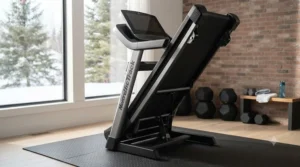
Runners chasing an actual personal best need a machine that can keep up, and the NordicTrack Commercial 2450 is NordicTrack’s answer. It’s the brand’s fastest folding model, with a motor commonly rated around 4.25 CHP, top speeds up to 14 mph (22.5 km/h), and a 24-inch touchscreen that both tilts and pivots.
The 12% incline and -3% decline range matches the 1750, but the extra motor headroom and self-cooling design mean the NordicTrack Commercial 2450 is built to sustain intense interval sessions without straining. Reviewers who’ve tested both units back-to-back note the 2450’s deck feels noticeably more stable at high speed, which honestly matters more to serious runners than another inch of incline would.
Reviewers consistently flag one quirk worth knowing before you buy: the on-screen speed and incline shortcut buttons jump in large increments rather than offering every intermediate value, so fine-tuning pace mid-workout takes an extra tap or two. Otherwise, aggregated feedback treats this as one of the more dependable machines in the lineup, with the lifetime motor warranty cited repeatedly as a genuine confidence booster.
Pros:
- ✅ Fastest top speed in NordicTrack’s current lineup
- ✅ Lifetime motor warranty backs up the price tag
- ✅ Large tilt-and-pivot screen suits off-treadmill workouts too
Cons:
- ❌ Speed and incline shortcut buttons skip increments
- ❌ Premium price puts it out of reach for casual users
Typically found in the C$4,000–C$4,800 range, the NordicTrack Commercial 2450 is the pick for buyers who’ve already decided they’re runners, not just walkers.
7. NordicTrack Commercial X22i — the incline specialist for hill training
Every list needs a specialist, and the NordicTrack Commercial X22i is it. Rather than chasing top speed, this machine is engineered around an eyebrow-raising 40% maximum incline — roughly triple what the rest of this lineup offers — paired with a 22-inch HD touchscreen and Wi-Fi connectivity that supports up to five user profiles.
Here’s what that 40% figure actually means in practice: this is less a treadmill and more an indoor hiking trainer, built for people training for backcountry trekking, ruck marches, or serious hill-repeat programs where flat running simply doesn’t build the right muscles. Reviewers who’ve compared it directly to the Commercial 2450 note that if raw speed is your priority, the 2450 wins outright, but nothing else on this list touches the X22i’s incline range.
Aggregated owner sentiment describes it as a niche but beloved machine — people who buy it tend to know exactly why they’re buying it, and few report buyer’s remorse. The trade-off is a steep price of entry that only makes sense once you’ve confirmed incline training is actually your priority, not just a nice-to-have.
Pros:
- ✅ Unmatched 40% incline range for hill-specific training
- ✅ Supports up to five separate user profiles
- ✅ Purpose-built for hiking and rucking preparation
Cons:
- ❌ Highest price point in this entire lineup
- ❌ Overkill for anyone who mainly wants flat-ground running
At C$5,300 and up, the NordicTrack Commercial X22i is a purpose-built tool, not a general-purpose treadmill — buy it because you need that incline, not because it has the biggest number on the spec sheet.
Practical Usage Guide: Getting the Most Out of Your First 30 Days
Unboxing day excitement fades fast if the first few weeks go badly, so here’s how to avoid the most common early mistakes. First, resist the urge to run the incline motor to its maximum setting immediately after assembly — give the machine a proper 10–15 minute manual warm-up session before letting an iFit trainer take full control of speed and incline changes.
Second, pair your Bluetooth heart rate strap before your first guided workout, not during it. ActivePulse and similar heart-rate-adaptive features only work if the sensor is already connected when the session starts, and fumbling with pairing mid-workout kills momentum fast. Third, set a maintenance reminder now: most manufacturers recommend lubricating the belt roughly every three months for home use, and skipping this is the single biggest cause of early belt wear on machines like the NordicTrack Commercial 1750 and ProForm Pro 9000.
Finally, resist bingeing every scenic destination iFit offers in week one. Reviewers who track long-term usage note that people who ease into a structured weekly plan — rather than randomly sampling global workout destinations — are far more likely to still be using the treadmill six months later than those who treat the first week like a highlight reel.
Real-World Scenarios: Who Actually Buys These Machines
Meet Priya, a Calgary-based nurse who works rotating shifts and needs a treadmill for iFit trainers who can adapt a session to whatever energy she has left after a 12-hour shift. For her, the NordicTrack EXP 10i makes sense: compact enough for her condo, and the trainer-led sessions mean she doesn’t have to think about programming her own workout at 11 p.m.
Then there’s Marcus, a suburban dad in Mississauga training for his first half-marathon while sharing equipment with two teenagers. His household needs multi-user support and enough motor headroom for genuine tempo runs, which points squarely at the NordicTrack Commercial 1750 — durable enough for daily rotation, with decline training that helps his knees handle race-day downhills.
Finally, consider Élise in Gatineau, prepping for a multi-day backcountry trek and unwilling to wait for spring to start training on real inclines. For her, nothing on this list beats the NordicTrack Commercial X22i — its 40% incline range is the closest thing to actual mountain trail conditioning available indoors, and the price premium is easy to justify against a season of missed training.
Buyer’s Decision Framework: Match Your Situation to a Model
If you’re still torn, use this simple framework rather than getting lost in spec sheets. If budget is your single biggest constraint, choose the NordicTrack T 6.5 S or NordicTrack EXP 7i, because a smaller machine you’ll actually use beats a premium one gathering dust in the corner.
If you’re specifically hunting for a treadmill for iFit trainers who deliver structured, adaptive programming without you fussing over settings, prioritize screen size and ActivePulse compatibility — that points toward the NordicTrack EXP 10i or ProForm Pro 9000. If your household shares the machine across different fitness levels and body types, choose the NordicTrack Commercial 1750 for its balance of durability, decline capability, and moderate footprint.
If your goal is measurable athletic performance — actual race training, actual pace goals — choose the NordicTrack Commercial 2450 for its motor headroom and top speed. And if incline training for hiking, rucking, or serious hill work is the entire point, skip straight to the NordicTrack Commercial X22i and don’t look back at the cheaper options; they simply can’t do what this machine does.
How to Choose an iFit Compatible Treadmill
Shopping this category gets easier once you know which specs actually matter. Here’s the shortlist, in order of importance:
- Screen size and placement — a bigger, tilting screen genuinely improves how often you’ll use trainer-led content, not just how the machine looks in your living room.
- Motor rating (CHP) — look for at least 3.0 continuous horsepower if you plan to run rather than walk; anything less shortens the motor’s usable lifespan under sustained speed.
- Incline and decline range — decline is rare below the Commercial series, but it meaningfully changes which muscles get worked.
- Deck size — taller runners need at least a 60-inch belt to avoid a cramped stride.
- Warranty structure — lifetime motor warranties, common on NordicTrack’s Commercial line, are a strong signal of manufacturer confidence.
- Weight capacity and household use — multi-user homes should prioritize sturdier frames rated well above any single user’s body weight.
- Subscription cost tolerance — decide your monthly budget for iFit before falling in love with a screen you can’t actually afford to use.
For context on why incline and interval variety matter physiologically, the Canadian Society for Exercise Physiology’s movement guidelines for adults point to varied-intensity activity as a core recommendation for adult health — a useful benchmark when deciding how much incline range you actually need.
iFit Compatible Treadmill vs Peloton Tread: How They Actually Differ
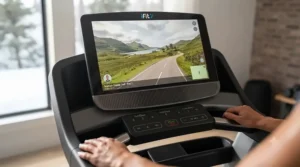
It’s worth addressing the elephant in the room: Peloton also sells iFit-adjacent, screen-equipped treadmills, so how does an iFit compatible treadmill actually compare? The biggest difference is philosophy. Peloton leans heavily on live-feeling studio classes with instructor personalities front and centre, while iFit leans into filmed, trainer-led global workout destinations where the terrain itself — not just the instructor — drives the experience.
On hardware, NordicTrack’s Commercial-tier machines generally offer wider incline and decline ranges than Peloton’s Tread lineup at comparable price points, which matters if hill training specifically is your goal. Subscription-wise, both platforms charge a comparable monthly rate, so the decision usually comes down to content style rather than price.
Reviewers who’ve used both tend to agree that iFit wins for anyone who wants their treadmill workout to feel like an actual destination, while Peloton wins for anyone who prioritizes instructor rapport and community leaderboards. Neither is objectively better — they’re built around different motivational triggers.
iFit Subscription Cost and Monthly Subscription Fees: What You’ll Actually Pay
Here’s the part Amazon’s product page won’t spell out clearly. As of iFit’s most recent membership restructuring, the platform now offers two core tiers: an individual plan built for one user, running roughly C$20 per month, and a multi-user Pro plan supporting up to five profiles, running roughly C$45–50 per month. These figures are approximate CAD equivalents of iFit’s published U.S. pricing, so always confirm current monthly subscription fees directly on iFit’s site before purchasing, since exchange-rate-driven pricing can shift.
Most machines in this review ship with a 30-day trial, not a full year as older marketing sometimes implies, so budget for the subscription starting in month two. Annual billing typically saves the equivalent of one to two months compared to paying monthly, which is worth considering if you’re confident you’ll stick with it past the honeymoon phase.
One consumer-protection note worth flagging: subscription auto-renewal is legal in Canada, but it must be transparent and easy to cancel. The Competition Bureau of Canada’s guidance on subscription traps warns consumers to watch for pre-checked boxes, vague cancellation clauses, and unclear billing terms when signing up for any recurring service, and that advice applies just as much to a fitness subscription as anything else — read the cancellation terms before you enter a credit card number, not after your first unexpected charge.
How the iFit Treadmill Auto-Incline Feature Works in Practice
The iFit treadmill auto-incline feature is arguably the single biggest reason these machines feel different from a basic treadmill, so it deserves its own explanation. When a trainer leads an outdoor filmed workout, the treadmill’s AutoAdjust technology automatically raises or lowers incline and decline to mirror the terrain on screen — climb a real hill in the video, and your treadmill deck tilts up beneath you without you touching a button.
Layered on top of that is SmartAdjust, which personalizes those automatic changes to your fitness level based on adjustments you’ve made in past sessions, and ActivePulse, which uses a connected heart rate monitor to fine-tune speed and incline in real time to keep you inside a target heart-rate zone. What the spec sheet won’t tell you, but reviewers note repeatedly, is that you can always override any of this manually mid-session — the automation is a convenience, not a cage.
In practice, this means the incline motor is working almost constantly during a guided session, which is worth knowing if you’re sensitive to mechanical noise; several reviewers across different models mention the incline motor getting audibly louder during steep climbs before settling down once warmed up.
Global Workout Destinations: Where iFit Actually Takes You
The marketing phrase “global workout destinations” sounds like fluff until you actually try it, so let’s ground it in what iFit really offers. Through partnerships and Google Maps-integrated route technology, iFit lets you follow filmed or mapped routes through locations ranging from Swiss mountain trails to coastal hiking paths to desert terrain, with your treadmill’s speed and incline syncing to match the footage in real time.
Based on the spec comparison across models, bigger screens meaningfully change how immersive this feels — a 24-inch tilting display on the NordicTrack Commercial 2450 does more justice to a scenic trail than a 5-inch screen ever could. You can also build a custom route through Google Maps workout technology, mapping an upcoming race course or a hometown route you can’t run outdoors in January.
Reviewers describe this feature as the difference between “exercising” and actually looking forward to a session, though a fair criticism worth noting is that content freshness depends entirely on iFit’s filming schedule — don’t expect infinite new destinations added every month.
Common Mistakes When Buying an iFit Compatible Treadmill
The most frequent misstep is buying based on screen size alone and ignoring motor rating entirely — a gorgeous display attached to an underpowered motor will burn out faster under real running conditions. A close second is underestimating shipping and doorway dimensions; several of these units, especially the NordicTrack Commercial 2450 and NordicTrack Commercial X22i, are large enough that a miscalculated stairwell turn becomes a genuine problem on delivery day.
Buyers also frequently forget to budget for the ongoing iFit subscription cost, treating the machine’s sticker price as the full cost of ownership when the software is arguably half the value proposition. Another common mistake is skipping the manufacturer’s recommended belt lubrication schedule, which quietly shortens belt life on every model in this lineup. Finally, many buyers assume decline capability is standard — it isn’t, and it’s worth double-checking before assuming your chosen model can replicate downhill running.
Frequently Asked Questions
❓ Do I need an iFit subscription to use these treadmills?
❓ What treadmills are iFit compatible besides NordicTrack?
❓ How fast can an iFit-enabled treadmill go?
❓ Is the iFit subscription cost worth it for casual users?
❓ Can I use an iFit treadmill without Wi-Fi?
Conclusion
There’s no single “best” iFit compatible treadmill, and honestly, anyone claiming otherwise is oversimplifying a genuinely personal decision. Budget-conscious beginners land well with the NordicTrack T 6.5 S or NordicTrack EXP 7i, most households will be happiest with the NordicTrack Commercial 1750 or ProForm Pro 9000, and serious runners or incline-focused trainees should look straight at the NordicTrack Commercial 2450 or NordicTrack Commercial X22i.
What matters most is matching the machine to how you’ll actually use it, not how you imagine using it in an ambitious New Year’s resolution fantasy. Factor in the ongoing iFit subscription cost from day one, measure your space honestly, and pick the model that fits your real weekly routine rather than your aspirational one. Do that, and whichever machine you choose from this iFit compatible treadmill review should earn its spot in your home for years, not months.
✨ Don’t Miss These Exclusive Deals!
🔍 Take your home cardio routine to the next level with these carefully selected treadmills. Click on any highlighted model to check current pricing and availability on Amazon.ca. These machines can help you build a consistent training habit your future self will thank you for!
Recommended for You
- 7 Best WiFi Treadmill Under $1200 CAD Picks for 2026 (Tested amp; Compared)
- 7 Best touchscreen treadmills under $2000 CAD (2026 Picks)
- Smart Treadmill Under $1500 CAD: 7 Best Picks for 2026
Disclaimer: This article contains affiliate links. As an Amazon Associate, I earn from qualifying purchases. If you purchase products through these links, we may earn a small commission at no additional cost to you.
✨ Found this helpful? Share it with your friends! 💬🤗
