In This Article
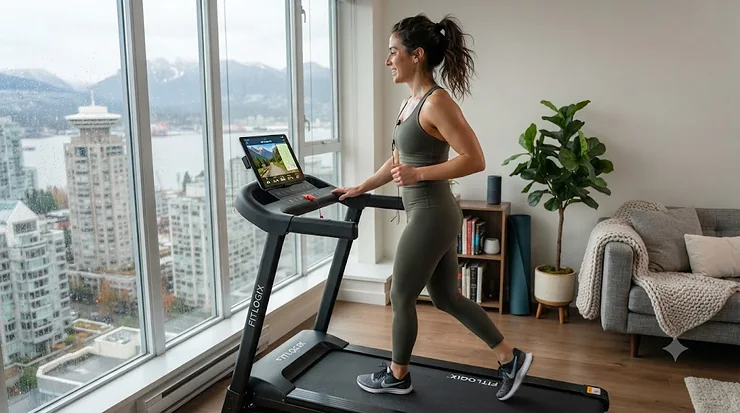
If you’ve ever tried to picture a treadmill fitting in your one-bedroom apartment, you already know the mental math involved: measure the hallway twice, eye the closet, then quietly give up. That’s exactly the gap an app-connected treadmill for small spaces is built to close. These machines fold down to a sliver of their working size, sync your speed, distance, and heart rate straight to your phone, and — done right — never make your downstairs neighbour bang a broom on the ceiling. In Canada, where the average condo keeps shrinking while rent keeps climbing, that combination of compactness and connectivity has quietly become one of the most searched fitness upgrades of the year.
This guide digs into seven real, currently available models spanning budget walking pads to premium auto-folding treadmills, all chosen specifically for their footprint, folding mechanism, and app integration rather than raw gym-grade power. We’ll compare specs honestly, flag where the marketing oversells reality, and match each machine to the kind of apartment, condo, or shared house it actually suits. Whether you’re chasing a compact app-connected treadmill for a 500-square-foot studio or a foldable smart treadmill that tucks under a desk between video calls, you’ll leave with a shortlist instead of a headache — and a clear sense of what treadmill app tracking small footprint machines can and can’t do for your routine.
What Is an App-Connected Treadmill for Small Spaces?
An app-connected treadmill for small spaces is a compact, typically foldable treadmill that pairs with a smartphone app or built-in touchscreen to track speed, distance, calories, and workout history, while its folding frame and reduced footprint let it store against a wall, under a bed, or inside a closet between sessions. The “smart” part is the software; the “small space” part is the engineering.
Two separate design problems get solved at once here, and it’s worth pulling them apart. The connectivity side covers everything from simple Bluetooth syncing with Apple Health or Fitbit up to full guided-workout ecosystems like iFIT or Echelon’s class library. The compactness side covers deck size, folded height, wheels, and — increasingly — motorized auto-fold mechanisms that do the heavy lifting for you. A machine can nail one of these and completely miss the other, which is exactly why so many shoppers end up disappointed after buying on price alone.
Quick Comparison Table
| Treadmill | Folded Footprint | Top Speed | App/Connectivity | Best For |
|---|---|---|---|---|
| WalkingPad Z1 | Ultra-slim vertical fold, ~4 in tall | ~6.2 mph | Bluetooth, Fitbit/Apple Health/Google Fit | Tightest budget apartments |
| UREVO Strol 2E Pro | Smallest folded box on this list | ~7.5 mph | UREVO app tracking | Under-bed or closet storage |
| Sunny Health & Fitness SF-T4400SMART | Soft-drop fold, compact | ~9 mph | SunnyFit app | Budget walkers and beginners |
| Horizon 7.0 AT | Standard fold-up frame | ~10 mph | App-enabled console | First-time treadmill owners |
| NordicTrack T 6.5 S | SpaceSaver fold | ~10 mph | iFIT auto-adjust | Guided, coached workouts |
| Echelon Stride 6S-10 | Hands-free auto-fold, flat to ~10 in | ~12.5 mph | Echelon membership | Daily folders who want zero effort |
| WalkingPad MX10 Vertical Fold | Vertical fold with tray table | ~6.5 mph | Bluetooth app tracking | Under-desk walking while working |
Looking at the spread above, the real split isn’t budget versus premium — it’s how much of the folding and tracking work you want the machine to do for you versus how much you’re willing to do by hand. The Echelon Stride 6S-10 and NordicTrack T 6.5 S automate almost everything, from incline changes to fold storage, which is exactly why they cost more. Meanwhile, the WalkingPad Z1 and UREVO Strol 2E Pro ask you to do a bit more manual folding and app pairing, but reward you with the smallest possible footprint for the money.
💬 Just one click — help others make better buying decisions too!😊
Top 7 App-Connected Treadmills for Small Spaces: Expert Analysis
We picked these seven specifically to cover every kind of small-space living situation Canadians actually deal with — the walk-up apartment with thin floors, the condo with a home office corner, and the basement suite where every square foot of storage matters. Each entry below blends real specifications with honest analysis, not marketing copy.
1. WalkingPad Z1 — smallest starting price with vertical auto-fold
Right out of the gate, the standout here is how little floor space this thing claims even when it’s in use, thanks to a walking-pad-style deck rather than a full treadmill chassis. At roughly 4 inches tall when vertically folded and around 50 pounds, it’s genuinely light enough for one person to lean against a wall or slide under a bed frame without a workout of its own first.
Based on the spec comparison, the WalkingPad Z1‘s top speed of about 6.2 mph caps it firmly in walking-and-light-jog territory rather than running, and there’s no motorized incline — this is a machine built for consistency, not intensity. What most buyers overlook about this model is that its no-assembly design isn’t just a convenience footnote; it’s the entire reason it works for renters who move every year or two and don’t want to disassemble furniture-grade equipment each time.
Reviewers consistently note that the companion app syncs cleanly with Apple Health, Google Fit, and Fitbit, which matters more than it sounds like on paper — it means your treadmill sessions land in the same dashboard as your daily step count instead of living in a separate, ignored app. The tradeoff, as with most walking pads, is a narrower belt that experienced runners find restrictive at faster paces.
Pros:
- ✅ Among the lightest, thinnest folded profiles available
- ✅ No-assembly setup suits frequent movers and renters
- ✅ Broad third-party app compatibility for step tracking
Cons:
- ❌ No motorized incline for hill-style training
- ❌ Belt width limits comfort above a light jog
Price-wise, expect this one to sit in the C$450-C$550 range at most Canadian retailers, prices confirmed at the time of research. For a walking-first apartment setup, that’s a fair value verdict — you’re paying for footprint, not horsepower.
2. UREVO Strol 2E Pro — smallest folded footprint in this lineup
The UREVO Strol 2E Pro wins on a single, very specific metric: once folded, it takes up less floor real estate than anything else on this list, small enough to disappear behind a door or under a low bed frame without a second thought. That’s not a marginal advantage in a 400-square-foot studio — it’s often the deciding factor.
The brushless motor is the quieter, longer-lasting technology now standard on better compact treadmills, and here it delivers smooth walking with light-jog capability up to roughly 7.5 mph. A large LED touch display handles speed and incline adjustments directly, while Bluetooth connects to the UREVO sports app for personalized workout reports. What the spec sheet won’t tell you, but reviewers note, is that the handrail design — unusual for a folding pad — meaningfully reduces the wobble some renters feel on uneven condo subfloors.
Aggregated review sentiment consistently praises UREVO’s customer service responsiveness, with buyers reporting quick replies to setup questions, and the brand’s refurbished-unit program gives budget-focused shoppers a legitimate way to save further without stepping down in quality tier.
Pros:
- ✅ Tightest folded dimensions of any model reviewed
- ✅ Handrail adds stability missing from most walking pads
- ✅ Refurbished option available for tighter budgets
Cons:
- ❌ Top speed still walking-and-light-jog only
- ❌ App ecosystem is narrower than bigger-name competitors
Look for this one in the C$300-C$400 range, with refurbished units occasionally dipping lower. For anyone whose apartment closet is the actual limiting factor, this is the value pick to beat.
3. Sunny Health & Fitness SF-T4400SMART — budget pick with the deepest app workout library
The standout feature here isn’t the hardware — it’s that the free SunnyFit app unlocks access to over 1,000 workouts and scenic routes, a library size that punches well above this treadmill’s price point. That’s a meaningful differentiator for anyone who gets bored on a treadmill fast.
A backlit LCD display keeps stats visible without leaning forward, and manual incline adjustments let you add resistance the motor alone can’t provide at this price. The foldable deck uses soft-drop technology, meaning it lowers itself gently rather than slamming down — a small mechanical detail that matters enormously if you’re folding it daily in a shared-wall apartment. Top speed lands around 9 mph, comfortably covering walking through a moderate jog.
Reviewers consistently describe this as one of the more approachable machines for both total beginners and returning exercisers, largely because the SunnyFit app’s guided sessions remove the guesswork of “what workout do I even do today.” The narrower belt is the honest tradeoff for the low price — taller users or faster runners will feel it sooner than on premium decks.
Pros:
- ✅ Enormous free workout and scenic-route library
- ✅ Soft-drop fold reduces noise and impact
- ✅ Manual incline adds resistance without extra cost
Cons:
- ❌ Belt feels narrow for taller or faster runners
- ❌ Incline requires manual adjustment, not motorized
Expect a price in the C$400-C$550 range. For pure value-per-workout-variety, the Sunny Health & Fitness SF-T4400SMART is hard to beat.
4. Horizon 7.0 AT — best entry point for first-time treadmill owners
What stands out immediately about the Horizon 7.0 AT is how little it assumes about the buyer — controls are intuitive, speed and incline adjustments are straightforward, and the app connectivity layers on tracking without demanding a steep learning curve. It’s the treadmill equivalent of training wheels, in the best sense.
The frame folds up rather than flat, so it claims a bit more storage depth than the walking-pad-style entries above, but the payoff is a sturdier deck built for regular jogging rather than walking alone, with a top speed around 10 mph. Here’s what to weigh: this isn’t the thinnest folded profile on this list, but it’s noticeably more stable underfoot during faster intervals, which matters if your workouts regularly go beyond a brisk walk.
Aggregated customer sentiment frequently highlights the console’s app pairing as “just works” reliability — not flashy, but consistent — which is exactly what a first treadmill needs to build a lasting habit rather than becoming an expensive coat rack within a month.
Pros:
- ✅ Beginner-friendly controls with minimal setup friction
- ✅ Sturdier deck supports regular jogging, not just walking
- ✅ Reliable app pairing without a steep learning curve
Cons:
- ❌ Bulkier folded profile than walking-pad-style models
- ❌ Fewer premium coaching features than iFIT or Echelon tiers
Pricing typically falls in the C$1,300-C$1,500 range. As a first “real” treadmill that won’t intimidate a beginner, the value case is solid.
5. NordicTrack T 6.5 S — best for guided, auto-adjusting workouts
The headline feature is iFIT integration that automatically adjusts your speed and incline mid-workout to match a trainer-led session — you’re not just watching a video, the machine is physically responding to it. That’s a genuinely different experience from static treadmills with an app bolted on as an afterthought.
The SpaceSaver fold trims meaningful floor space once you’re done, and the deck itself measures a generous 20-by-60 inches with incline capability up to 12%, putting real hill-training range within reach. Based on the spec comparison, this is noticeably larger than the walking-pad entries on this list — the tradeoff for the extra deck size and incline motor is a bigger folded footprint, so measure your storage spot before buying.
What the spec sheet won’t tell you, but reviewers note, is that the ongoing iFIT membership is where the real value lives or dies — buyers who skip the subscription report the treadmill feeling noticeably less “smart,” since automated incline and speed control depend on it. Factor that monthly cost into your total budget from day one rather than as an afterthought.
Pros:
- ✅ Auto-adjusting incline and speed via iFIT sessions
- ✅ Generous 20-by-60-inch deck with 12% incline range
- ✅ SpaceSaver fold reclaims real floor space after use
Cons:
- ❌ Larger folded footprint than compact walking pads
- ❌ Full smart features depend on an ongoing subscription
Expect a price around C$1,050-C$1,200. If guided coaching is the point of buying smart at all, the NordicTrack T 6.5 S earns its premium over simpler app-tracking models.
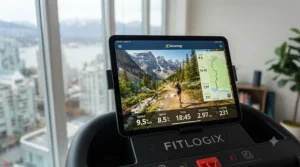
6. Echelon Stride 6S-10 — best for daily folders who want zero manual effort
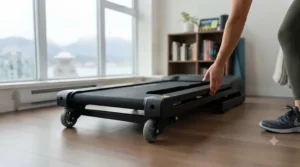
This is the one built for people who will actually fold their treadmill every single day — the hands-free auto-fold mechanism handles the lift-and-lock motion at the press of a button, which sounds like a small thing until you’ve wrestled a 90-pound deck upright by hand after a tiring run.
Top speed reaches roughly 12.5 mph, putting genuine running range within reach rather than just brisk walking, and it folds flat to about 10 inches — impressively low for a machine with a running-length deck. Reviewers consistently point to the auto-fold as the single feature that determines whether they use the treadmill daily or let it sit open (and in the way) for a week at a time; in a studio apartment, that’s the difference between consistent training and an expensive floor obstacle.
Here’s what to weigh: Echelon’s connected-fitness membership unlocks thousands of live and on-demand classes, similar in spirit to NordicTrack’s iFIT, and the subscription cost should be treated as part of the real total price rather than a nice-to-have extra.
Pros:
- ✅ Genuine one-button auto-fold, no manual lifting
- ✅ Running-capable top speed near 12.5 mph
- ✅ Folds flat to roughly 10 inches for storage
Cons:
- ❌ Premium price reflects the auto-fold engineering
- ❌ Full class library requires an ongoing membership
Expect this one toward the C$2,300-C$3,000 range depending on bundled membership offers at the time of research. For daily-use apartment dwellers who fold religiously, the time and effort saved genuinely justifies the premium.
7. WalkingPad MX10 Vertical Fold — best for under-desk walking while working
The defining feature is the foldable tray table, which turns this into a genuine walk-and-work station rather than a treadmill you occasionally use before or after your job. That single design choice puts it in a different category from every other entry on this list.
Its 16.1-inch-wide belt is noticeably narrower than the running-focused models above, which makes sense once you realize this machine is optimized for slow, sustained walking during calls and reading rather than sprint intervals — top speed tops out around 6.5 mph, enough for light jogging in a pinch but clearly secondary to its walking-desk role. The vertical fold keeps its footprint tight against a wall between sessions, echoing the space-saving logic of the WalkingPad Z1 but built around a desk-first use case.
Aggregated review sentiment describes setup as refreshingly simple, requiring only a balance bar secured with an included Allen wrench, and Bluetooth connectivity syncs steps and distance to standard fitness apps throughout the workday — meaning your “treadmill workout” quietly becomes several kilometres logged before dinner without ever feeling like exercise.
Pros:
- ✅ Integrated tray table enables true walk-and-work use
- ✅ Vertical fold keeps footprint minimal against a wall
- ✅ Simple setup with minimal tools required
Cons:
- ❌ Narrow belt limits faster running use
- ❌ Not a substitute for a dedicated running-focused deck
Pricing tends to land around C$950-C$1,150. If your real goal is more daily movement while working rather than structured cardio sessions, this is the most purpose-built option here.
How to Choose an App-Connected Treadmill for Small Spaces
Picking the right machine comes down to matching a handful of concrete criteria to your actual apartment and habits, rather than chasing the longest spec sheet. Here’s the expert-reasoned checklist we’d walk a friend through:
- Measure your storage spot first, not last. Know the exact folded height, width, and depth you can spare before comparing a single model — a treadmill that’s “compact” on paper can still be too tall for a low bed frame.
- Match top speed to your real workouts. If you mostly walk while working, a 6-7 mph walking pad like the WalkingPad Z1 or WalkingPad MX10 Vertical Fold is plenty; runners need the 10-12.5 mph range of the NordicTrack T 6.5 S or Echelon Stride 6S-10.
- Decide how much folding effort you’ll tolerate daily. Auto-fold mechanisms like the Echelon Stride 6S-10‘s cost more but remove the single biggest reason folding treadmills end up left open.
- Check what the app actually does. Basic Bluetooth syncing to Apple Health or Fitbit is different from a full guided-coaching ecosystem like iFIT — decide if you want a tracker or a trainer.
- Factor in subscription costs honestly. Some of the smartest features on this list, from auto-incline to class libraries, live behind a monthly membership — build that into your real annual cost.
- Consider your building’s noise tolerance. Thinner floors and shared walls favour lighter walking-pad designs over heavier fold-up frames with bigger motors.
- Confirm weight capacity and belt width for your body and stride. A narrower belt that’s fine for one household member can feel cramped for another — check this before anyone commits to daily use.
Reading through Canada’s own physical activity guidance is a useful gut check here too: the Canadian 24-Hour Movement Guidelines for adults recommend at least 150 minutes of moderate-to-vigorous activity weekly, which is a genuinely achievable target on even the smallest walking pad if it’s actually accessible enough that you use it daily.
Practical Usage Guide: Setup, First 30 Days & Maintenance
Getting a compact treadmill into daily use — rather than daily avoidance — comes down to a handful of habits in the first month. Start by placing the machine on a dedicated mat at least 3/8-inch thick; this single step protects both your floor and your downstairs neighbour’s ceiling from motor vibration, and it’s the most commonly skipped setup step among first-time buyers.
For the first week, resist the urge to max out speed and incline immediately. Most treadmill injuries in small-space users come from rushing the calibration period your body needs to trust an unfamiliar moving surface underfoot, not from the machine itself. Pair the app on day one rather than “eventually” — syncing your baseline stats early makes the progress tracking meaningfully more motivating by week three, when the novelty naturally starts to fade.
Maintenance on these compact models is lighter than a traditional gym treadmill but not zero. Wipe down the belt weekly, check the folding hinge for debris monthly, and lubricate the belt per the manufacturer’s schedule — typically every three months for a moderately used machine, more often if you exceed 150 km a month on it. Common first-30-days mistakes worth avoiding: folding the deck before it’s fully stopped, storing it against a heat source like a radiator, and ignoring an early squeak, which almost always signals a belt-tension issue that’s cheap to fix now and expensive to ignore.
Timing matters more than people expect, too. Canada’s own movement research on when you exercise, not just how much, points out that consistent timing supports better sleep and adherence — worth reading if you’re deciding between a morning or evening treadmill habit, and the Public Health Agency of Canada’s guidance on movement timing breaks this down further.
💬 Ready to reclaim your floor space and your fitness routine at the same time?
✨ Don’t Miss These Exclusive Deals!
🔍 Take your small-space workout setup to the next level with these carefully selected picks. Click on any highlighted model above to check current pricing and availability, and start building a routine that actually fits your apartment.
Real-World Scenarios: Which Treadmill Fits Your Life
The remote-working condo dweller. You’re on calls most of the day and want movement without leaving your desk setup. The WalkingPad MX10 Vertical Fold‘s built-in tray table is the obvious match here — slow, sustained walking paired with a laptop shelf means you can log kilometres during a meeting instead of after it, and its vertical fold tucks against the wall the moment you’re done.
The budget-conscious first apartment renter. Storage is tight, the lease is a year at most, and moving day is always looming. The UREVO Strol 2E Pro or WalkingPad Z1 both fit this life well — no-assembly setup and the smallest folded footprints mean you’re not disassembling furniture-grade equipment every time you relocate, and neither represents a major financial commitment if your space changes again soon.
The serious runner in a small unit. You want real running range, not just brisk walking, but you still live somewhere with limited storage. The Echelon Stride 6S-10 threads this needle — a 12.5 mph top speed with a genuine auto-fold mechanism means the machine earns its larger price tag by matching gym-level performance to apartment-level storage constraints, folding flat to roughly 10 inches when the session ends.
Problem → Solution: Fixing Common Small-Space Treadmill Frustrations
Problem: The treadmill is too loud for shared walls. Solution: add a thicker rubber mat underneath, tighten the belt per the manual (a loose belt is almost always the real noise source, not the motor), and favour walking-pad-style machines like the WalkingPad Z1 over heavier fold-up frames if noise is your top concern.
Problem: The app won’t sync reliably. Solution: keep Bluetooth range under about 9 metres with no major obstructions, close other Bluetooth-paired apps competing for the connection, and update the treadmill’s firmware — a surprisingly common fix reviewers report across brands like UREVO and Sunny Health & Fitness.
Problem: Folding daily feels like its own workout. Solution: this is precisely what auto-fold models like the Echelon Stride 6S-10 solve — if manual folding is genuinely the barrier keeping you from using the machine, it’s worth paying for the mechanism rather than fighting your own habits indefinitely.
Problem: The deck feels unstable on an older subfloor. Solution: models with an integrated handrail, such as the UREVO Strol 2E Pro, meaningfully reduce perceived wobble, and a proper anti-vibration mat helps across every model on this list.
Problem: Motivation drops after the first few weeks. Solution: lean on the app’s workout library rather than freestyling every session — the Sunny Health & Fitness SF-T4400SMART‘s 1,000-plus SunnyFit routines exist specifically to solve this exact drop-off point.
Common Mistakes When Buying a Compact Smart Treadmill
The single biggest mistake is buying based on folded height alone without checking belt length and weight capacity — a treadmill that slides perfectly under your bed is useless if it can’t comfortably support your stride or your body weight. A close second is skipping the subscription math: several of the “smart” features driving purchase decisions, from iFIT’s auto-incline to Echelon’s class library, sit behind an ongoing membership that can add hundreds of dollars a year to the sticker price.
Buyers also frequently underestimate motor requirements, assuming any motor works for any use case. As a rule of thumb, walking comfortably calls for at least 2.0 HP, while regular jogging or running performance benefits from 3.0 HP or more — undersizing this leads to a motor straining audibly under load, which is both a noise problem and a longevity problem in apartment settings. Finally, don’t assume all “folding” mechanisms are equal: a soft-drop hinge, a full auto-fold button, and a manual lift-and-latch design deliver wildly different daily experiences even when the folded dimensions look similar on a spec sheet.
Foldable Smart Treadmill vs Full-Size Traditional Treadmill
A full-size traditional treadmill wins on raw performance ceiling every time — bigger motors, longer decks, and higher weight capacities that a folding frame simply can’t match pound-for-pound. If you have a dedicated home gym room and never plan to move the machine, that permanence buys you durability and a smoother ride at higher speeds.
But that comparison changes completely the moment storage becomes a real constraint. A foldable smart treadmill trades some of that performance ceiling for a footprint that can shrink by roughly 40% or more once folded, and pairs that compactness with app tracking that many older full-size machines never bothered to include at all. The practical question isn’t really “which is better” in the abstract — it’s whether you have a permanent 20-square-foot floor space to dedicate to fitness equipment or not. For most Canadian renters answering that honestly, the folding category wins by default.
| Factor | Foldable Smart Treadmill | Full-Size Traditional Treadmill |
|---|---|---|
| Footprint when stored | Shrinks 40%+ when folded | Fixed, permanent floor space |
| Typical top speed | 6-12.5 mph depending on model | Often 12+ mph consistently |
| App/connectivity | Standard on nearly all modern models | Varies widely, often absent on older units |
| Best For | Apartments, condos, shared housing | Dedicated home gyms with permanent space |
The analysis holds up in practice: renters gain flexibility and connectivity at a modest performance tradeoff, while permanent-space owners gain raw durability at the cost of a machine that can never be tucked away. Neither choice is objectively wrong — it’s a function of your square footage, not your fitness level.
What to Expect: Real-World Performance in a Small Space
On paper, most of these treadmills look similar — motors, belts, apps. In daily use, the differences show up in ways spec sheets rarely capture. Walking-pad-style machines like the WalkingPad Z1 feel noticeably quieter underfoot than fold-up frames, but that same lighter construction means you’ll feel more deck flex at faster paces than you would on the Horizon 7.0 AT‘s sturdier build. Auto-fold models like the Echelon Stride 6S-10 genuinely change behaviour, not just convenience — reviewers consistently report using the machine more often simply because putting it away takes seconds instead of effort.
App-driven motivation is real but uneven across ecosystems. iFIT and Echelon’s guided-class libraries produce measurably higher usage in aggregated reviewer feedback compared to treadmills offering only basic Bluetooth step syncing, likely because a trainer’s voice adjusting your incline mid-session is simply more engaging than watching a number on a screen. That said, simpler tracking apps paired with a machine you’ll actually use daily — because it’s light enough to fold without friction — often outperform a fancier app on a treadmill that ends up permanently open and in the way. The 24-Hour Movement Guidelines from CSEP are a useful reminder here: consistency across the week matters more than any single session’s intensity, which is exactly where a genuinely low-friction folding routine pays off.
Long-Term Cost & Maintenance of a Compact Treadmill
The sticker price is only part of the real cost of ownership. Subscription-dependent models — the NordicTrack T 6.5 S with iFIT and the Echelon Stride 6S-10 with its class membership — typically run an additional monthly fee on top of the hardware, which over two or three years can rival or exceed the treadmill’s own purchase price. That’s not a reason to avoid them, but it is a reason to budget honestly rather than comparing sticker prices alone.
Non-subscription models like the WalkingPad Z1, UREVO Strol 2E Pro, and WalkingPad MX10 Vertical Fold carry lower ongoing costs, with maintenance limited mostly to belt lubrication, occasional motor brush replacement on brushed-motor units, and periodic hinge cleaning. Cost-per-use math favours whichever machine you’ll genuinely keep using — a C$450 walking pad used four times a week for three years beats a C$3,000 auto-fold treadmill left folded in a corner after month two, every time. Total cost of ownership, in other words, is as much a behavioural question as a financial one.
Safety, Certification & Apartment Living Rules in Canada
Before anything else, confirm the treadmill carries a recognized certification mark. In Canada, electrical products that plug into an outlet are legally required to meet national safety standards and carry a certification mark such as CSA, cUL, or cETL, and Health Canada’s guidance on electrical product safety explicitly advises against buying or using electrical products without one. Every model featured in this guide should be checked for this marking at the point of purchase, since certification can occasionally vary by retailer batch or import channel.
Beyond electrical certification, apartment and condo living adds a second layer of practical consideration that full-size traditional treadmills rarely require: noise, vibration, and shared-floor etiquette. Placing your treadmill on a thick rubber mat, avoiding peak quiet hours in your building’s bylaws, and choosing a lighter walking-pad design over a heavier fold-up frame if you’re on an upper floor are all reasonable courtesy steps, not just legal ones. Some condo corporations also have specific rules about exercise equipment noise in their bylaws, so it’s worth a quick check with your building management before your first workout, not after a complaint.
Frequently Asked Questions
❓ What is the best app-connected treadmill for small spaces in 2026?
❓ How much does a compact foldable smart treadmill cost in Canada?
❓ Do foldable treadmills need a lot of floor space when folded?
❓ Can I use a walking pad treadmill without a fitness app?
❓ Is a compact treadmill worth it for an apartment?
Conclusion
Choosing an app-connected treadmill for small spaces really comes down to being honest about two things: how much floor space you can permanently dedicate, and how much manual effort you’re willing to put into folding and unfolding a machine you actually want to use daily. Budget walking pads like the WalkingPad Z1 and UREVO Strol 2E Pro solve the space problem elegantly for walkers on tighter budgets, while auto-fold premium options like the Echelon Stride 6S-10 solve the effort problem for serious runners willing to pay for convenience. In between, models like the Horizon 7.0 AT and NordicTrack T 6.5 S offer a middle path for buyers who want sturdier decks and guided coaching without going all-in on top-tier pricing.
None of these seven machines is objectively “the best” — they’re built for genuinely different apartments, habits, and budgets, and the honest answer is that the right one is whichever machine’s footprint, speed range, and app ecosystem match how you actually plan to use it, not how you imagine you might. Measure your space, be realistic about subscription costs, and pick the one you’ll actually unfold every week.
✨ Don’t Miss These Exclusive Deals!
🔍 Take your small-space fitness routine to the next level with these carefully selected treadmills. Click on any highlighted pick above to check current pricing and availability — the right compact treadmill might be closer to fitting your space than you think.
Recommended for You
- Bluetooth Treadmill for Home Gym: 7 Top Picks for 2026
- iFit Compatible Treadmill Review: 7 Best Picks for 2026
- 7 Best WiFi Treadmill Under $1200 CAD Picks for 2026 (Tested amp; Compared)
Disclaimer: This article contains affiliate links. As an Amazon Associate, I earn from qualifying purchases. If you purchase products through these links, we may earn a small commission at no additional cost to you.
✨ Found this helpful? Share it with your friends! 💬🤗
