In This Article
Somewhere between “I should really move more” and actually doing it sits a treadmill nobody’s using properly. Most of us don’t need a machine built for marathon training — we need something that quietly, reliably lets us rack up steps while the Canadian winter does its worst outside. That’s the whole case for a walking treadmill: a slower top speed, a smoother low-speed motor, and a deck built for a steady daily stride rather than sprint intervals.
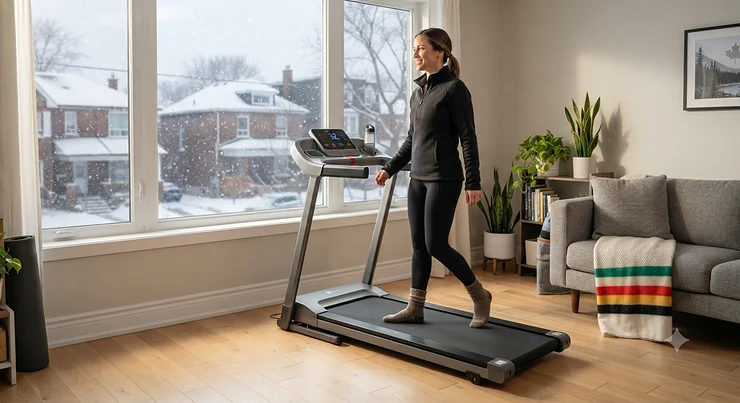
A walking treadmill is a motorized treadmill purpose-tuned for speeds under about 6-7 km/h (4 mph), prioritizing smooth low-speed belt control, cushioning, and compact storage over high-speed running performance. Roughly a third of Canadian adults hit the classic 10,000-step target, and according to Statistics Canada’s physical activity data, men average about 9,500 steps a day compared with 8,400 for women — numbers that drop noticeably once winter sets in and the sidewalks ice over. That’s the gap a good walking treadmill is built to fill.
Below, we’ve researched seven real, currently available models spanning under-desk walking pads to full-size cushioned treadmills, with honest analysis of specs, aggregated review sentiment, and who each one actually suits. No invented reviews, no fabricated “I tested this for six months” stories — just what the spec sheets and real owner feedback tell us, interpreted plainly. Every price below is a range in Canadian dollars, since exact listings shift by the week.
Quick Comparison Table: Best Walking Treadmill Picks at a Glance
| Product | Price Range (CAD) | Speed Range | Best For |
|---|---|---|---|
| XTERRA TR150 | Under C$550 | 0.8-16 km/h | Tightest budget |
| Sunny Health & Fitness SF-T7643 | C$450-C$650 range | Up to ~10 km/h | Heavier users, no-frills walking |
| UREVO Strol 2E | C$400-C$550 range | 1-10 km/h | Small apartments |
| WalkingPad C2 | C$550-C$750 range | 0.8-6 km/h | Under-desk walking |
| Egofit Walker Pro (M1) | C$500-C$650 range | 1-5 km/h | Ultra-narrow footprint |
| NordicTrack T Series 6.5 S | C$1,300-C$1,550 range | 0-16 km/h | Smart, guided walking |
| Sole F63 | C$1,400-C$1,700 range | 0.8-19 km/h | Joint comfort, bigger frame |
A quick read of the table tells its own story: price climbs fastest with deck size, cushioning quality, and how much of the motor’s rated speed you’ll actually use at a walking pace. The Sole F63 and NordicTrack T Series 6.5 S cost roughly three times what the XTERRA TR150 does, but that premium buys a longer belt, meaningfully better cushioning, and — in NordicTrack’s case — guided iFIT programming. If your walking pace tops out around 5-6 km/h, though, the cheaper compact options in the middle rows do the actual job just as well; you’re simply paying less for less deck and less headroom to grow into jogging later.
💬 Just one click — help others make better buying decisions too!😊
Top 7 Walking Treadmills: Expert Analysis
1. XTERRA TR150 — cheapest real option that still folds safely
The TR150 earns its “budget classic” reputation by doing the basics competently and nothing else. Its 2.25 HP motor drives speeds from roughly 0.8 to 16 km/h (0.5-10 mph) across a 50″ x 16″ belt — narrower than most, which matters more for runners than walkers with a natural, contained stride.
What that spec sheet means in practice: the motor is sized for walking loads, not sustained jogging, so treat any speed above a brisk walk as occasional rather than routine. Incline is manual — you pull a pin and set one of three fixed positions rather than pressing a button mid-walk, which is the trade-off you accept at this price. Based on the spec comparison against competitors like the Sunny SF-T4400, the TR150’s main edge is its lifetime frame warranty, unusually generous for a sub-C$550 machine.
Reviewers consistently note quick, sub-30-minute assembly and solid build quality for the weight, though several flag the folding-lock height as something to watch around young kids or pets. This is honest budget gear for someone who wants daily steps in front of the TV, not a stepping stone to 10K training.
Pros:
- ✅ Lifetime frame warranty at an entry-level price point
- ✅ Straightforward assembly, typically done in under 30 minutes
- ✅ Compact folded footprint for apartment storage
Cons:
- ❌ Only 3 manual incline levels, no power incline
- ❌ 250 lb (113 kg) weight capacity trails the category average
At under C$550, the XTERRA TR150 is the walking treadmill to buy when the goal is simply “get me off the couch,” and it does that job without pretending to be anything more.
2. Sunny Health & Fitness SF-T7643 — best wide-deck pick for heavier daily walkers
This one is built specifically as a walking treadmill for daily walking rather than a general-purpose folding treadmill with a low top speed bolted on. The 19.5″ wide belt and 350 lb (159 kg) weight capacity are both above what you’ll find on most machines in its price bracket, and the “quick button” speed presets (1, 3, and 5 mph) let you change pace without hunting through a menu mid-stride.
Here’s what most buyers overlook about a wider belt: it’s not about comfort alone, it’s about confidence. A narrow deck makes you unconsciously shorten your stride to stay centred, which quietly caps how natural your walking motion feels over a 30-45 minute session. The extra 3-4 inches of width on the SF-T7643 removes that hesitation for most body types.
Aggregated buyer feedback consistently praises the soft-drop hydraulic folding mechanism and built-in transport wheels — both genuinely useful in a Canadian condo where floor space is precious. The trade-off is a completely flat deck; there’s no incline option at all, manual or powered, which rules this model out if hill-simulation matters to your routine.
Pros:
- ✅ 350 lb weight capacity, well above typical budget treadmills
- ✅ Quick-speed 1/3/5 mph buttons for on-the-fly pace changes
- ✅ Soft-drop folding hinge plus built-in transport wheels
Cons:
- ❌ No incline feature whatsoever, flat deck only
- ❌ Basic backlit LCD has no step-goal memory or app pairing
In the C$450-C$650 range, the Sunny Health & Fitness SF-T7643 is the pick for anyone whose priority is a sturdy, wide walking surface over smart features.
3. UREVO Strol 2E Smart Treadmill — best space-saving pick for small apartments
The Strol 2E folds down to a genuinely tiny 4.6″ tall, which is the whole appeal for anyone renting a one-bedroom where every square foot of closet space is contested territory. Its 2.25 HP motor covers 1-10 km/h (0.6-6.2 mph), and the running surface measures 15″ x 40.2″ — on the narrow, short side, which is the honest trade-off for that folded height.
What most spec sheets won’t spell out clearly: a 40″ deck length is fine for a controlled, in-place walking stride but starts to feel cramped the moment you try to open up your gait past a moderate pace. Shorter users and those sticking to a slow-to-moderate walk will barely notice; taller walkers may feel boxed in.
User reports consistently mention the quiet motor as a standout, with several noting they can hold phone calls or watch video without the belt noise intruding — a meaningful point for anyone using this at a desk. Multiple layers of shock absorption in the deck are also frequently cited as easier on the knees than expected for the price point.
Pros:
- ✅ Folds to just 4.6″ tall for tight storage spaces
- ✅ Dual walk-and-light-jog speed range up to 6.2 mph
- ✅ Multi-layer deck cushioning reduces joint impact
Cons:
- ❌ No incline capability at any level
- ❌ 40″ deck length is short for taller walkers
Around C$400-C$550, the UREVO Strol 2E suits anyone prioritizing storage footprint over deck size or incline versatility.
4. WalkingPad C2 — best true under-desk walking pad
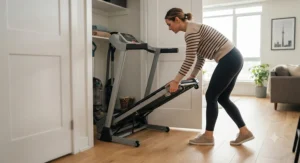
The WalkingPad C2 is less a treadmill and more a slim walking appliance: a double-folding pad that tucks under a sofa or desk in seconds, with a 47″ x 16.5″ belt and a genuinely quiet ~45 dB motor rated for speeds up to about 6 km/h (3.7 mph). It’s designed around one specific use case — light movement while you work — and it’s honest about not trying to be more than that.
Here’s the practical trade-off worth understanding before buying: the C2 offers both a manual mode and an automatic pace-sensing mode that’s supposed to speed up or slow down based on where you’re standing on the belt. Based on the spec comparison and aggregated owner feedback, the automatic mode is the feature most likely to disappoint — several reviewers report it responding inconsistently or stopping abruptly rather than smoothly decelerating when they step back.
On the plus side, both the app and the included remote reliably track steps, time, distance, and calories, and the sub-desk clearance of about 5″ is genuinely best-in-class for tucking away in a small home office. Reviewers who stick to manual mode report a far more predictable experience than those who lean on the automatic sensor.
Pros:
- ✅ Double-fold design slides under furniture in seconds
- ✅ Reliable step, distance, and calorie tracking via app or remote
- ✅ Quiet enough for calls and video meetings
Cons:
- ❌ Automatic pace-sensing mode is inconsistent per multiple reviewers
- ❌ Max speed caps around 6 km/h, too slow for power walking
At roughly C$550-C$750, the WalkingPad C2 is the pick specifically for desk-adjacent walking rather than a dedicated home cardio session.
5. Egofit Walker Pro (M1) — narrowest footprint, honest trade-offs included
The Egofit Walker Pro is built almost exclusively for under-desk use: no handrail on the base M1 model, a fixed 5% incline that can’t be adjusted, and a compact 16.5″ x 34″ walking area that’s among the smallest in this roundup. Speeds run roughly 1-5 km/h (0.6-3.1 mph), which is genuinely a walking-only range — there’s no jogging here even in theory.
Honesty matters more here than with most entries on this list, because review sentiment on the Walker Pro is genuinely mixed rather than uniformly positive. Multiple independent testers report the motor running louder than advertised at top speed — figures cited range from roughly 56 to 70 dB depending on the source and unit — and the fixed 5% incline, while good for calorie burn, makes typing or holding a controlled desk posture noticeably harder than on a flat-deck alternative. If you cannot verify quiet, all-day comfort matters to your setup, this is a model worth trying in person or buying from a retailer with an easy return window.
What it does deliver honestly well: an extremely small footprint, plug-and-play setup with no assembly beyond unfolding, and a single-button emergency stop that testers describe as reassuring rather than fussy.
Pros:
- ✅ One of the smallest footprints available for tight desk spaces
- ✅ Fixed 5% incline adds calorie burn without touching controls
- ✅ Simple one-button emergency stop, no assembly required
Cons:
- ❌ Reviewers report motor noise running louder than advertised at top speed
- ❌ Fixed incline and narrow deck limit natural arm swing and posture
In the C$500-C$650 range, the Egofit Walker Pro fits a very specific buyer: someone who wants the smallest possible desk treadmill and is willing to accept its quirks in exchange for that size.
6. NordicTrack T Series 6.5 S — best smart, guided walking treadmill
The T Series 6.5 S is where this list crosses from “walking appliance” into “connected home cardio machine.” Its speed range runs the full 0-16 km/h (0-10 mph) spread, meaning it comfortably covers a slow recovery walk through a light jog without ever feeling maxed out, and NordicTrack’s KeyFlex cushioning is specifically engineered to soften joint impact more than a rigid deck would.
What the spec sheet doesn’t fully convey is how much of this machine’s value depends on the iFIT ecosystem. SmartAdjust and Follow-Trainer modes will automatically change speed and incline to match a guided walking route, which genuinely helps beginners who find “just walk at whatever pace” oddly difficult to sustain without external pacing. But that guided-workout layer requires a paid iFIT membership; without it, you still get a capable manual treadmill, just not the adaptive coaching that’s arguably the model’s biggest selling point.
Aggregated owner sentiment is generally positive on build quality and cushioning feel, with the most common complaint centring on the console being Bluetooth-only — you’ll need to prop up your own phone or tablet rather than getting a built-in touchscreen at this tier.
Pros:
- ✅ KeyFlex cushioning noticeably softens impact versus a flat deck
- ✅ Full 0-10 mph range covers walking through light running
- ✅ iFIT-guided walking programs with automatic speed/incline adjustment
Cons:
- ❌ Full smart-coaching features require a paid iFIT membership
- ❌ Bluetooth-only console, no built-in screen at this price tier
Around C$1,300-C$1,550, the NordicTrack T Series 6.5 S makes sense for walkers who want a program nudging them along rather than setting their own pace every session.
7. Sole F63 — best cushioned deck for joint comfort
If your walking treadmill needs to double as a genuinely comfortable long-session machine — 45 to 60 minutes most days — the Sole F63’s 20″ x 60″ CushionFlex Whisper Deck is the standout reason to consider it. Sole rates the cushioning as reducing impact by up to 40% versus a hard surface, and independent reviewers consistently single out the deck feel as noticeably softer than competitors at a similar price.
Based on the spec comparison, the F63’s 3.0 CHP brushless motor is also comfortably oversized for walking speeds, which in practice means it runs quieter and cooler during sustained sessions than a motor working closer to its rated ceiling. Fifteen incline levels, reaching 15%, give genuine hill-simulation range that the budget picks on this list simply can’t match, and the 325 lb (147 kg) weight capacity is among the highest here.
What most buyers overlook until they’ve owned it a while: the F63 weighs over 250 lbs itself, so while it folds, relocating it between rooms is a two-person job. Reviewers otherwise rate the lifetime frame and motor warranty, plus 2-year parts coverage, as genuinely reassuring for a machine you’ll want to keep for years.
Pros:
- ✅ CushionFlex Whisper Deck rated to cut impact by up to 40%
- ✅ Spacious 60″-long, 20″-wide belt suits taller walkers
- ✅ Lifetime frame/motor warranty plus 2-year parts coverage
Cons:
- ❌ Over 250 lbs, heavy to relocate between rooms alone
- ❌ LED display only, no touchscreen at this tier
In the C$1,400-C$1,700 range, the Sole F63 is the premium pick for anyone who walks daily and wants the deck itself to disappear under their feet.
Treadmill for Daily Walking: Practical Usage Guide
Buying the right machine is half the job; setting it up so you’ll actually use it every day is the other half. Start by placing your treadmill for daily walking on a hard, level surface — carpet compresses unevenly under the feet and can throw off belt tension over time. Leave at least a metre of clear space behind the unit; every safety manual for these machines flags the “step-off zone” for a reason, and it’s the single most-skipped setup step according to owner forums.
In the first 30 days, the belt on most new treadmills needs occasional re-centring and light lubrication — most manufacturers (Sole and XTERRA included) ship a small bottle of silicone lube for exactly this. Skipping it is the most common reason budget belts start squeaking or tracking off-centre within a few months. Set a simple maintenance rhythm: wipe the deck weekly, check belt tension monthly by lifting the centre (roughly 2-3 inches of give is normal), and vacuum under the motor housing every season to keep dust from building up around the low-speed motor.
The most common early mistake is starting too fast. Even on a machine rated to 16 km/h, your actual walking pace should sit closer to 4.5-6.5 km/h for most adults — anything faster starts recruiting a running gait pattern your joints may not be ready for on a belt surface. Give yourself two weeks at a comfortable pace before nudging the speed or incline upward.
✨ Ready to stop scrolling and start walking? Compare today’s prices on any of the seven picks above — check availability while stock lasts! 🚶♀️
Real-World Walking Treadmill Scenarios
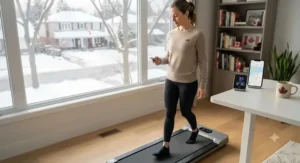
The condo-dwelling remote worker. Working from a 550-square-foot apartment with a standing desk already crowding the room, this buyer needs something that vanishes when not in use. The WalkingPad C2 or Egofit Walker Pro both fold small enough to slide under the desk itself between calls, and neither demands the two-person carry the Sole F63 would.
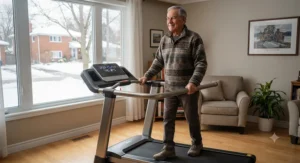
The retiree walking for joint health. Someone managing mild knee discomfort, walking most days for 30-45 minutes at a gentle, steady pace, benefits most from deck cushioning over raw speed range. The Sole F63‘s CushionFlex deck is the strongest match here, with the NordicTrack T Series 6.5 S a reasonable second choice if guided pacing through iFIT appeals.
The budget-conscious first-timer. Someone testing whether a home treadmill habit will actually stick, without committing serious money upfront, is better served by the XTERRA TR150 or UREVO Strol 2E — low financial risk, genuine walking capability, and an easy resale if the habit doesn’t take.
What Is a Walking Treadmill?
A walking treadmill is a motorized treadmill purpose-built around low-speed control, cushioning, and a compact footprint rather than high-speed running performance, typically topping out between 6 and 10 km/h. It prioritizes a smooth, jerk-free low-speed motor and deck comfort — the two things that matter most when your workout is a steady daily walk rather than interval sprints.
Best Treadmill Speed for Walking: Why Low-Speed Motors Matter
The single most misunderstood spec on any treadmill listing is top speed, and it’s largely irrelevant to a walker. The best treadmill speed for walking sits between about 4.5 and 6.5 km/h (2.8-4 mph) for a brisk, purposeful pace — well below the 10-16 km/h ceilings these machines advertise. What actually determines comfort at that pace is motor quality, not motor ceiling.
Here’s what the spec sheet won’t tell you: a cheap, underpowered motor struggles hardest not at top speed but at the bottom of its range, where it has to deliver smooth, continuous torque without surging or stuttering. That’s precisely the “low-speed motor” spec worth researching before buying — models like the UREVO Strol 2E and Sole F63 use motors deliberately rated for sustained low-RPM operation, which is why their belts feel steady rather than jerky at a casual pace. A treadmill with a huge top speed but a cheap, generic motor can actually feel worse for walking than a purpose-built low-speed unit half its rated ceiling.
Walking Treadmill Features Worth Paying For
Not every walking treadmill features list is created equal, and marketing copy loves to bury the genuinely useful specs under flashier ones. Based on the seven models compared above, three features consistently separate a comfortable daily-use machine from a frustrating one: belt width (18-20 inches lets your natural stride breathe), deck cushioning quality (not just “cushioned” as a marketing word, but a named system like CushionFlex or KeyFlex you can research), and quick-access speed controls that don’t require menu-diving mid-walk. Incline, by contrast, is a nice-to-have rather than essential for pure walking — three of the seven picks above skip it entirely and remain solid choices.
Step Tracking: What It Actually Measures (and Doesn’t)
Step tracking on a treadmill console estimates your step count from belt revolutions and your set stride length, not from an accelerometer reading your actual footfall the way a smartwatch does. That distinction matters: models like the WalkingPad C2, which pair console tracking with an app, tend to report more consistent numbers than basic LCD counters, because the app calibrates against your actual pace rather than a fixed assumption. If matching your treadmill’s step count to a fitness tracker matters to you, expect a modest mismatch of 5-10% as normal rather than a defect — the two devices are measuring the same activity through different methods.
Belt Cushioning: What “Cushioned Deck” Actually Means
Belt cushioning refers to the shock-absorbing layer built into the treadmill deck beneath the running belt — typically rubber, foam, or a multi-layer composite — designed to reduce the impact transmitted up through your joints with every step. Sole’s CushionFlex Whisper Deck and NordicTrack’s KeyFlex are two named, researchable systems; a listing that only says “cushioned” without naming a specific technology is worth a more skeptical read, since the term itself has no fixed industry standard. On paper, this means the difference between a deck that genuinely reduces knee and hip strain over a 45-minute session and one that’s cushioned in name only.
Common Mistakes When Buying a Walking Treadmill
The most frequent buying mistake is chasing top speed on a spec sheet you’ll never actually use — a 16 km/h ceiling matters little if your real pace sits at 5 km/h. According to a recent ParticipACTION report covered by CTV News, only 46 per cent of Canadians currently meet national physical activity guidelines, and the treadmills that actually get used consistently tend to be the ones matched to a realistic pace and routine, not an aspirational one. A second common error is underestimating belt length for your height — anyone over about 5’9″ should look past the sub-40″ decks toward the 50-60″ options on this list. Third, buyers frequently skip weight capacity math entirely; check it against your own weight with meaningful headroom, not right at the limit, since motors and belts wear faster near their rated ceiling.
Walking Treadmill vs Walking Pad: Which Actually Fits Your Space?
A full walking treadmill — like the Sole F63 or NordicTrack T Series — offers a longer belt, higher weight capacity, and often incline, at the cost of floor space and machine weight. A walking pad — like the WalkingPad C2 or Egofit Walker Pro — trades away belt length and incline range for a footprint that genuinely disappears under furniture. The decision point isn’t really about price; it’s about whether you have a dedicated four-by-seven-foot area to spare. If you do, a full treadmill’s wider belt and incline options pay off in comfort over years of use. If you don’t, a walking pad’s storability is the difference between a machine you use daily and one gathering dust behind the couch.
Long-Term Cost & Maintenance: What You’re Really Paying For
The sticker price is only part of the total cost of ownership. Budget picks like the XTERRA TR150 and Sunny SF-T7643 carry no subscription costs but typically shorter parts warranties, meaning a belt or motor replacement after year three or four comes fully out of pocket. The NordicTrack T Series adds an ongoing iFIT membership if you want its guided-coaching features, which over three years can meaningfully exceed the machine’s own purchase price — worth factoring in before you compare the sticker prices alone. The Sole F63’s lifetime frame and motor warranty, by contrast, meaningfully shifts long-term risk back onto the manufacturer, which is part of why it costs more upfront.
Safety, Regulations & CSA Compliance in Canada
Any electrical treadmill sold or used in Canada should carry an approval mark from an accredited certification body — most commonly the CSA monogram or a “cUL” mark — confirming it meets Canadian Standards Association safety requirements for electrical equipment. As UBC’s engineering services office explains, by law, all electrical equipment in Canada must meet CSA Electrical Standards, and reputable retailers list this certification directly on the product page; if you can’t find it, that’s worth asking about before buying, particularly with lesser-known imported brands. Beyond certification, basic treadmill safety habits matter more than any single spec: keep the emergency-stop clip attached to your clothing during use, never let young children operate or approach a running belt unsupervised, and step off only after the belt has fully stopped. Canada’s Physical Activity Guidelines, developed with the Canadian Society for Exercise Physiology, recommend at least 150 minutes of activity a week for adults — a target any of the seven treadmills above can comfortably support once safety basics are in place.
Frequently Asked Questions
❓ What is the best walking treadmill for a small apartment?
❓ What speed should I walk on a treadmill?
❓ Do walking treadmills need a lot of maintenance?
❓ Is a walking pad as good as a full treadmill?
❓ How much does a good walking treadmill cost in Canada?
Conclusion
There’s no single best walking treadmill for every home — there’s the one that matches your space, your budget, and how honestly you’ll use it. If floor space is the constraint, the WalkingPad C2 or Egofit Walker Pro solve that at the cost of belt length. If joint comfort during longer sessions matters most, the Sole F63’s cushioned deck is worth the premium. And if you just want to start walking more without overthinking it, the XTERRA TR150 or Sunny SF-T7643 get the job done without ceremony. Whichever you choose, the machine that gets used beats the machine with the best spec sheet every single time — so weigh your real routine over any single number on this page.
Recommended for You
- 7 Best Simple Treadmills for Home in 2026 (Easy; Reliable)
- Folding Treadmill vs Manual Treadmill for Beginners—7 Real Picks 2026
- Top Starter Treadmills: 7 Best Picks for Beginners (2026)
Disclaimer: This article contains affiliate links. As an Amazon Associate, I earn from qualifying purchases. If you purchase products through these links, we may earn a small commission at no additional cost to you.
✨ Found this helpful? Share it with your friends! 💬🤗
